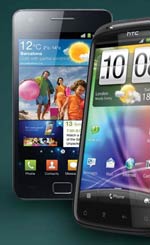
The sudden buzz about smartphones is dual-core processors. The reasoning was, with dual power coming to tablets, why not on smartphones? The common perception is that these dual-core phones are smarter and faster devices. With the LG Optimus 2x, Samsung Galaxy SII and HTC Sensation-phones with the new processors-doing decently well in the market, many phone makers are following them blindly. And yet there are many upcoming smartphones that are still equipped with the regular singlecore processors, raising a question: When we have the latest technology, why are companies still coming out with such phones? Well, one of the reasons could be the nascent development stage of Android devices. Even with the OS upgrades for smartphones, Google hasn't listed support for dual-core processors. Also, there are not many applications that are multi-threaded that can fully utilised the dual power. So, should you go in for one?
DUAL BENEFITSAlthough, you might not get the best out of the above mentioned phones at this moment, there are still a few features that come out of the box. With two cores powering the phone, it does act in super fast mode. While browsing through the menu or launching an application, everything happens within a fraction of a second. Android is known for its multitasking and here you will love the overall enhanced performance. The browsing speeds are super fast and even the browsers themselves have undergone improvements. For instance, on HTC Sensation, you can watch videos within the webpage without going to the YouTube application. Heavy applications such as gaming have gained the most from the dual-cores. Devices powered by these processors are capable of capturing Full HD video at 1080p resolution, instead of 720p. There are a few small differences that go unnoticed. For instance, the camera operates much faster than in other phones, the same for certain apps.
THE SPEED TESTThree smartphones operating on dual-core processors are available in the Indian market. We had the Samsung Galaxy S II and HTC Sensation with us. However, the LG Optimus 2x, the third phone with dual-core capability, was not made available to us for this testing. As we put the two dual core processors through a series of benchmark tests, we stack the results against those for a single-core processor phone, the HTC Incredible S.
THE ARMOURS
SAMSUNG GALAXY SII:
4.3-inch Super AMOLED display; 1.2 GHz dual-core processor; 1GB RAM; 16GB internal storage; expandable; 8MP camera; 1080p@30fps
HTC SENSATION:
4.3-inch display; 786 MB RAM, 1GB integral storage; expandable memory; 8 MP; 1080p@30fps
HTC INCREDIBLE S :
4-inch display; 1GHz singlecore processor; 768 MB RAM, 1.1GB, expandable; 8 MP camera; 720p @30fps
|
QUADRANT BENCHMARK:This is a commonly used benchmark to analyse CPU performance, I/O and 3D graphics. Higher marks indicate better performance. Here, Samsung Galaxy S II scored the highest whereas the single-core Incredible S had the lowest score.
SAMSUNG GALAXY SII: 3432 marks
HTC SENSATION: 2160 marks
HTC INCREDIBLE S: 1416 marks
BENCHMARK PI:This is a useful benchmark that evaluates CPU speeds of different Android smartphones. It checks how fast an Android devices calculates the value of Pi (approx). Better the calculation power, faster the device. In other words, lower the time, better the performance. Once again Samsung Galaxy S II outdid the others.
SAMSUNG GALAXY SII: 596 milliseconds
HTC SENSATION: 698 milliseconds
HTC INCREDIBLE S : 1156 milliseconds
LINPACK:This benchmark test puts Android devices and ROM to test. It has special features to check multicore processors with the use of multi-threaded applications. A higher score indicates better performance. Score is in millions of floating point operations per second.
Single thread :SAMSUNG GALAXY SII: 55.852
HTC SENSATION: 35.598
HTC INCREDIBLE S : 25.614
Multi thread :SAMSUNG GALAXY SII: 80.089
HTC SENSATION: 69.439
HTC INCREDIBLE S : 35.772
NENA MARK 2:This graphics benchmark measures performance with advanced graphical effects and hiresolution graphics. It uses realistic scenes and presents results in frames per second. Even though HTC Incredible S has a qHD screen, Samsung Galaxy S II scores higher.
SAMSUNG GALAXY SII: 46.3
HTC SENSATION: 26.0
HTC INCREDIBLE S : 12.6
VELLAMO MOBILE WEB BENCHMARK:As the name suggests, this evaluates the browser performance on Android smartphones. It involves 11 steps while providing a view to browser stability, including networking, JavaScript, rendering and user experience.
SAMSUNG GALAXY SII: 951 marks
HTC SENSATION: 759 marks
HTC INCREDIBLE S: 650 marks
BOTTOM LINEThere is a noticeable difference between phones powered by dual-core GPS all at the same time. processors and those that use single-core processors. However, between the Samsung Galaxy SII and the HTC Incredible S, the Korean device was the clear winner.
THE FUTUREToday, buying a high-end Android smartphone will force you to shell out a good sum. Whether it is powered by single-core or dual-core processor, you will spend ` 26,000-30,000. So why not go in for a device that is ready for the future? Although Google has not yet officially confirmed it, it is possible the IceCream Sandwich upgrade with be compatible with dualcore smartphones. Also, Augmented Reality applications, which are expected to get really big, will smoothly work on such devices as it involves camera, connectivity,GPS all at the same time.