

Why is it that some sector funds outperform while others deliver miserable returns? The answer lies largely in stock selection. If the fund manager chooses stocks that are rising, this will obviously mean that the fund performs well and vice versa. Stocks in some sectors are cyclical, so the fund manager must not only choose stocks wisely, he will have to be able to time the market well.
But cyclicality alone cannot explain the poor performance of stocks in the pharmaceuticals and health-care sector. From being one of the most promising sectors, pharma is now shunned by investors and fund managers alike. That's why, in spite of a 50% rise in the Sensex, the BSE Healthcare Index delivered an abysmally low return of 16%.WIN SOME, LOSE SOME |
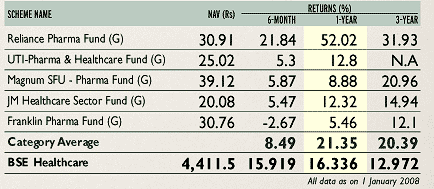 |
"Companies in the pharmaceuticals sector were going through a rough patch. Increased competition in the generics space, pricing pressure, rupee appreciation and high R&D costs muted growth," says Sarabjit Nangra, VP Research, Angel Broking. And this means pharma sector funds have also been performing poorly, with the category average return at 21% in the past one year. The assets under management (AUM) of the five pharma funds fell by over 22% between September 2006 and September 2007.

This is not to say that all pharma sector stocks have been poor performers. There have been winners and there have been outperforming pharma funds as well. Reliance Pharma, the top performing pharma fund, leads by a significant 40 percentage points. Its holdings include firms such as Ankur Drugs, Divis Labs and FDC. These have only recently moved into the large-cap or emerging large-cap space from small- and mid-cap stocks.
Strangely, some of the industry biggies, including Dr Reddy's and Pfizer, were attractive to only a few funds. Companies like Divis Labs have returned 200% over the past one year compared to a modest 6% gain by Ranbaxy, whereas Dr Reddy's and Cipla have delivered negative returns of 10% and 16%, respectively. One reason is that the heavyweights have more than 60% of their revenues coming from the generic drugs business, which has witnessed increasing competition and pricing pressure. International markets too posed challenges for Indian generics companies.
"The currency appreciation has impacted companies that have exports in excess of 50% of their revenues," says Sailesh Bhan, fund manager, Reliance Pharma Fund. Pricing pressure in the UK and health-care reforms in Germany and France all impacted revenues of companies like Dr Reddy's, Ranbaxy and Wockhardt, which have a significant presence in these countries.
Although generic drugs have always been the main earner for Indian pharmaceutical companies, the introduction of the Patents Law in the country has led to a paradigm shift in many business models. Pharma companies that planned for this shift began to look at the more profitable business areas within the sector. Businesses like contract research and manufacturing services or CRAMS (see box) started doing well from 2005, when the CRAMS market grew by 40%. Other profitable areas were new drug discoveries, research and development alliances, co-marketing alliances, etc. This is where companies like Divis Lab or Dishman Pharma score over the others.

Fund managers who recognised this shift and moved out of potentially unprofitable holdings ensured that their funds performed better than the industry average. "The fund has consistently stayed focused on the changing big picture of the industry and assets have been positioned accordingly," says Bhan. Conversely, Franklin Pharma, which has been the worst performer in the category, has underperformed its benchmark. The fund has not bet on any particular theme and has a higher weighting in the large caps. Most of the other funds in the category like JM Healthcare Fund and UTI Pharma have also underperformed the market, delivering modest returns of 10-12%.
So, does this mean you should stay away from pharma? No, says Vivek Pandey, fund manager, SBI Mutual Fund: "The worst seems to be over and investors should hold on to the funds/stocks with an expectation of a 10-15% return. Currently, the contract research segment looks attractive."
Consider the opportunities in future; CRAMS is likely to grow at 25-30% for the next few years. "We are positive on the CRAMS space, since India is at the beginning of the growth phase," says Nangra.
R Sreesankar, head of research, ILFS Investsmart, points out: "The sector is a hedge against the economy, since it does not necessarily move in tandem with the economy. In a downturn, it is least likely to be impacted," he says. Also, given its underperformance in the last one year, the sector appears under owned. "Given that the industry is specialised, a focused fund is better placed to capture complex changes in the environment," adds Bhan.
The dampener could be the National Pharmaceutical Policy, which is responsible for fixing ceiling pricing on drugs and proposes to bring 354 essential drugs under price control. If this goes through, it will enforce a price cut on some commonly used drugs, putting the profitability of domestic pharma companies in jeopardy. However, this might not happen, as experts reckon there's a slim chance of consensus.
Winning with CRAMS
Contract research and manufacturing services (CRAMS) is considered one of the most promising medium- to long-term opportunities for the Indian pharma industry. Companies that have got into it in a bigger way than others are Divis Labs and Dishman Pharma, which reflects on their stock performance.
To improve cost efficiency, global pharma companies are resorting to outsourcing core and non-core processes, including research and manufacturing. India, with its competitive advantages, is one of the most preferred outsourcing destinations and is now becoming a critical component in the manufacturing as well as the drug development value chain of various innovator pharma companies (those that are into drug discovery).
A recent KPMG-CII report on the Indian pharma industry identifies CRAMS as the industry's key growth driver. Outsourced manufacturing activities are currently estimated at $20 billion and are projected to increase to $31 billion by 2010. The Indian CRAMS market is expected to grow at 25-30% over the next few years, and domestic companies could gain 35-40% of the global CRAMS market.
For Indian players, opportunities exist on two fronts—capture a larger share of the opportunities created by the shift to outsourcing by innovator pharma companies and foray into western countries by acquiring existing contract manufacturing players in those countries.











