

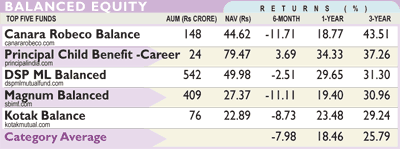
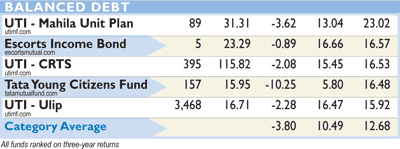
Equity-oriented balanced funds (first table) have earned more than debt-oriented balanced funds (second table) in the past one year but have lost more than them in the past six months. Principal Child Benefit has best managed to protect the downside. Incidentally, even the debt portion of these balanced funds has contributed to losses due to the rise in inflation and interest rates.
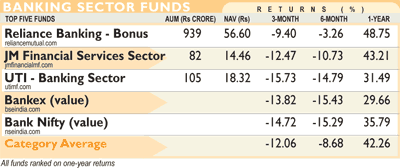
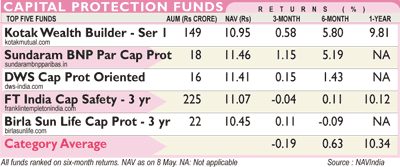
Banking funds have outperformed their benchmarks in the past one year (third table). The category average for the past year is double that of equity diversified funds. Capital protection funds (fourth table), whose objective is to protect capital, have lived up to their name.The category lost a minuscule 0.19% in the past three months.
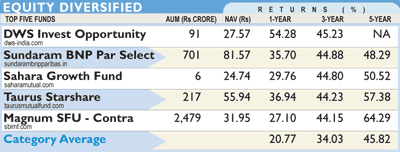
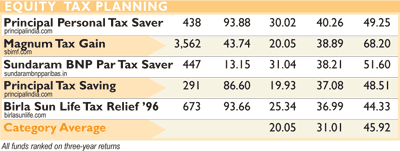
You don’t have to be big to give the fattest returns.The DWS Investment Opportunity fund, a minnow compared to Magnum SFU Contra Fund, was the best performer in the equity diversified category (fifth table). On the whole returns from tax plans (sixth table) have mirrored those from equity diversified funds. But the 80C tax benefits make them more attractive to investors.
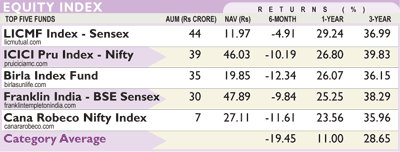
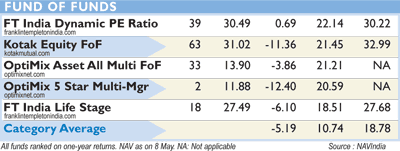
The variation in the returns from index funds (seventh table) in the past six months shows that not all fund houses are prudent at risk management. Birla Index fund lost a good 7.4 percentage points more than LIC Index Fund.The Fund of funds category (eighth table) is yet to pick up in India, as is evident by the tiny AUMs.
| Power of compounding | |||
| Rs 10,000 invested at 8% a year at various compounding frequencies will give you following returns in 5 years: | |||
| Compounding frequencies | Amount after 5 years | Annualised interest (%) | Yield (%) |
| Annual | 14,693 | 8.00 | 9.39 |
| Semi annual | 14,802 | 8.16 | 9.60 |
| Quarterly | 14,860 | 8.24 | 9.72 |
| Monthly | 14,898 | 8.30 | 9.80 |
| Continuous | 14,918 | 8.33 | 9.84 |
The takeaways
• Change in compounding frequencies makes a big difference to returns you get
• Compounding over higher frequencies increases the effective yield
• Reinvest the earnings from an investment as you receive them; your investment grows exponentially











