It was a month of mixed sentiments for stock investors. After witnessing a continuous fall for three weeks, with the Sensex and the Nifty both losing 1.6 per cent of their value, the markets bounced back in the third week of February. With a jump of 171 points in two sessions the Nifty closed at 5481 on Tuesday, 15 February. Investor sentiments were mainly battered by the disappointing industrial output data. The December IIP numbers came in at a weak 1.6 per cent compared to 2.7 per cent in November, although, analysts believe the fall is mainly due to a high base effect.
Some relief came with moderation in inflation. Food inflation dropped to 11.05 per cent in the first week of February as compared to 13.07 per cent the week before. The hope for a JPC probe on the 2G scam which has reduced the chances of the budget session suffering, thereby further aiding investor sentiments.
Some positive news came in from the global front as well. The recent concerns over civil unrest in Egypt ended with President Mubarak stepping down. The continuous strengthening of the US markets also helped improve sentiments. At the same time, there are concerns of slowdown in corporate profit growth due to rise in costs of raw materials. Also, foreign funds have pulled out around Rs 8,192 crore from the stock market this year, which has seen the BSE Sensex shed nearly 11 per cent.
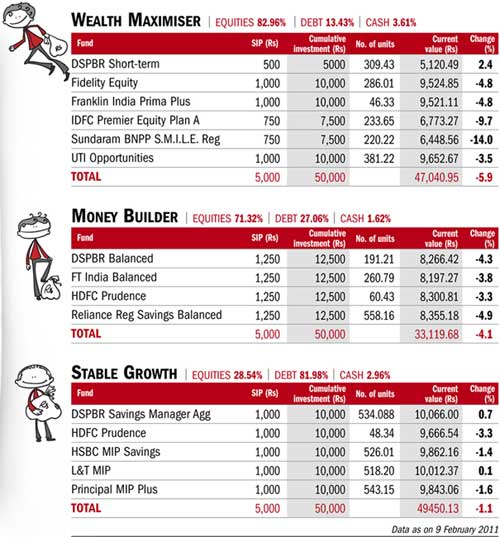
The Lifestage Portfolios seem to be suffering with the market as three of the portfolios delivered negative returns. The aggressive equity-oriented Wealth Maximiser, with almost 83 per cent of its funds parked in stocks has suffered the most with a -5.9 per cent return. The other two portfolios, Money Builder and Stable Growth, followed suit losing 4.1 per cent and 1.1 per cent respectively. But this is just short-term volatility and experts see this as an opportunity to collect units at cheap prices.
FUTURE TRIGGERS
- Global equity markets which seem to be settling down, can act as a positive cue.
- The Union budget which is to be announced on 28 February will be crucial for the markets.
- Easing inflation can revive the flow of foreign funds which have recently been cautious on India.
- The probe findings on 2G scam can give direction to the market.
|
The low-risk Income Generator was the only portfolio to give a positive return. With 81.98 per cent of the funds in debt, the portfolio earned a 2.96 per cent absolute return. Majority of debt instruments (44.56 per cent) have a P1+ rating which indicates that these short-term instruments offer the highest degree of safety with regard to timely payment of financial obligations.
Also, looking at the present fluctuations of interest rates, which hardly provide any clarity on the long term outlook, it is safer to park your investments in short-term papers. Another 28.63 per cent of the debt portfolio in long-term instruments has an AAA safety rating providing a solid anchor to the portfolio. Almost 7 per cent is invested in zero-risk money market instruments like government securities and treasury bills making it a welldiversified portfolio.
If we look at the equity portion, which makes 15.06 per cent of the portfolio, top holdings are in the energy sector. Singapore GRM (gross refining margin) increased for the fourth consecutive month, reaching $6.9/bbl in January 2011. According to Motilal Oswal Financial Services, the month-onmonth GRM uptick was led by higher requirement for gasoline, diesel, LPG and kerosene due to a strong winter and increased demand outlook. They expect GRM to be rangebound, supported by demand recovery in the key global economies, such as the US and Japan.