A year ago, the unfolding global economic crisis put equities on the blacklist and real estate out of reach. Debt funds, however, were seen as a hot investment. Credit worries and a slowdown in the US economy were pushing investors to bonds and government securities markets. In fact, in early 2008, we had discussed the resurgence of investor interest in debt funds (The Return of Debt, 6 March 2008).
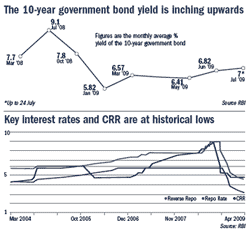
At the time, domestic as well as global economic indicators showed that interest rates were close to their peak. Soon after, we saw the repo rate (the rate at which banks borrow from the RBI), the benchmark for general interest rates, touch 9% (see chart). Clearly, this spelt bad news for the domestic economy, and with inflationary pressures persisting, the RBI embarked on a rate cutting spree in October 2008.
After hovering around 7.75% for most of 2007 and 2008, the repo rate has come down from its peak of 9% at the end of 2008 to 4.75% now. This is the lowest it has ever been. The result has been a decline in the 10-year government security yield, which came down from a high of 9.1% in July 2008 to 5.82% in January 2009.
How does this affect our debt investments? The falling yield from government securities leads to an increase in bond prices since the basic property of a bond is that its price moves inversely with the yield. So, when interest rates come down, bond prices go up and the net asset values (NAVs) of debt funds rise. Conversely, if bond yields go up, there is a reduction in bond prices and hence the NAVs of debt funds come down.
The current yield relates the annual coupon interest to the market price. This is presented by the following formula: Current Yield - (Annual Interest / Price)
So, apart from a fixed coupon rate of a bond, an additional component of capital appreciation comes into play with changing prices.
In fact, due to steep rate cuts, bond prices moved up and long-term debt funds as well as gilt funds delivered astounding returns of up to 20-30% during this period. However, like all good things, this too came to an end. The demand and supply of government paper is an important factor in determining the movement of bond prices and their yields. So, although the RBI has not increased interest rates, the yield on the 10-year government bond crept up from a low of 5.82% in January 2009 to 6.57% in March 2009, and then to 7% in July 2009, in light of the government’s massive borrowing programme.
Further, in the quarterly review of its monetary policy in July 2009, the RBI, while keeping all key interest rates unchanged, seems to have concluded the current phase of reduction of rates and is looking for signs of economic recovery and inflation, says Sujoy K. Das, head, fixed income, Bharti AXA Investment Managers. A similar opinion is voiced by K. Ramanathan, vice-president & head of fixed income at ING Investment Management India, who sees a limited scope for a significant fall in interest rates. In fact, interest rates are likely to remain volatile in the short term before moving up again, he adds. If this happens, the capital appreciation component of returns is likely to be low going forward.
Impact of monetary policy
The RBI’s monetary policy turned out to be a non-event for the bond market, as it was in line with expectations. The result was that government security yields remained unchanged (10-year paper was at 6.95%). “However, with growth picking up and inflation likely to rear its head towards the end of the year, we expect yields to move higher in the medium term to 7.5-7.75% by March 2010,” says Ramanathan. In fact, with the base effect coming into play and in the wake of a rebound in global commodities prices, the RBI has already upped its inflation expectation from 4% to 5% by March 2010.
Where does this leave us right now? Typically, when the economy slows, interest rates fall and debt funds provide good returns. This happened during 2000-2, when repo rates came down from a dramatic peak of 16% to 8% and bond funds delivered astronomical returns. But as the economy starts to recover, (the US economy seems to be reviving and corporate earnings in India have improved), interest rates begin to rise or remain at the same level. In the short term, ample liquidity and increased foreign fund flows will enable the government to manage its borrowing, reckon experts. “But the market runs the risk of possible rate hikes by the RBI, starting 2010,” says Das. Having said that, fixed income investments would still give superior risk-adjusted return over the inflation rate in the medium to long run, he adds. Investors should hold their debt funds as long as they are content with their asset allocation, but should keep a watchful eye on the RBI’s rate action, he adds.
Options for investors
Clearly, with the decline in interest rates, fixed deposits, which once seemed attractive, have lost their lustre. The RBI has been persistently asking banks to reduce their lending rates. This has been combined with a reduction in deposit rates. Deposit rates for 1-3 years’ maturity in public sector banks have come down from 9.5-10.75% in October 2008 to about 7% now, and could probably move lower. If we factor in the tax implication, in the highest income bracket the post-tax returns would be a meagre 5%.
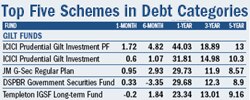
A few corporate FDs and nonconvertible debentures offer attractive interest rates, but these would be more suitable for investors willing to take some risk, depending on the quality of the paper and compromising on liquidity. A good option for investors who have a time horizon of at least a year would be to go for income or gilt funds, says Ramanathan. However, one must revise one’s expectations, considering that erstwhile returns of 15-20% are likely to reduce to annual returns of 6-8%.
For investors with a time horizon of six months to one year, Ramanathan recommends shortterm income funds, which typically invest in corporate bonds with a duration of 1-3 years. Generally, the prices of long-term bonds are more vulnerable to a firming up of interest rates than short-term bonds. So, even if rates inch up, these funds will be attractive. They also have the potential to outperform liquid funds, adds Ramanathan.
For ultra-short-term investments, Das says liquid funds continue to be a good option since the drop in yields has been combined with a fall in liquidity risk and interest rate risk. These funds would typically give 50-100 basis points over the overnight call rate, says Bekxy Kuriakose, assistant vicepresident and senior fund manager, DBS Cholamandalam Asset Management. Though the returns from liquid funds may have deteriorated in line with the money market rates, these funds remain the safest option since they invest in instruments that are not affected by interest rate movements, she adds. One could also look at liquid plus funds that have a slightly longer duration than their liquid counterparts.