
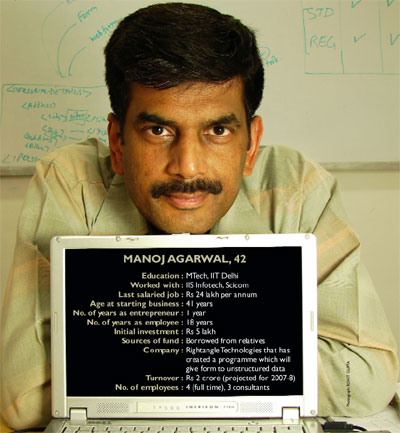
 It is not easy to locate the office of Rightangle Technologies at Ansal’s Fortune Arcade in Noida. Tucked away amid real estate offices, travel agencies and photostat shops, Rightangle is housed in a 1,000 sq ft of partially occupied space.
The chief executive, Manoj Agarwal’s office has all the hallmarks of an early stage start-up: no fancy interiors; just four work stations, a whiteboard and the air conditioner desperately trying to cool the empty spaces.
But over-riding all this is the unflappable confidence that Agarwal exudes. Confidence that his product, Pro-active, would soon be on the musthave list of all business process outsourcing (BPO) firms.
Pro-active, a software, gives shape to unstructured data within set parameters. In more simple terms, it is a software that compiles and processes raw data for online applications.
BPOs, who receive huge quantities of information, are likely to benefit from this program. Back in 2000, while working for IIS Infotech, Agarwal, an IIT Delhi postgraduate, got a chance to work on a business-toconsumer idea to create applications that would help sift through data and mould it according to customers’ needs.
While the IIS client did not take the idea further, he was hooked. “I realised the potential of the idea and just wanted to develop it,” he says.
The work at IIS was not strenuous and Agarwal had enough time to work on his personal project. But, since he did not have a dedicated team to carry the work forward, it took a while and lots of breaks before the pilot could be ready. During those initial days the thought of making the project commercially viable did not arise. “It was more of an intellectual challenge and I justwanted to see it reach its logical end,” says Agarwal.
By 2004, the pilot project was ready and Agarwal too had moved on from IIS and joined Scicom. Having tried out the program with a few companies, Agarwal realised the potential in turning commercial. However, he had to spend more time on the project, fine-tuning it. His employers at Scicom offered to renegotiate his contract so that he would not have to work full time. It was an ideal situation— the job was secure and the risks were low. For a year Agarwal tried out the project with various BPOs and IT companies like Genpact, CSC, IDSIL, The Indus Entrepreneurs (TiE). The interaction with TiE opened a new world for Agarwal who found it a good networking medium. “Since TiE helps budding entrepreneurs by way of advice, guidance and assistance from successful and experienced entrepreneurs and professionals, it helped me give a form to my vision,” says Agarwal.
When the response to the pilot projects carried out at various companies came in, this middle-class professional had enough reasons to turn entrepreneur. Quitting his wellpaid job was the next hurdle he had to cross. Since support from family was not forthcoming, it was quite difficult to take that final step into the world of entrepreneurship. By the time he quit, Agarwal had paid off two home loans he had taken. Even though there was not much savings, Agarwal knew he could bank on his provident fund of Rs 15 lakh till clients started coming in.
He moved to National Small Industries Corporation’s (NSIC) incubation centre in Okhla, Delhi, to give formal shape to the project in February 2006. This technology business incubator in the IT sector has been especially set up for nurturing innovative ideas and commerciallyviable business propositions. Suddenly then, Agarwal’s calculations started going awry. The provident fund that was to be released within two months took over six months; the companies that had shown keen interest in the pilot project were non-committal about turning customers; presentations to venture capitalists did not materialise into fundings. With no money coming in, Agarwal had to borrow Rs 5 lakh from relatives to start the venture formally. He agrees that it was one of the most difficult phases in his life as an entrepreneur.
“The VCs wanted me to show them a customer and I had none,” he says. The tough times lasted over three months and all through Agarwal did not lose sight of the goal. “If you focus only on the hurdles, the vision is lost,” he says.
Xansa, a business processing and IT sourcing company, was the first to turn customer for Rightangle in August 2006, and with the first instalment of Rs 20 lakh that Agarwal received from them he shifted to a formal office in Noida with three employees. Implementation was the next big step. Agarwal was cash-strapped, he couldn’t expand and hence from installing the program to providing support, he handled it himself.
“It was a lot of work but the challenge was exciting and at the same time motivating,” says Agarwal. While he is hopeful that three more projects will come his way soon, he is equally worried about the rising rentals in Noida (a direct fallout of the sealing drive in Delhi). “We will be shifting out soon to a less expensive place,” he says.
The current year is most crucial for Agarwal’s start-up. “Once the three projects are in, we should be comfortable,” he says. Scaling up is not possible till it happens. He hopes to net Rs 2 crore in 2007-8 and agrees that “a lot is at stake”.
His life is still that of a commonman— standing in queue to pay the electricity and water bills and sales tax; travelling to make presentations to customers; putting in 15 hours a day at work. However, Agarwal is on a high. Confident that at last his dream is set to fructify. “This start-up has helped me find my moorings,” he says.













