

One would think that technology and law make strange bedfellows. But when they do come together, it is the beginning of a great business idea. So realised Shaleen Raizada (Ph D in Physics) who has harvested rich benefits from this communion. Having dabbled with intellectual property rights (IPR) for over 10 years, she knew there was scope for a service to bridge the gap between the legal and technical side of patent issues. The moment of transition from scientist to business woman was when she realised—Why don’t I? And she did.
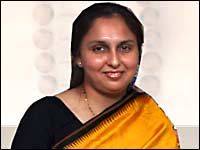 |
| SHALEEN RAIZADA, 38 Education : Ph D (Physics) Last job : IPR consultant with Samtel Industries Last salary : Rs 5 lakh a year Business : Technical consultancy on patents and IPR Idea occured : While working on IPR at Samtel Age at starting business : 35 year What is new : First service firm to deal with IPR exclusively Initial investment : Rs 15 lakh Sources of fund : Family and angel investor Company : Sanshadow Annual fee : Rs 1 crore No of employees : 35 |
| Shaleen Raizada used her education, experience and skill to spot knowledge business opporunity and now she is building it into an enterprise |
Start-up Strategy: Raizada’s association with IPR began with her stint as senior scientific officer in the Patent Facilitating Cell of the Ministry of Science and Technology. She continued working in this field till motherhood brought a pause in her career for three years. After this break, she joined Samtel Industries as IPR consultant, helping them set up the IPR cell. It was here that the immense potential for a service exclusively for patents and IPR grew on her. Raizada decided that the timing couldn’t be more perfect—her husband was doing well in his job, there was always someone at the house to look after her toddler and she had credible experience to fall back on if she failed. With the support of her family behind her, she quit her job and took the plunge. The name came first. ‘Sanshadow’ was a physicist’s inspiration. “The only thing without (sans) a shadow is the sun. So the name,” she grins. The business plan came next. At the very outset, Raizada wanted to clearly define the exact nature of services her organisation would offer, the kind of research and data base that would be required and the profile of potential clients.
Right People at Right Cost: But all this was mere paperwork which in any start-up is almost always the easier part. The first challenge was finding the right people. Raizada went back to her contacts from her first job in Lucknow University. She adopted a two-pronged strategy of enlisting specialists as associates and hiring a few full-time employees to work with her in office. “Due to the nature of the work, I knew we would need people of great expertise. It did not seem viable to get them together at a single place. Thus the idea of having some work as associate consultants in different cities,” she says. This also proved to be cost effective. Interestingly, Raizada laid a lot of emphasis on roping in women who had completed their post-graduation or studied even further in the science stream. “Women make better researchers,” says Raizada, who today has over 15 employees and 20 associates (most of them women) working in fields as diverse as biotechnology and electronics.
| What I learnt |
| HAVE FAITH IN YOUR TEAM People reciprocate and do little extra for the organisation |
| BE HANDS-ON About everything including cleaning up the office |
| THINK BEYOND MONEY Focus on business vision. Monetary success will follow |
| REINVEST IN THE BUSINESS Avoid har vesting the initial profits for self-use |
| DON’T FRET Problems will be sorted out as they show up |









