
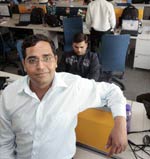
 Vijay Shekhar Sharma, 31 | |
| EducationEngineering, Delhi University | BE, Delhi College of |
| Last drawn salary | Rs 1 lakh per month |
| Age at starting business | 23 years |
| Initial investment | Rs 2 lakh |
| Source of funds | Savings |
| Company | One97Communications |
| Expected turnover | Rs 126 crore (2008-9) |
| No. of employees | 600 |
A prodigious streak, persistence and willingness to adapt to changing market needs have seen Vijay Shekhar Sharma make a success of his One97Communications by adding unprecedented value to mobile services.
Overcoming obstacles: Age and language may have been barriers to his getting ahead, but he managed to vault over both. Just 14 when he finished school from Aligarh, Vijay Shekhar Sharma had to wait a year before he got special permission from the vice-chancellor of Delhi University to gain admission. He joined the Delhi College of Engineering for an undergraduate course in electronic communication.
Here, however, he found that despite the headstart of beginning young, he was hamstrung because he had studied in Hindi, the medium of instruction in Aligarh. “Throughout my school days I had done well, but in college, I could not understand what was taught in the class,” he says.
But Sharma did not give up. To battle his poor grasp of English, he sought help from his friends and began working on his vocabulary. “I would keep two textbooks of each subject, one in Hindi and the other in English,” he explains. Soon, his grades began to improve.
Meanwhile, he became fascinated by the Internet, which had just made its debut. “Along with one of my college friends, I developed a Website named Indiasite.net, an Indian Web directory,” says Sharma.
As he had no Internet access for downloading content for his Website, he began teaching Web usage to people who had Internet access. In return, he was able to download content that he processed offline. It was early promise of an entrepreneurial streak; by 1998, when he finished his degree, his Internet venture had begun generating revenue through advertisements.
Getting to work: Soon after college, he joined US MNC Riverrun Software Group in Delhi as an Internet expert on an annual salary of Rs 2.1 lakh. “My family was against the whole idea of business. They wanted me to go abroad. Though I hated working for somebody, I ended up joining Riverrun Software,” says Sharma.
However, after a six-month stint, he quit. Along with four friends from college, he set up a Web solutions and services company named XS Corps. In 1999, they partnered with the Living Media India Pvt. Ltd. to establish a Website called Indiadecides.com. It was later sold, along with Indiasite.net, to Living Media India Ltd. for cash and as a deal for more business during election coverage.
Meanwhile, XS Corps received an offer from Intersolutions India Pvt. Ltd. for cash and equity valued at a few crore rupees. Sharma was offered a monthly package of Rs 1 lakh to be the technology manager and he accepted it. Dialling the right number: After a year, in 2001, Sharma left to set up One97Communications. “I started this as a people search Website on the lines of a telephone directory,” says Sharma. But it flopped because telecom companies refused to share data with him.
He also felt that the idea was too early for its time. So when he came across another idea, he changed his focus. He heard from a former colleague at Intersolutions that Bharti was looking for live astrology centres, where people could dial and learn about their future. “I rented a place in Delhi for Rs 20,000 per month and hired astrologers for this service,” says Sharma.
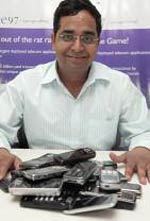
After this, there was no looking back. Firmly hooked to the concept of value-added services, Sharma hired more staff and started developing different applications, ranging from SMS and voice to video and audio. “While some services were already in existence, they couldn’t take off due the involvement of different stakeholders— content developers, technology providers and applications developers. I brought the entire thing under one umbrella on the basis of a 50:50 revenue-sharing model,” he says. In fact, his revenue model soon became the model for the telecom industry.
 |
| Tips for launching a start-up - Be committed to your dreams. You will overcome failure if you remain persistent. - Set your benchmarks and don’t let small problems affect you. - Business needs money. Make sure you have enough before starting it. - Learn to spot exciting opportunities and exploit them to the fullest. |
Scaling up: Though Sharma had found his calling, glitches remained. He had invested Rs 2 lakh from his savings to fund the venture, but the period from 2003-5 was a struggle. To begin with, he had 16 employees. “We started off with Bharti, but were not able to keep pace with its growth. We needed more servers as it was starting services in Punjab. We also had to hire more programmers,” says Sharma.
This created a problem with the cash flow. “While we used to spend heavily on applications and technology, our payments would get delayed,” says Sharma. There were some working capital problems, and to make the capital investments required, he had to take a Rs 15-lakh loan from the ICICI Bank.
But this was a period of expansion and several applications for value-added services were developed. Ring-back tone, music download, m-Commerce and mobile gaming are all applications from One97. Another popular application for rural areas was developed last year: if a farmer has information he wants to share with others, he can record a voice message and all the subscribers of the service can listen to this message.
It wasn’t until 2007 that Sharma got the real boost: a funding of $8.5 million from SAIF Partners and the Silicon Valley Bank (SVB). “It was the right time and we wanted to expand further,” says Sharma. Since then, funds haven’t stopped flowing in. Recently, it received another major injection of $15 million from SVB and Intel Capital, the funding arm of Intel Corporation. “No single product generates more than 30% of our revenue. Also, we have been pioneers for business models, new applications and technologies in the market. Most of our competition has followed what we have delivered first,” says Sharma.
Future calling: Today, One97 Communications has offices in Delhi and Mumbai, besides onsite staff across all telecom circles in India. Its projected turnover for 2008-9 is Rs 126 crore, which he wants to increase exponentially. Increasing manpower from 600 to 1,000 is also on the agenda. Sharma says One97 will continue to innovate products and reinvest significant percentage of revenues in R&D. Though One97 went international in 2005—it works with Roshan in Afghanistan, Optus and Telstra in Australia, Bhutan Telecom in Bhutan and Dialogue in Sri Lanka—Sharma is certain that its major revenue source will always be India as it has a tremendous telecom potential.













