Rahul Jain, a Delhibased software professional, started an aggressive search for an apartment just after the election results. His broker had told him that the real estate market was likely to revive and prices could head north. The problem: the prices quoted by developers, though marginally down from last year, were higher than he could afford. When he asked his broker why middlemen always seemed to get a better deal than the average consumer, he was told that this was because of volumes, which mattered a great deal to builders. “He said that as brokers catered to multiple clients, they were often given attractive deals for selling a certain number of flats,” says Jain.
That forced him to ask another question — this one to himself. Why can’t individual buyers band together, generate similar volumes and get the rate that is being offered to the broker? For him, such a discount would mean being able to buy an apartment in the project that he liked.
The deal that he eventually got was much better than the top brokers’ expectation. He succeeded in nabbing a discount of 20% on the developer’s quoted price - and here’s the rub - not just for himself, but also for 25 of his office colleagues who bought apartments in the project along with him.
The magic key that unlocked the profitable deal was Jain’s negotiation as the representative of a group of 26 people. How did he manage it? “It took much less effort than I had imagined. Most people in my office faced the same situation— they were willing to buy, but waiting for the prices to reduce further. All it took was a series of mails over 15 days and we had a group of 30 people who were ready to buy,” he says. Even after four of them backed out at the eleventh hour, the builder agreed to pass on the negotiated discounts to the rest of the group.
The fact that builders are desperate to clear their inventories is common knowledge. However, prices continue to come in the way. “For developers, bringing down the prices works like a downward spiral: every new customer starts quoting the previous base price and asks for a better deal,” says Mahesh Raghupati, real estate consultant, highlighting the most important reason why the developers are unwilling to negotiate aggressively.
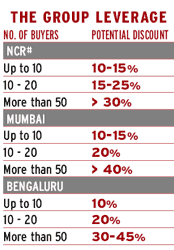
However, this hurdle can be overcome if the builder realises that he can clear a certain percentage of his project at one go—by selling it to a buyers’ group. Most builders would be willing to offer a decent discount if they can sell more than five flats/units at a time in a particular project. “The scale of the project also plays an important role. The smaller the project and the developer, the higher the discount a group can get,” says Raghupati. Some are even willing to construct a separate tower if the numbers are big enough, he adds.
Pre-negotiation rules |
|---|
| To get serious members, take contributions in advance. |
| Let the group representatives negotiate with the builder. |
| To avoid bids by the builder to break the group, don’t disclose the identity of all members. |
| Bargain on the basic price, not add-ons. This will help save registration costs. |
| Before making payments, take a written commitment from the members. |
Forming a group
For Jain, forming a group was as simple as circulating mail in his office. For others, a relatively easy route is the Internet, though this option makes it convenient for the builder to know about it, especially if the target project is specified. However, a standard method of getting group discounts is by forming a registered society. “Once you have a society in place, not only are you assured the numbers, but can also apply for land from the government at concessional rates,” says Raghupati.
It doesn’t cost much to form and register a society even after including the lawyer’s fee. “In some states like Delhi, even the forms and format of the documents to be submitted are available on the government Website. So, all you need to pay a lawyer is for modifying the standard format according to the specific requirements of your society and for representation at the registrar’s office,” says Delhibased lawyer Rajiv Gupta (see How to Register a Society).
“Most state governments come out with schemes, for which a registered society is eligible to apply at rates that are often less than a third of the prevailing market rates. Even if the society doesn’t have money to construct, developers are more than willing to do it in exchange for the rights to sell a certain number of flats in the society at the market rate,” says Pradip Rangnekar, head (marketing), SED Homes, a Mumbai-based real estate company.
How to register a society |
|---|
| The best way to benefit collectively is to register as a society and have a committee in place before beginning negotiations. Here are the steps involved in forming one: |
| Fee: Form a group and collect a minimum fee to handle the legal expenses incurred while forming a society. |
| Committee: Elect a body to represent the society. The president and members need to be specified. |
| Aim: The members need to have a clear mandate and define the objectives of the society. |
| Size: The number of members varies from state to state and ranges between five and 20. |
| Registration: Apply to the registrar of societies, the authority that takes up the process. |
| Documents: You need to submit MoA* and R&R# (format at registrar’s office) with clauses specific to your society. |
| Certificate: After the society is registered, a Certificate of Registration is issued. |
| Apply for land: As a registered society, you can apply to the local authority for land for a housing project. |
| * MoA: Memorandum of Association; # Rules and Regulations |
How to negotiate
While bargaining as a group, it is imperative that you have a clear command structure in place. Though electing a committee or representatives is mandatory at the time of registration, it’s important that only the representatives negotiate with the builder, not the entire group.
Also, members should be willing to contribute the initial deposit money, sometimes even for the absent members. In case there is uncertainty about the participation of some members before the talks with the builders, take a part of the contributions prior to the opening of the negotiation. This will clearly show the number of members who will go through with the purchase. Besides, any bargaining with the builder should be on the basic price, not on add-ons as it helps save the registration costs.
Developers’ club
Even the developers are joining hands to come up with projects within a gated area in order to help cut costs on land acquisition and provision of common facilities (see Builders are Doing it too). The advantage is that the project is sold at two levels. While the location is sold collectively, the individual developers advertise their own projects as well. For example, seven developers have come together to form a company and buy land for a project called the Crossings Republik in the National Capital Region. Since this was a completely unexplored area, they will be able to develop the basic infrastructure faster than a single developer would have been able to.
Builders are doing it too... |
|---|
| CROSSINGS REPUBLIK: Promoted in the National Capital Region by seven developers, who came together to acquire land and develop the area. |
| RAJ NAGAR EXTENSION: As many as 15 developers in Ghaziabad formed a group after failing to sell their projects in three years |
| PATLIPUTRA GARDENS: Promoted by four developers in Patna. Each is responsible for a specific area: land, construction, permissions, marketing. |
| GATEWAY VILLAGE (yet to be launched): Six developers in Nagpur were forced to come together after the funding agency refused to help with smaller projects. |
While some builders have tied up before executing a project, others have formed an association after they failed to sell their projects. For instance, as many as 12 developers offering 15 projects have recently joined hands to sell an area just off the Delhi-Meerut highway, called Raj Nagar Extension.
Many of the developers are offering their first or second projects and these apartments have been up for sale for almost three years now, but so far not a single project has been sold or offered for possession. They have also worked out an incentive structure. “If the property of one builder is chosen over another’s by the customer, then the builder who was approached first will get an incentive from the builder who managed to sell,” says Sanjeev Sharma, a property broker in the area.
However, just because a builder is part of a consortium with reputed developers, it doesn’t guarantee a safe investment. The basic rule still applies: check the track record of your builder. Often, within the same location, some projects tend to fall behind schedule.
So, whether you are a part of a buyers’ group or a single buyer courted by a clutch of builders, remember that while there are benefits to be had, you need to avoid the pitfalls as well.