
Every expert will tell you that there is only one factor to consider before buying a property: location, location and location. "When it comes to buying property for one's residential use, basic infrastructure and connectivity to the main city areas play a very important role. This is because you won't sell it anyway and are not too concerned about the appreciation," says Sanjay Verma of Cushman & Wakefield.
However, when it comes to investment in land and you are looking to sell the property over a certain period of time, you need to give serious thought to the appreciation potential. Most speculators, or those who wish to sell at a huge profit, blindly follow a general rule—they buy land near a proposed mega infrastructure project coming up in any of the cities or towns. Such projects could include a metro or a second airport, even expansion of the existing highway. Once the project is completed, the prices of all the properties around it or along its route tend to jump manifold. This is precisely the reason why even politicians and wealthy individuals follow this real estate rule.
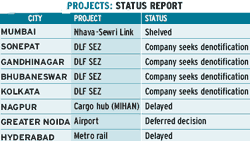
However, in a slowdown like the current one, this strategy can prove to be a failure and result in huge losses. The reason: most of such infrastructure projects are delayed, shelved or cancelled. In such cases, the value of your property remains stagnant, or could even go down as speculators rush to cash out and look for other investment opportunities. In the recent past, this is exactly what has happened to realty investors in several cities across the country.
The area around the Nhava-Sewri trans-harbour link project in Mumbai, which was intended to connect the southern part of Navi Mumbai with the mainland, attracted several buyers and property prices went up in these areas. However, when the 13 companies that had shown an interest in the project failed to submit bids, the state government shelved the project. Consequently, the prices fell.
In Andhra Pradesh, political pressure forced the government to cancel the Coastal Corridor plan, an express highway along the 960-km coastline from Ichapuram to Tada. Property prices zoomed in Visakhapatnam, but fell after the project was shelved.
In another instance, after Arcelor Mittal started acquiring land (it has already acquired 1,050 acres) in Jharkhand for setting up a steel plant, several new projects started coming up in state capital Ranchi in anticipation of the city turning into a hub. Land prices also went up sharply. Now the project, which was supposed to start last year and become operational by 2011, is delayed by three years because of the slowdown.
Obviously then, investing in property because of a proposed mega project is not enough to guarantee the success of a location. Experts, however, do not recommend that you ignore such projects. They suggest that infrastructure projects, in conjunction with a number of other factors, should be taken into account before buying. "Some people get carried away by the low price that a far-away location offers, not thinking that in the end you have to find a buyer to make a profit and this will be difficult if the location is not attractive enough," says Sunil Jindal, CEO, SVP Group.
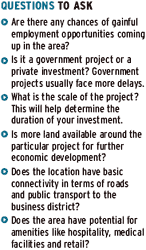
"The first thing to look for in a location, apart from an infrastructure project, especially if it is in an undeveloped area, is whether there are chances of gainful employment opportunities coming up there," says Anshuman Magazine of CB Richard Ellis, a real estate consultancy firm. If your investment timeline is short, the location should have at least the basic connectivity (in terms of roads and public transport) to the business district.
Even the infrastructure project should be evaluated by the prospective property buyer. "When it comes to banking on specific projects, investors should see whether it is a government project or a private investment because government projects usually face more delays unless they are tied to a deadline," he adds. Therefore, the returns, if one is investing around a government project, could be pushed back by decades, if at all.
Another important point to consider is the gestation period of the project—how long it will take for the project of this scale to come up—and decide your exit accordingly. "In places like Mumbai, it also means considering if there is land available around the particular project for further economic development," says Sandeep Sadh of Mumbai Property Exchange, a Mumbaibased brokerage firm. If you intend to invest in land, make sure you have a desirable plot. Owning a muddy, deserted area will get you nothing; farmland, however, could fetch you good returns. In such cases, the size of land you own is also important.
So, downturn or not, slowdown or boom, location still remains the single most important factor to consider when investing in property. It's just that other parameters need to be kept in mind during a slowdown. Keep your eyes open, do your homework and you can still land a great deal.













