The economy might be bad and the forecast gloomy, but if you need a house to live in, this is as good a time as any to buy. However, when it comes to buying a house as an investment, would you put your hard earned money in it? Do you think the real estate market is going to bounce back and is likely to give you phenomenal returns on your investment?
“Like stock markets, when the real estate market is hit by fear psychosis, potential buyers just postpone their decisions; there is no distinction between a good property and a badly located property. This is where a savvy investor can step in to land a good deal,” says Hitesh Sahni of HSN Realty. At present, transaction prices in most markets are down by 25-30% across the board.
This is precisely why experts suggest that you take this opportunity to invest in property. With many investor-driven markets having shown a substantial correction of late, they say it’s a good idea to get in before the markets start picking up. Already, some smart investors have begun to explore the real estate market in smaller cities. This is because the entry cost at these places is lower when compared with the cost of property in metros. This is also a good time for investors to sharpen their bargaining skills to notch further discounts on the falling prices.
“High net worth individuals have started coming back to real estate as they feel that the sector has bottomed out and they will get good returns on the money invested in big projects,” says Rohtas Goyal, chairman, Omaxe. “Most of the investments have come between mid-December and January,” adds Anuj Puri, chairman and country head, Jones Lang LaSalle Meghraj. He adds that in January alone, four projects worth Rs 350 crore were finalised. This is definitely a sign of revival in the property market.
“I am bullish on the sector in the long term and believe the current down cycle is unlikely to stretch beyond 12 months. The residential segment, which is driven by rising population, urbanisation, nuclearisation and housing finance, will be a key driver,” says Sachin Sandhir, MD and country head, Royal Institution of Chartered Surveyors.
However, not everyone in the business is as gung-ho. Ambar Maheshwari, director, DTZ, an international investment advisory, says that while investors are evaluating the merits of buying property at present, investments are likely to come in “only in the middle or at the end of the year after the elections, when a trend is expected to emerge”. Others like Maheshwari insist that any investment in real estate should be only for those investors who are prepared to stay for the long term as prices are unlikely to move up in a hurry.
Why now?Experts feel that the residential property prices are likely to stabilise from April onwards, with fear of deflation brooding over the economy. They maintain that the continuous drop in the prices of general goods and services will bring the interest rates down to more affordable levels. This, combined with the recent downward trend in property, may see buyers coming back to the market. “The demand has not evaporated. It’s waiting to come to the surface, but at the right price, with the right sentiment and with some kind of guarantee that the product will come up in the market,” says Pranay Vakil, chairman, Knight Frank India, a global real estate consultancy.
“We have various guesstimates ranging from end-2009 to middle-2010 when the slowdown might come to an end, but it must be clearly realised that there is no scientific basis for such estimates. After all, how can one estimate when the ‘feel good’ factor returns to reverse adverse expectations? Whenever it does, it will offer at least a small rally for some time because of the pent-up demand over the past 18 months,” adds Sahni. In anticipation, investors are lapping up property when they believe they can negotiate good deals.
Changed Rules
- Some developers have increased the super area without a corresponding increase in the carpet area, even after the launch of the project.
- Instead of the surety of prices going up, some project launches have seen lower prices than those offered during soft launches.
- Payment for add-ons is not disclosed at the time of the sale.
- Developers now hold on for maintenance income even after project completion.
|
Where to investWhile the prices are falling, the property in metros is still expensive. The good news is that small towns and cities are emerging as complementary investment destinations. Smaller cities and large towns directly connected to tier 1 and 2 cities are becoming hubs because of the increased economic activity. Cities like Nagpur, Ahmedabad, Chandigarh, Jaipur and Coimbatore, which were earlier considered attractive because of their proximity to large cities and metros, are today seen as hubs themselves.
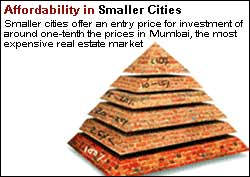
Affordability is one of the most important parameters (see Affordability in Smaller Cities). However, continuing to rely solely on cost savings will not be sufficient to ensure long-term growth. “Contrary to perceptions, our research indicates that the level of risk in some smaller cities is no different from that in the metros. For example, Chandigarh, Kochi and Nagpur have levels of real estate transparency similar to those in bigger cities,” says Puri.
While smaller cities still account for a relatively minor proportion of real estate activity (21% of modern offices and 34% of shopping malls), the potential of these tertiary markets is evident because of 41% of the country’s wealth.
“Also, given the government’s renewed push to speed up infrastructure projects, many new avenues will be opened just because of locational advantages, and an early mover at the right location will make gains over the next threefour years,” adds Sahni.
Checklist: New Markets Vs Established Markets
|
Parameters
| Established Markets
| Smaller Cities
|
First-mover advantage
| Not necessary
| Critical
|
Location within municipality limits
| Critical
| Not necessary
|
Deal size
| Medium to large (Rs 25 lakh or more)
| Small (Rs 5-6 lakh or more)
|
Developer commitment
| Preferred
| Strongly preferred
|
Developer track record
| Important
| Critical
|
Before you decideThe prices have been falling and you might be ready to invest in a small city, but should you buy commercial real estate or stick to residential projects? Obviously, the demand and supply position of each sector needs to be examined carefully before you invest. Experts believe that given the demand for residential properties and the smaller investment required here, this sector scores over the commercial and office space. Also, the price correction in the residential sector has been more pronounced in the new launches than in the existing projects.
While investing in smaller areas, it is critical to know the market well. However, timing is equally important if you are buying land purely as an investment; a first-mover advantage helps immensely. Also, while the city suburbs offer affordable opportunities, investments in smaller cities should ideally be within municipal limits. You also need to keep an eye on any new rules and regulations as these can change suddenly. For example, while soft launches almost always meant a low entry price and short-term profits, some developers have now been forced to bring the prices down during the actual launch. Finally, make sure that you take great care while evaluating the size of the property as some developers tend to increase the super area without a corresponding increase in the carpet area.
Remember that as the private equity players are not willing to go beyond the established markets at present, the correction in prices has been steeper in smaller markets. This also means that developers are giving the best deals (on lowest margins) to investors with cash. So far, the developers have been pricing their projects according to their expected profit margins vis à vis the cost of land in different locations. Buyers, however, are not prepared to consider the initial and appreciated cost of land as a valid component of the buying price.
The bottom line is that some sections of the real estate are still over-priced. Opportunities exist in the smaller cities, but prudent investors should focus on specific sectors or development types when venturing into these markets. The risks and opportunities that exist in the smaller markets are different from those in metros. The risk, when compared to metro cities, arises from lack of enough market information. If you do your homework well, you might find that there are good opportunities waiting to be tapped even now.