This time around, we've decided it is time that the enthusiasts got their due. So, we present the 'Best Driver's Car' for every price bracket.
PICTURES: Cars to look forward to If you like driving; acceleration, high speed stability, easy manoeuvrability to push into gaps, precise braking and a lovely gearbox, then this article will sort the grain from the chaff for your convenience. In the first part of a three part series, we have cars priced upto Rs 4 lakh.
Upto Rs 3 lakhNo real surprise that the
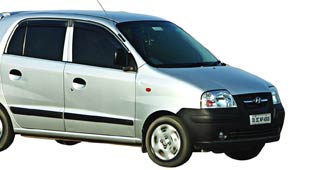
Santro is the winner here. With cars such as the Eeco, the Nano and the M800, the Hyundai really has no competition. But, there was the Indica Xeta and the Alto for competition.
However, both the Alto and the Indica lose out to the Santro when on the move. Both are slower offthe-line than the Hyundai. The Santro takes just over 14 seconds to complete the 0-100kmph run. The Indica and the Alto take an additional two and four seconds, respectively, to hit this mark.
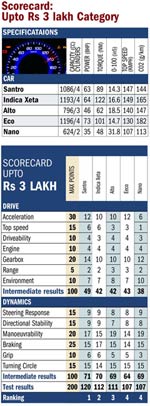
SCORECARD: Best car upto Rs 3 lakh
To add to the Alto's woes, it has a lower top speed. It is almost 10kmph slower than the quickest car in this category, the Indica.
Naturally, the Alto's chances were seriously hurt here. In addition to the quick full-bore acceleration, the Santro also has better driveability in its favour. So, when you want to quickly pull out from behind a lumbering truck on a single lane road, the Santro will not only feel more satisfying when the throttle is pressed, but also safer.
The bigger difference is in the way the Santro's gearbox feels. Compared with the Indica and the Alto, the Santro feels slick and smooth. So, when you want to up the gears quickly when showing off, the Hyundai will certainly hold you in better stead. Otherwise, in terms of range and being kind on the environment, the three aren't too far apart, with the Alto holding a slight edge over the other two.
The final two cars in this category are the Eeco and the Nano.
The Eeco isn't a slow car, mind you. In fact, in this bunch it's slower to 100kmph only compared with the Santro and takes a little under 15 seconds to complete the run. It has decent driveability too, almost matching the Santro. However, compared with the Hyundai, its gearbox just doesn't feel as good to operate.
The Nano manages to come close to the Santro on Dynamics, but poor grip and engine capability gives the Hyundai an unassailable lead as a better driver's car.
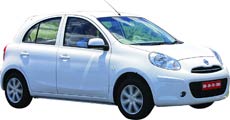
The Micra turned out to be a better driver's car than the swift, but only just.
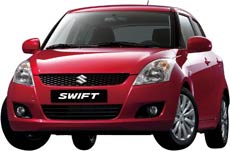
If it's a fun to drive hatchback you want, it doesn't get better than the Swift. Though it did not win the category, it's given stiff competition.
The
Nissan Micra's Dynamics pushed the Swift to second spot to come out on top. The Micra has as good a steering response as the Swift's and though it doesn't feel as planted as the Swift, since it wallows and rolls more, it is easier to slip into gaps. But, most of all, it brakes much better than the Swift.
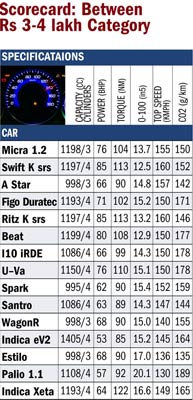
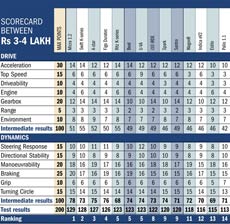
SCORECARD: Best car between Rs 3-4 lakh
The Swift, on the other hand, has a superb engine in the K series. Even though it loses out overall by a single point, it scores the best under drive. It has class-leading acceleration and top speed. The driveability too is up there with the best. But, it's the slick and quick shifting manual gearbox that makes it a delight to drive.
The A-star finishes third, and like the Micra and the Figo (which comes in fourth place) it beats the Swift under Dynamics. Surprised? Don't be. The A-star, you see has better steering response and feel.
It's clearly more manoeuvrable, and has a shorter turning circle as well. Though it doesn't feel as stable in a straight line or during quick direction changes, the advantage it garners in earlier mentioned criteria, gives it an edge over the Swift in terms of dynamics. The Figo has better dynamics than both the Marutis. It has the best steering response, the best stability to boot and braking, second only to the Micra.
MUST READ: The man behind luxury cars in India It's a tie for fifth place between yet another Maruti, the Ritz and two cars from General Motors, the spunky looking Beat and the more sedate U-VA. Both these, again, better the Maruti cars on Dynamics.
Bringing up the tail in this segment are cars the Maruti Eeco and the Indica Xeta. But, it's the Indica Vista and the Fiat Palio that caught our attention at the bottom of the table. The Palio isn't bad dynamically, but the 1.1-litre FIRE engine, even with 92bhp, does little for it. It takes the Palio an unbelievable 20.1 seconds to get to 100kmph. In today's day and age that's an eternity.
The Vista with the 1.2-litre Safire engine (which is again a Fiat engine), is quicker than the Palio, but again taking close to 18 seconds to 100kmph. And then of course, there's the matter of top speed. A car so big and prominent on the road that fails to touch even 150kmph is slow by any standard. The new Indica eV2 does better than both of these despite having a diesel engine.
Courtesy: Auto BuildExplaining the Scorecard
Drive and dynamics are the most important factors in determining a driver's car.
DRIVE
ACCELERATION: The time taken for a car to accelerate from standstill to upto 120kmph.
TOP SPEED: The maximum speed a car can attain. Points are awarded for the highest point and the car's stablity and handling getting there.
DRIVEABILITY: The ease with which a car accelerates through gears.
ENGINE: An engine's character is decided on the way it revs. Adding to the character is the refinement of the engine, the sound it makes and the thrust it provides during flat-out acceleration as well as roll-ons.
GEARBOX: A short throw, precise and smooth gearbox is always the best.
RANGE: The distance a car will go on a tankful.
ENVIRONMENT: A clean, but good driving car, is what we need today.
DYNAMICS
STEERING RESPONSE: Apart from how quickly a car responds, it includes the feel and how the steering weighs up from slow to high speed.
DIRECTIONAL STABILITY: How stable and composed a car feels at high speeds and while changing directions quickly.
MANOEUVRABILITY: How easy a car is to manoeuver into gaps when driving on a busy road plus parking and handling while reversing.
BRAKING: A car with a short stopping distance, good brake feel, bite and progression for better brake modulation is king.
GRIP: It's not just tyre grip we're considering here, but also what we call the chassis grip. It is how a car goes about losing its intended line. If it snaps without communication, it's no good. But, if it does so progressively while filling in the driver on details (read as feel), it's easier to catch and correct.
TURNING CIRCLE: How small a circle a car draws while handling a U-turn for instance. The smaller, the better.
|