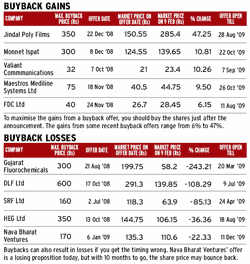
Towards the end of 2008, Jindal Poly Films announced a buyback at Rs 350 per share. At that time, the market price of the stock was Rs 150. Soon after the announcement, the share price started climbing; on 12 February 2009, it closed at Rs 286. Now, assume you had bought Jindal Poly Films shares a year ago after doing your homework and had planned to hold the stock till the price touched, say, Rs 400. Should you sell now simply because the company is offering to buy back at Rs 350 a share?
To answer this, you first need to understand how buybacks work. When a company decides to purchase back its shares, it can take one of the two routes. It can appoint an agent to buy back the shares from the open market, subject to a ceiling price. Or, in case of a takeover or an impending acquisition, it can buy back all the shares directly from the shareholders at a specified rate (known as a tender offer). Most companies announcing buybacks today take the former route.
The question is, will you get Rs 350 per Jindal Poly share even though the market price is around Rs 200? If you're facing a similar dilemma, it's time to face reality. The announced price is the upper limit that the company is prepared to pay. If the offer price is far above the prevailing market price, it could cause a revival of interest in that company, leading to the prices going up. But it doesn't imply that the company will buy back the shares at the upper limit.
So, if you're not going to get the highest price from the company, is there any reason for you to consider the buyback offer? Perhaps you should simply think of arbitrage. Sell at the right time and you can make a killing. Says Jayant R. Pai, associate vice-president, institutional equity sales, IL&FS Investsmart Securities: "There is an opportunity to book a profit if the share price rises, coming closer to the maximum buyback price. This provides a window of opportunity for arbitrage." It works especially when the buyback period is long.
Misleading
However, the road to arbitrage profits from buybacks is fraught with risk. You can, if you're a market maven, track the price after a buyback announcement is made, and sell when you think it has hit a peak. But this strategy should not be followed by the lay investor. Taking advantage of an arbitrage opportunity is a risky proposition and demands a deep knowledge and close tracking of the markets to gain from the price variation. Of the 24 companies that announced buybacks in 2008-most of which are still open-the share prices of more than half are below the maximum buyback price. So, the buyback favours the company.
Then, there's the problem with regulations. There is no legal obligation on the part of a company to follow through on its buyback plan. So, it can make a buyback announcement and not pick up any shares. Consider the mega buyback announcement by Reliance Industries in April 2000. It set aside Rs 1,100 crore for the mop-up. And how much did it spend during the 22 months that the offer remained open? Not a paisa. "There are a lot of uncertainties about whether a company will actually buy back, whether the price will go up, and if it does, how close it will be to the buyback offer," says Pai.
Also, current regulations do not make it mandatory for a company planning a buyback to declare a floor price. So, companies can announce inflated ceiling prices, but actually buy at a fraction of this rate. What can, and often does, happen is that bear cartels and merchant bankers act in tandem to bring down the share price much below the offer price. If you enter the market at the wrong time to take advantage of the arbitrage opportunity, you could lose heavily. "For traders, a volatile stock that is well traded brings gain opportunities, which can never be discovered by small investors," says Pai.
Advantage companies
You can also end up losing more than you can afford to, depending on the buyback objective of the company and other players in the market, especially merchant bankers. For promoters, buyback is a tool that can help improve profitability ratios and provide support to the stock price. It's also an effective way to exit public shareholding, and is far cheaper than making a tender offer. The cost associated with announcing a buyback is minimal, though it's a time-consuming process that may take up to six months. Therefore, the promoters' interest lies in being able to buy at the lowest possible price.
The companies, too, benefit when the stock is available at a much lesser price than its buyback offer. For instance, the recently concluded buyback offer of Reliance Infrastructure saw the company purchase its entire quota of 87.6 lakh shares at an average price of Rs 920. This was 42% lower than the maximum buyback price of Rs 1,600 that the company had offered. It used only Rs 806 crore as against the Rs 2,000 crore earmarked for the purpose.
Blindly accepting a company's share buyback offer might leave you poorer. It is advisable to study all aspects of a buyback carefully and understand the risks involved. If you play it right, you could make a fast buck.