Rooted in ratio
The price to earnings growth (PEG) ratio is calculated by dividing a stock's PE by its projected EPS growth. Though most analysts calculate the PEG ratio by using forecasted earnings, Lynch prefers the conservative approach. He strongly believes that projections can be inaccurate. While formulating the ratio, Lynch used the earnings data of the previous couple of years to derive the long-term EPS growth trend of the company. Lynch assumes that the future EPS growth of the company will be at least equal to the historical average growth rate.
The perfect peg
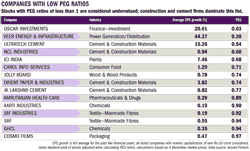
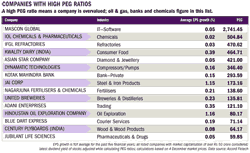
Stocks with PEG ratios of less than 1 are considered undervalued relative to their EPS growth rates, whereas those with ratios of more than 1 are considered overvalued. This is because such stocks are trading at prices that are too high to support their EPS growth. A PEG ratio of 1 implies that the stock is fairly valued.
According to Lynch, the best stocks are those that have PEG ratios of less than 0.5. Stocks with PEG ratios of 0.5 to 1 are considered acceptable. A PEG ratio of less than 1 implies that though the earnings expectations of the stock have risen, the market has not yet realised its potential.
The limitations
The ratio is not free of constraints. It cannot be applied to companies reporting losses as their PEs cannot be computed. Moreover, if the PEG ratio is calculated using projected earnings, the authenticity of such projections plays an important role in determining its effectiveness. The PEG ratio will be inaccurate if the projections or estimates are not realised.
Also, the ratio is not applicable to real estate and airline stocks as these are valued based on their asset values.