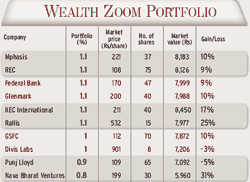
Egged on by more than one reader, this fortnight I have introduced 'shorts' as a new concept in our Wealth Zoom model portfolio. What is shorting? To many it might seem like a perverted, or even an unpatriotic, act to indulge in, but the proponents of shorting have logic on their side. If a stock is trading at rates that are significantly more than its 'fair price', there is money to be made by selling it now (going short) and buying it back when the price falls to its logical or fair level. This is the exact opposite of what we do when we invest in the stock markets: we try to find stocks that are undervalued and use cash to buy them. In other words, we go 'long' on those stocks.
Every time we short sell, cash rises at the aggregate level because of the fact that we have sold stocks even though we didn't own them. I promise that we will never use short selling to take on a gross exposure that is bigger than our initial capital of Rs 10 lakh. You are well aware of my allergy towards leverage of any kind.
We are in the early stages of fiddling with a long-short approach and have plenty to learn, so we will steer clear of heavy exposures on both long and short sides. If anything, the uncertain economic situation will ensure that markets don't run wild on either side— long or short.
Right now, our 'longs' add up to Rs 94,902 and our shorts add up to Rs (30,369), which works out to a gross exposure of Rs 1,25,271 (our net exposure, which is total longs minus total shorts, is Rs 64,534). We have short sold four stocks and have used spot prices for our shorts. Ideally, a real investor would have used futures to go short, but there is the attendant issue of rolling or closing shorts every time the contracts expire (last Thursday of every month). We have avoided this complication purely to improve accounting convenience. Also, as a matter of abundant caution, we are charging a 0.5% transaction fee even on futures trades, which is at least 10 times more than the prevalent rate in the market.
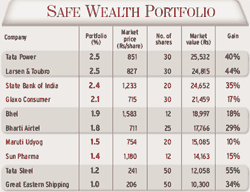
The Safe Wealth model portfolio, on the other hand, will avoid going explicitly short since we have a more mature mandate of delivering long-term returns. This implies that we have to deploy capital in corporates which have enduring franchises and solid businesses. Unless there is a very compelling short in a frontline stock (Bharti Airtel, Reliance Industries, ONGC, Tata Steel, Larsen & Toubro, NTPC, anyone?), we will avoid playing with shorts in Safe Wealth. Given its riskier slant, Wealth Zoom is a natural fit for a long-short combination, which is a model that many hedge funds follow. Note that we have left Safe Wealth unchanged this fortnight in the absence of visibly compelling trades.
Let's move to the four stocks we have short sold in Wealth Zoom this fortnight.
Crompton Greaves: This pick is the most difficult to justify. Actually, I had opened up a calculated trading call with a long exposure of only 55 shares (around 1% of NAV) last time, and it paid off. We gained about 17% in two weeks.
This company is investing part of its surplus cash in a power generation business owned by its promoters, and this might invite a de-rating at a time when its main business—power transmission and distribution equipment—is clearly not growing as fast as before. It remains a very capable player, acquiring new capabilities daily with globally competitive manufacturing facilities. But the premium it commanded was purely on the kind of growth that it was generating, and this growth would require the surplus cash to be progressively re-deployed in working capital. This has changed now and the management has diverted cash to a capped-return utility business. Hence, our short call.
Tata Consultancy Services: TCS has reported disappointing numbers for 2008-9. The company's mild quarter-on-quarter (QoQ) revenue de-growth hides the fact that it has the operations of CGSL (the erstwhile e-Serve) integrated after acquisition, so on a comparable basis, its organic operations actually shrank over 6%. I expect volumes to contract over 2009-10 at a time when TCS has made almost 25,000 campus recruitments (shudder!). The earnings per share (EPS) could fall by over 5% and the Street will hammer down TCS in a weak market devoid of triggers.
Zee Entertainment: The 2008-9 numbers for Zee Entertainment have also been disappointing. The company, stripped of its international subscription revenues, is actually running a loss on its Indian revenues, less costs. After the spectacular growth in ad revenues in the first half of 2008-9, Zee Entertainment faced a slowing economy and terrific competition in the second half; viewership and ad revenues cracked. The only saving grace could be subscription revenues as CAS (DTH and digicable) penetration steadily pick up this year. Still, the total revenues will probably fall and all the costcutting in the world may not suffice to grow profits. At over 14 times the estimated earnings, Zee Entertainment looks costly in an increasingly difficult environment, prompting us to take on a small short exposure.
Tata Motors: The company, with its ill-timed, and now bleeding, acquisitions of Jaguar and Land Rover, has been busy shooting itself in the foot over most of 2008-9. The Nano launch led to a wild and sentimental recovery from Rs 150 levels to well over Rs 270, which we think has played out more than enough. Over the next two years, the benefits of Nano will be more than compensated by the gashes that the Jaguar-Land Rover deal will leave on the company's leveraged balance sheet. A good management has done terrible things to itself, and we will wait to reverse this position only after the worst has played itself out.