
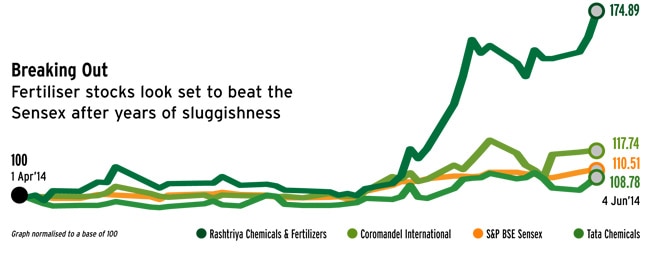
There is new life in the fertiliser sector. After three years of negative returns, fertiliser stocks have been on an upswing since the beginning of 2014-15. Between April 1 and June 2 this year, they surged 32% on an average as against 10.26% rise in the Bombay Stock Exchange (BSE) Sensex. In 2011-12, 2012-13 and 2013-14, they had fallen 9.5%, 20% and 3.6%, respectively, on an average. The Sensex had returned -10%, 8% and 19%, respectively, in these years.
Market experts say the rally in fertiliser stocks since the start of the financial year can be attributed to the upbeat sentiment after the general elections and company-specific news. For example, Mangalore Chemicals rose 15.39% to Rs 71.60 because of open offers by Deepak Fertilizers and Zuari Global. Coromandel International and Deepak Fertilizers did well due to investor expectations that government decisions would favour the sector. Since the start of 2014-15, these two have surged 16.4% to Rs 258.55 and 26.6% to 152.20, respectively.
Runjhun Jain, senior research analyst, Nirmal Bang Securities, says, "Most fertilisers stocks failed to perform well in 2013-14 as the companies were burdened by high outstanding subsidy, rising fertiliser prices which led to a fall in volumes and excess inventory and, therefore, higher working capital requirement. This impacted profitability. However, a clear election verdict, falling inventory levels and company-specific news have helped the sector register gains in the ongoing financial year."
In 2013-14, fertiliser majors Tata Chemicals, Rashtriya Chemicals & Fertilizers, Fertilisers & Chemical Travancore and Gujarat State Fertiliser & Chemicals had tanked 11.38% to Rs 286.85, 13.9% to Rs 33.10, 7% to Rs 20.55 and 4% to Rs 56.30, respectively. However, Coromandel International and Deepak Fertilisers & Petrochemicals Corporation rose 14.8% to Rs 222.10 and 20.13% to 120.20, respectively.
VALUATION AND OUTLOOK
Are fertiliser stocks attractive at their present valuations? Among the 23 stocks which are listed on the BSE, the price-to-earnings, or PE, ratio of 15 was lower than the industry average of 11.64 on June 2. Deepak Fertilizers, Chambal Fertilisers & Chemicals and Gujarat State Fertilizers & Chemicals were trading at PE ratios of 5.50, 6.60 and 8.74, respectively. PE ratio is a valuation measure that shows a stock's price relative to the company's earnings.

J K Jain, head of research, Karvy Stock Broking, says, "We are highly bullish on players with high DAP/NPK and complex fertiliser capacities and with significant capacities of chemicals derived from ammonia and crude oil derivatives." Coromandel International, Gujarat State Fertilisers & Chemicals and Rashtriya Chemicals & Fertilisers are among the large companies which manufacture DAP/NPK fertilisers.
Jain also throws light on other issues which can impact profitability. "There has been a significant drop in international prices of fertilisers such as urea. This, though, is not the case with complex fertilisers like DAP, which along with the fall in prices of rock phosphate might help complex fertiliser makers expand margins to a small extent. For complex fertiliser makers, the margin expansion could be limited because of steady short-term upward trend being seen in prices of ammonia and phosphoric acid. Thus, pure-play urea players might end up seeing a drop in margins because of cheaper imports. But this, too, could be moderated to an extent by export of ammonia if the domestic demand is weak and international prices continue to support such a move," he says.RECENT DEVELOPMENTS 33% is the average rise in shares of fertiliser companies between March 31 and June 2. The BSE Sensex rose 10.26% during the period
The Cabinet Committee on Economic Affairs, or CCEA, in February cleared an increase in the fixed cost of urea by up to Rs 350 per tonne. For plants that are more than 30 years old, the increase was Rs 500 per tonne. For urea plants, the fixed cost includes salary, repair/maintenance and selling expenses. The increase will push the cost of urea production. As the selling price is fixed, the move will result in a higher subsidy bill.
The CCEA also cleared amendments to the new investment policy to encourage companies to invest in the sector so that the country can reduce dependence on imports. The policy has got a good response from companies as about 13 urea makers, including Rashtriya Chemicals & Fertilizers, Chambal Fertilisers and Tata Chemicals, have applied for expansion under it.
India's urea production has been stagnant at 22 million tonnes for some years. The annual shortage of eight million tonnes is met through imports. According to India Ratings, fertilisers, chemicals and automotive suppliers have shown a negative sensitivity change to rupee depreciation, with operating profit getting affected to the extent of 0.5% to 1.4% in 2012-13 for every 1% rupee fall. However, margins will expand if the rupee rises. In the previous financial year, the rupee had plunged 10.43% to 60.09 against the dollar.
INVESTMENT OPTIONS
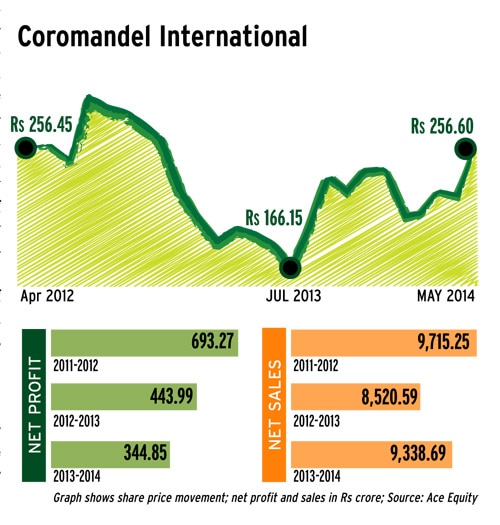
Coromandel International: In 2013-14, the stock had risen 15%; it was at Rs 222.10 on March 31 this year as against Rs 193.45 on April 1 last year. In the quarter ended March 2014, the company registered a net profit of Rs 83.09 crore, up 511% from Rs 13.6 crore in the corresponding quarter a year ago. Market experts believe the Murugappa group company will benefit from the ongoing amalgamations of Liberty Phosphate and Sabero Organics, as these will help the company decrease the dependence on DAP and ammonium phosphatic fertiliser.
S Ranganathan, head of research, LKP Securities, says, "Coromandel International remains a good investment for long-term investors and will give lucrative returns in the next 12-months."
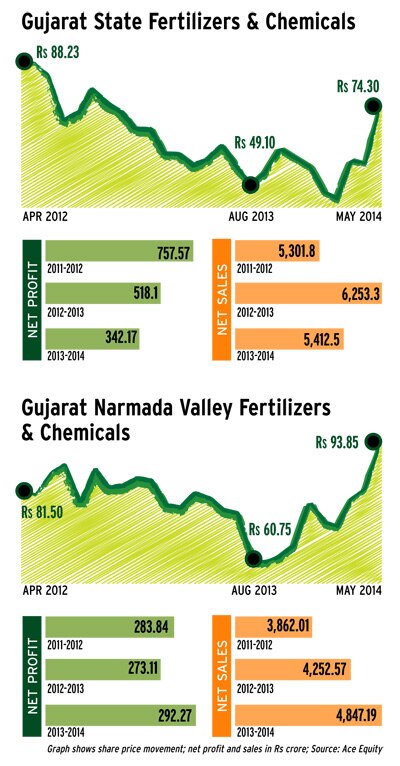
Gujarat State Fertilizers and Chemicals (GSFC): The stock has risen 33% since the beginning of 2014-15; it was at Rs 75.05 on June 2. GSFC has a strong pipeline of industrial chemicals/products like caprolactam, Nylon-6, Methanol and Melamine. Jain of Karvy says, "The company's fertiliser capacities are mainly focused on DAP and complex fertilisers, which are expected to yield better margins this year. Continuance of market-determined prices for complex fertilisers (as against the reference price mechanism) will act as a support. We believe the stock can deliver a return of over 15% this financial year from the current levels."
Gujarat Narmada Valley Fertilizers & Chemicals (GNFC): Though GNFC has 650,000 tonnes per annum urea capacity, it earns an equal amount of revenue from ammonium nitro phosphate, acetic acid, aniline and toluene di isocyanate (TDI). Jain believes that the commissioning of the new 50,000 tonnes per annum TDI capacity and shift of ammonia synthesis feed stock to natural gas from fuel oil will help the company report stable numbers by compensating for the falling margins in urea. "The stock can rise over 15% in the next 12 months."













