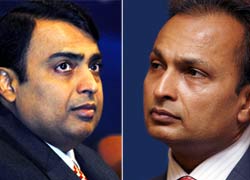
The rift between the Ambani brothers and the possibility of a patch-up have affected the prices of the shares in the two Reliance groups. We examine the differences between Mukesh and Anil, the circumstances in which the brothers could reunite and the likely impact of such a unification on their businesses and on the stock prices of the two Reliance packs.
A few days before 24 February, the birthday of Kokilaben, the mother of Mukesh and Anil Ambani, there was hectic trading in the stocks of the Reliance pack. This was nothing unusual as the counters of the Reliance Group—divided between the two brothers in June 2005 after an intense public battle and which comprise large-caps such as Reliance Industries (owned by Mukesh) and Reliance Power (Anil)—have millions of shareholders and witness huge volumes. This time it was different.
There was speculation among investors that the two brothers, whose companies together contribute 3% to India’s GDP, had decided to bury the hatchet and smoke the peace pipe. In fact, the media reported that the Ambani clan would announce the patch-up when the brothers met at Kokilaben’s residence. Investors were palpably excited since such a move would help them immensely; the stocks of the Reliance pack would certainly go up, thanks to the commercial synergies and other benefits accruing in the future.
Alas, it didn’t happen. But it left investors with an afterthought. What if? They thought about the possible scenarios if the two brothers were to shake hands. “The recession could be one reason to bring them together. This is definitely a good time for the Ambani brothers to reunite,” says M.K. Swaminath, ITPF chairman. Adds Som Mittal, chairman, Nasscom: “Considering the current economic and business climate, there is a real possibility of them coming together.” Other market observers believe that the probability of a truce is remote. “The situation is hypothetical and can only happen in a fiction movie,” says Nexgen Capital’s equity head, Jagannadham Thunguntla.
Still, as almost every investor household holds some shares of the Reliance Group, it seems like a good exercise to analyse what is likely to happen if the two brothers were to join hands yet again. It will also help you to understand whether you should hold on to these shares, buy more from the market, or sell if the rumours turn into a possibility. More importantly, the move can provide a much-needed boost to flailing market sentiments at a time when the Sensex has lost almost 60% in the past 14 months.
Impact on valuationsEach time there has been news, either of the beginning and intensification of a battle between Mukesh and Anil, or a settlement between the two, the Reliance pack has gyrated wildly (see charts). After Mukesh publicly disclosed on 18 November 2004 that there were “ownership issues” with Anil, RIL, then the flagship company of the group and today the largest within the split group, went into a tailspin, falling 10% within the next 30 days.
Similarly, after the announcement of a settlement between the brothers on 18 June 2005, the Sensex crossed the 7,000 mark on 20 June. Reliance Energy (now Reliance Infrastructure and owned by Anil) was the biggest gainer; even RIL closed at its then all-time high of Rs 630.40. On 21 November 2008, a day after the Ambani brothers shook hands at a meeting of top industrialists called by BJP leader Lal Krishna Advani, investors rushed to buy shares of the companies belonging to the Reliance Group, pushing the various scrips higher by 4-14%.
Therefore, it is a no-brainer to assume that there will be an upswing in the Reliance pack if the two brothers decide to bury their differences. This will prove to be a delight for investors, who have seen the combined market capitalisation of the split Reliance Groups tumble from a high of over Rs 8,00,000 crore in 2007 to just over Rs 3,00,000 crore. In fact, the two brothers’ dream of individually becoming the richest man on earth—Mukesh did become the richest man for a few days in 2007—has vanished.
Impact on businessesThe first possibility is that after the truce, the brothers may decide to merge their respective groups. This will result in the birth of a huge conglomerate, with combined revenues of Rs 1,60,000 crore and net profits of Rs 25,000 crore, making it one of the world’s largest companies. Recently, when Mukesh’s RIL announced the merger with RPL, a subsidiary, the RIL stock dipped initially, but later rose by almost 5% in less than two weeks. In the case of Mukesh and Anil’s groups, the positive impact of a reunion is guaranteed.
Besides, consider the other positives of a merger between Mukesh and Anil in business terms. Economies of scale? Yes. Capitalisation of cash flows? Yes. Easier sourcing of finance for new businesses? Yes.
Apart from these there are other benefits. An oil and gas analyst with a foreign brokerage says that the settlement would be a clear “positive” for RIL, which can begin to monetise its gas reserves from the Krishna-Godavari basin. It would benefit Anil’s group as well through the supply of gas from the Mukesh-owned KG basin in Andhra Pradesh to Anil’s proposed mega power project in Uttar Pradesh.
What is more important is that there are tremendous synergies between the two groups. Mukesh is into retail and can only gain from Anil’s recent forays into setting up a retail powerhouse for financial services. Anil is into power, and stands to benefit from the huge gas reserves owned by his elder brother. Anil’s convergence strategy can mesh beautifully with Mukesh’s city pipeline dreams; many global groups have dreamt of setting up Internet infrastructure along with gas supply pipelines.
The political falloutThere are also several intangible benefits. The first is obviously that the brothers would be able to manage political risks more effectively. Ever since 18 November 2004, and even after the split in June 2005, the fight between the brothers has become a politician’s delight. From being feared by opponents and political parties alike, the two brothers are being played like puppets these days. In fact, the two have lobbied against each other in the corridors of power. Obviously, all this has adversely impacted their businesses and future plans.
For example, in July 2008, after the UPA government won the debate on the Indo-US nuclear deal with help from the Samajwadi Party, Mukesh was clearly in trouble. The reason: Samajwadi Party general secretary, Amar Singh, who is a close friend of Anil, lobbied with the government to impose additional tax on Mukesh’s RIL.
Mukesh has also alleged that Anil lobbied politically to scuttle his plans to sell gas from the KG basin to third parties, or to start city pipeline networks. At the same time, Anil has felt that several of his expansion plans, including the launch of DTH, were delayed by several months since the relevant ministries refused to give green signals. Then there is the time and effort that the two siblings have wasted in fighting each other.
When RIL picked up a prime plot in the Bandra-Kurla business district against Anil’s competing bid, the younger Ambani moved the Bombay High Court when he realised that the government had increased the Floor Space Index of the plot from the standard one to four. The Mumbai metro project was among the first turf battles fought over by the brothers; Mukesh and Anil led two separate consortia and used every trick in the book to outdo each other in the bidding process. Eventually, the city’s first metro was allotted to Anil’s Reliance Energy-led consortium.
In conclusion, there is no doubt that both investors and the Ambani brothers can only gain from peace moves. Says Thungutla: “Both the brothers can concentrate... their productive energies to cooperate and operate with each other. The groups have evolved considerably since the days of the demerger (in 2005). So, if at all this happens, it would be a good thing for the shareholders.”
- With Sameer Bhardwaj