Advertisement
The power to profit

The power to profit

The government’s thrust on power is good news for the sector, but investors must watch out for project delays because of the credit drought, says R. Sree Ram

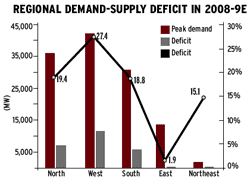
Power gives sleepless nights to millions of Indians. From ordinary consumers to industrialists and businessmen, from farmers to politicians, everybody faces problems because of the shortfall in the supply of this vital ingredient of economic growth. The total annual power shortfall in India is 15,175 megawatts (MW).

This gap could widen in the future. The generation capacity is increasing at a very slow rate, with a 5% annual addition in the past five years. On the other hand, the demand for power is galloping. The Power Ministry estimates that in another three years, the per capita electricity consumption will rise by 50%—from the current 672 KW to 1,000 KW by 2011-12. In 2007, the government had set a target of adding 78,000 MW of power generation capacity during the 11th Five Year Plan (2007-12). But two years down the line, only 15% of this target capacity addition has been achieved.

The Central and state governments are now offering sops such as 10-year tax holidays and import duty waiver on capital goods to attract investment in the sector. The recent move by the Central Electricity Regulatory Commission to increase the minimum return on equity from 14% to 15.5% and an additional 0.5% incentive for the timely completion of projects highlights the government’s resolve.

The sector: All this is good news not only for the power companies but also for investors in power stocks. The power industry is recession-proof. Power generation and distribution companies such as NTPC, Tata Power, CESC and Neyveli Lignite have clocked consistent earnings growth even during downturns. This is partly because they have always had an assured buyer, with the government buying the electricity that these companies produce.

Now, these firms need to worry about the timely arrangement of funds, tying up of fuel supplies and execution of projects. This is where prudence scores over reckless aggression. When the economy was doing well and funds were aplenty, many companies overstretched themselves and grabbed several large projects to garner a thicker slice of the pie. Now that the credit market has dried up, they are finding it tough to arrange funds and fuel supplies.
“The order flow is over. It is time to focus on execution. This will be the big driver over the next three years,” says Sumeet Agrawal, a power sector analyst at HSBC. Early financial closure and execution help in reducing the interest costs. “The winners will be those with operating experience, financial stability, and with projects that have achieved financial closure,” adds Agrawal.

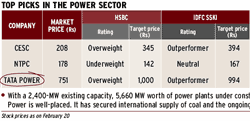
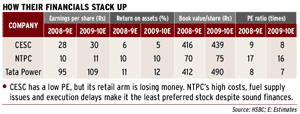
The stocks: For the analysts, CESC and Tata Power are the most preferred picks. CESC distributes electricity in Kolkata. It has 2.1 million customers and an installed capacity of 945 MW. The company plans to add 1,850 MW over the next three years, of which 250 MW is expected to be commissioned by September. “The company’s operational performance has been consistent over the years and we believe it will be maintained in the future as well,” says Shankar K., an analyst at Edelweiss. However, CESC’s diversification in non-core businesses like retail and real estate is a major concern. Analysts at India Infoline say the company’s retail arm, Spencer’s, is losing Rs 20 crore a month.

With an installed capacity of 2,400 MW, Tata Power straddles the value chain. The company distributes power in Delhi and Mumbai and has tied up with the Power Grid Corp to explore opportunities in transmission. “Tata Power’s healthy balance sheet puts it in a strong position to capitalise on emerging opportunities,” says Shirish Rane, an analyst at IDFC SSKI.

India’s largest power generator NTPC is the least preferred stock due to slippages in execution and fuel scarcity. The publi-sector unit plans to add 20,000 MW to its current installed capacity of 29,000 MW by 2011-12. But most of its plants are coal-based and analysts fear that the company will fall short of fuel supplies. NTPC plans to import around 10.5 million tonnes of coal in 2008-9 as its captive mines are still under development. “Fuel unavailability and execution delays have led to slippages in targets. This is likely to result in muted earnings growth in the medium term,” says Shankar of Edelweiss.