It has not been the
smoothest of rides for automobile companies and their investors this year. As industrial slowdown hits sales of commercial vehicles and stagnant incomes force people to defer car purchases, the sector is bracing itself for a long bumpy ride ahead.
This July marked ninth straight month of decline in car sales (down 7.4% year-on-year). Since January 1, the Bombay Stock Exchange, or BSE, Auto Index has fallen 13%. However, August brought some cheer, with companies reporting a 15.4% rise in car sales.
Market analysts say the industry is likely to remain under pressure till the current economic slowdown, compounded by high fuel prices and interest rates, persists.
On August 28, 10 out of 11 stocks in the BSE Auto Index were trading lower than their January 1 levels. Ashok Leyland was down 55% to Rs 12.10, followed by Bajaj Auto (19% to Rs 1,730), Maruti Suzuki (18% to Rs 1,236) and Mahindra & Mahindra (17% to Rs 777). Hero MotoCorp was the lone gainer (up 1% to Rs 1,913).
Besides the overall slowdown, there are other factors at work too. As Savitree Singh, senior equity research analyst, The Market, says, "Increase in fuel prices and import duties on commercial and sports utility vehicles are hitting sales." The Market gives advice on capital market instruments.
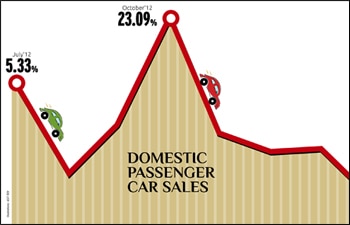
Domestic passenger car sales over the months
On August 28, the price-to-earnings, or P/E, ratios of Ashok Leyland, Maruti Suzuki, M&M and Bajaj Auto stocks were 14.31, 14.39, 13.42 and 16.35, respectively, lower than the five-year average of 15.83, 19.24, 16.30 and 16.42, respectively. P/E ratio measures how much the market is willing to pay for a stock compared to the earnings per share.
"Overall, auto stocks are trading below their mean valuations and and at attractive P/E ratios. However, in view of possible de-rating of market multiples due to the current economic crisis, the sector's multiples may also see a downgrade. To say that the sector is undervalued by looking at just history may not give the true picture," says Nishant Vass, auto analyst, ICICI Securities.
ROAD BLOCKThe sector has been facing a number of problems. One, economic slowdown and high inflation have reduced discretionary spending. Two, the increase in excise duties on various categories of vehicles has pushed up their prices. "The recent weakness in the rupee has hit Indiacentric companies such as M&M and Maruti Suzuki," says Vass.
Rupee fall increases prices of imported inputs as companies have to pay more rupees to buy dollars. This higher cost is difficult to pass on to customers. That is why companies such as Bajaj Auto which are big exporters are cushioned from rupee devaluation to an extent.
FOLLOW THESE RULESBesides factors such as the company's debt and technological edge, you must look at its exposure to different markets such as rural and urban along with contribution of exports to total revenue. "Research & development is also crucial," says Singh of The Market.
Ajay Shethiya, analyst, auto & auto ancillaries, Centrum Broking, says in this depressed market, one should look at segments that offer volume growth and stable pricing.
MILEAGE LOGGEDThe companies posted mixed numbers for the quarter ended June. The operating profit of Ashok Leyland fell 86% to Rs 35.51 crore from Rs 253 crore in the same quarter a year ago. Hero MotoCorp's operating profit fell 1.3% to Rs 1,027 crore from Rs 1,041 crore in the year-ago period.
Tata Motors, Maruti Suzuki and M&M reported operating profits of Rs 1,725 crore (up 50%), 1,370 crore (up 52%) and Rs 1,451 crore (up 24%), respectively.
According to an IndiaNivesh Securities report issued on August 22, the operating profit margins of automobile companies expanded due to better products, favourable rupee movement and falling raw material prices. While sales of utility vehicles were hit by an increase in excise duty, tractor demand rose on the back of good monsoon that is expected to push up farm output.
According to database Ace Equity, for quarter ended June 2013, tractor sales rose 22.9% to 1,86,958 units from 1,52,094 units in April-June 2012.
But what about the future? Most analysts paint a gloomy picture. "The uncertain economic outlook for 2013-14 has quashed hopes of revival in 2013-14, which has led to downgrade of volume expectations and, therefore, earnings," says Yaresh Kothari, research analyst, auto and auto ancillary, Angel Broking.
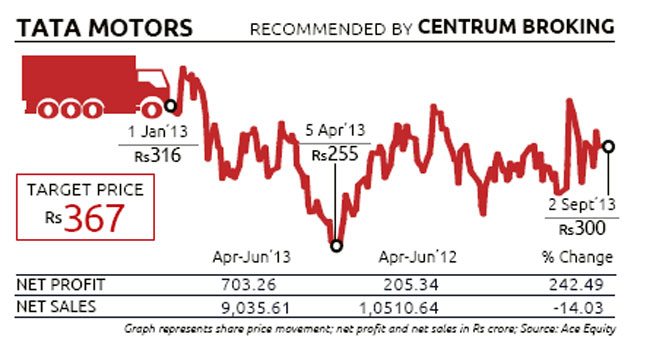
WAY TO GOTata Motors: Since the start of the year, the stock has fallen 3.31% from Rs 316.40 to Rs 305.90 (August 29). The company's net sales were Rs 9,035.61 crore in quarter ended June, down 14% from Rs 10,510 crore in the corresponding quarter a year ago.
Ajay Shethiya of Centrum says the stock can touch Rs 367 in the next few quarters on the back of demand for recently-launched vehicles and a strong product portfolio.
"Tata Motors' profile is skewed towards Jaguar Land Rover or JLR. JLR is well-placed for fast growth on the back of product initiatives and global presence. The stock provides a unique 'non-India' investing opportunity. We have a target of Rs 360 for the stock," says Vass of ICICI Securities.
On August 29, the stock was trading at a P/E ratio of 104.68.
Eicher Motors: Revenue has grown 34% a year in the three years to 2011-12. The company reported a revenue of Rs 1,173 crore in 2011-12 as against Rs 737 crore in 2010-11 and Rs 484.38 crore in 2009-10.
Since April, the stock has risen 23%, and was at Rs 3,152 on August 29. "Eicher Motors-Royal Enfield continues to motor along at a scorching pace as cruiser bikes catch on with young Indians. Eicher's Royal Enfield and commercial vehicle businesses are slated to see even better days. Strong earnings growth should help the stock command a premium. We have a target of Rs 3,850 for the stock," says Vass of ICICI Securities.
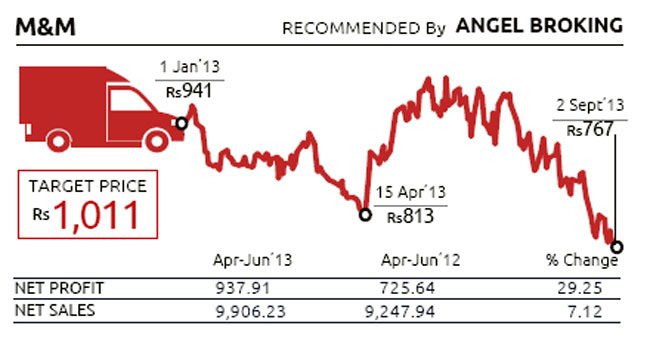
Mahindra and Mahindra:Yaresh Kothari of Angel Broking says the company's tractor sales, which fell 5% in 2012-13, are expected to rise 12% due to normal monsoon and good kharif output in 2013-14.
"We expect that strong growth in tractor sales will offset the weakness in the automotive segment. The stock can touch Rs 1,011 in the next few quarters," he says. On August 29, it was at Rs 793, with price-to-book value of Rs 3.12 and EV/Ebitda of 9.13. On the day, EV/Ebitda of peer companies such as Escorts and VST Tillers Tractors was 4.8 and 3.98, respectively. EV is enterprise value while Ebitda, also called operating profit, stands for earnings before interest, tax, depreciation and amortisation. The ratio can be used to compare the value of a company to that of another in the same industry. A lower figure indicates that the stock is undervalued.
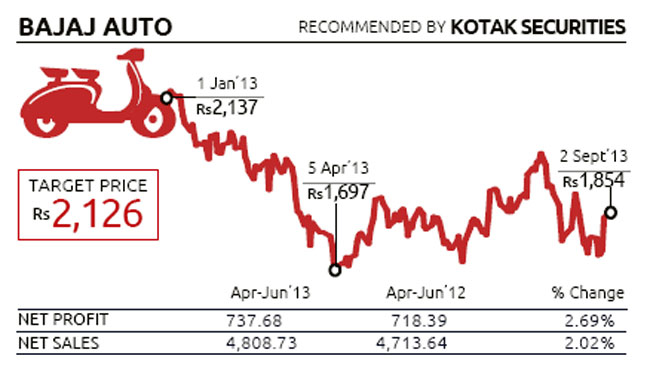
Bajaj Auto:The company reported a 2.7% rise in net profit to Rs 738 crore for quarter ended June as against Rs 718 crore in the same quarter a year ago. However, the stock fell 2.37% to Rs 1,741 between April 1 and August 29.
According to a Kotak Securities report released on August 29, Bajaj Auto's sales have been slowing since April. But two-wheeler sales may get a boost from the upcoming festive season, new launches and good monsoon. Also, new permits should lead to an increase in threewheeler sales in the near to medium term. The company is entering new export markets too; in this it should be helped by a weak rupee.
Kotak says the stock can touch Rs 2,126 in the next few quarters.
Hero MotoCorp:
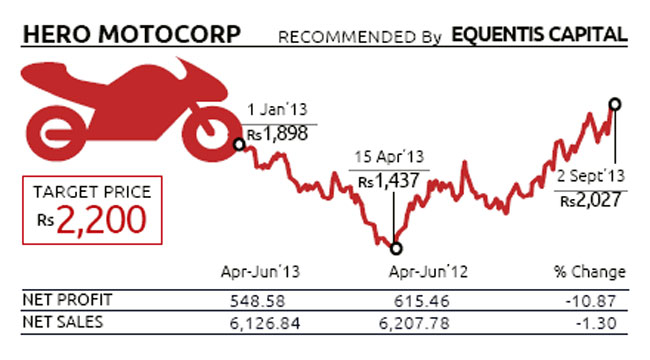
Market experts say good monsoon this year may increase the demand for twowheelers in rural and semi-urban areas, benefitting Hero MotoCorp.
"We expect the stock to be an outperformer in the next two quarters. It can touch Rs 2,200," says Vikram Dhawan, director, Equentis Capital.
"A weakening rupee will increase input costs and compress margins. However, the company's export thrust may offset the impact to an extent," he says. On September 16, the stock was at Rs 2,095, with a PE ratio of 20.40.