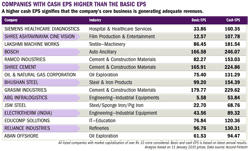
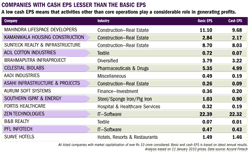
The deception caused by manipulated earnings can be overcome by considering basic EPS along with a variant called cash EPS. The cash EPS is calculated by dividing the operational cash flow of the firm by the number of outstanding shares. Some analysts also calculate it by adding depreciation and other intangible assets like goodwill and amortisation to the net profit, and then dividing the sum by the number of outstanding shares.
Valued Information
Cash EPS is derived from the cash flow statement of a company, which breaks up the cash flow into operating, financing and investing activities. Cash EPS gives the net result of the cash inflow and outflow of a company's daily operational activities. Cash flows are difficult to manipulate and, therefore, significant insights into a company’s affairs can be gained if we analyse the cash EPS and basic EPS.
A positive cash EPS implies that the company has more operating cash inflow than outflow, though it does not necessarily mean that it is generating profits. However, if the cash EPS is consistently high, it indicates that the firm is producing excess operating cash after deducting expenses pertaining to sales. While the basic EPS and cash EPS should be analysed together, there could be divergences. One may be positive while the other could be negative. Investors need to be wary of companies which have a negative cash EPS.
When alarm bells should ring
For identifying a good company, the basic EPS and cash EPS should always be analysed over a period of time. A company is considered superior if its cash EPS is consistently higher than its basic EPS. On the other hand, an in-depth investigation is required for companies where the cash EPS is consistently lower than the basic EPS.
A cash EPS which is constantly negative is not a good sign. Investors need to be vigilant when a company's basic EPS is positive but its cash EPS is negative. The reasons for this divergence could be unsold inventory or high account receivables. Since there is always a risk of account receivables turning into bad debts, investors should be cautious if such a situation arises within a company.
On the other hand, investors need not worry if the basic EPS is negative as long as the cash EPS is positive. The negative basic EPS could be due to depreciation and other non-cash expenses.