

Serpentine queues. Dusty corridors. Sweltering heat. Indifferent staff. Frayed tempers. Apathetic officials. Missing documents. And a deadline fast approaching. If you are a taxpayer you must have been there, seen that at income tax offices across the country around this time of the year. The seemingly endless wait in the queue is enough to push even the most easy going person into a furious rage.
Far from the madding crowd, Girish Behere is keying in his income details in the air-conditioned comfort of his house in Pune. Behere, 42, is filling up his tax return form online. “This is so convenient. Why didn’t they offer such an option earlier,” he says excitedly. Behere has been filing his tax return for the past 18-odd years. Each year he has gone through the rigmarole of finding a tax consultant, filling up the tax return form and then going through the excruciating ordeal of submitting the return at the nearest income tax office.
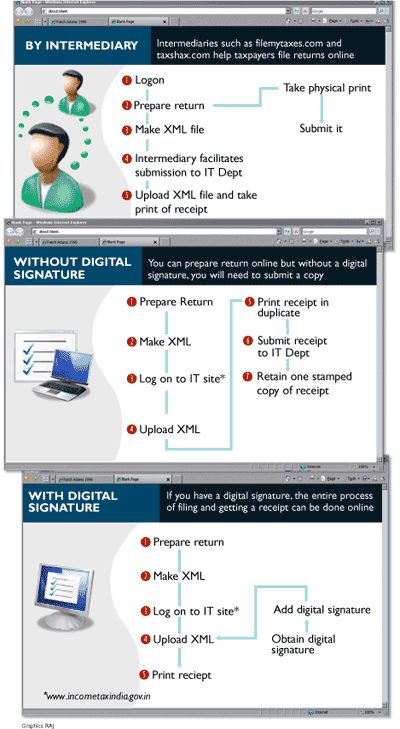
Well, not anymore. The new forms introduced in May this year mark a big stride towards e-filing of income tax return. Taxpayers can simply log on to the website of a tax return facilitator, fill up their relevant details and submit their income tax return. Behere, for instance, uses the services of www.taxshax.com, an online facilitator that handles individual’s tax returns for a small fee of Rs 175-525. Another facilitator is filemyreturns.com. To avail of the service, you have to log on to the website, register yourself and fill in your details in the form online. Says Manoj Sinha, co-founder, First Altus Resources and Networks, promoters of taxshax.com: “There is a step-bystep guide that even computes your tax liability.”
 E-filing of tax return is not new to India though. It was started in the assessment year 2002-3 when companies could do bulk filing of returns on behalf of their employees. But the scheme never gained popularity because employers were unwilling to take on the additional load of filing tax returns for their workers.
Now it is back in a new avatar that could redefine the way income tax is filed by individuals. The new tax forms are e-friendly because taxpayers don’t have to attach any documents such as Form 16, TDS certificates and proof of investments with them.
But it may not be as easy as it sounds—not as yet. For one, you need to have a digital signature to file your tax return online. A digital signature is a seal of verification which when appended with a file establishes the identity of the sender. Your digital signature cannot be used by someone else. The message with which it is appended gets automatically time-stamped. What’s more, it comes with a digital certificate from the issuing authority so the receiver knows that it is authenticate.
Right now, it costs about Rs 1,000- plus to get a digital signature which is valid for a year. That’s a steep price to pay for something which needs to be renewed every year. The cost and complexity of using the digital signature poses the biggest bottleneck to efiling of tax return.
There’s no need to fret even though you do not have a digital signature. You can still use the Internet to file your return. Just submit all your details online. The computer will then generate an acknowledgement form (ITR-V). You have to take two prints of this acknowledgement form and submit them at the income tax office. The receiving official will return one stamped copy to you, which will be your evidence of having filed your return.
That’s where tax consultancies such as taxshax.com and filemyreturns. com assume significance. They not only help you with the online filing of tax return but also submit the acknowledgement form at the income tax office. Their fees ranges between Rs 50 and Rs 500 depending on the services you seek. Delhi-based Shankar Roy is all praise for filemyereturn.com which gave him an additional benefit with the filing of return. “They helped me with a PAN application,” he says.
Online payment is easier. But you may still have questions regarding IT rates and exemptions that IT forms do not explain. To address this need the Central Board of Direct Taxes has recently started a weblog (blog) —http://incometaxindia.gov.in:8080/itblog/default/. Taxpayers can post queries, comments or discuss tax-related issues on the blog. Don’t expect tax authorities to reply to your queries, but the blog at least lets you share your tax problems or solutions with other taxpayers.
Helping Hand
E-filing of income tax return is now a reality. If you still feel intimidated by the elaborate entries, there is help at hand. The Department of Income Tax has authorised some 3,700 tax return preparers (TRPs) to fill up income tax return forms for individuals and file them. The TRPs have been trained and certified by the Central Board of Direct Taxes and NIIT and will do everything from computing your tax liability to filling up the form, even filing your return for you. All this for a fee of up to Rs 250. That’s a small price to pay for peace of mind.
What’s in it for the CBDT? More people in the tax net, better tax compliance and correctly filled forms. By helping people file tax returns, TRPs would help increase income tax revenues. To meet this objective, the CBDT is even willing to give them a slice of the collection pie. The slice is thicker in case of new assessees (3% of the tax collected). This drops to 2% in the second year and then to 1% in the third year. That’s over and above the Rs 200- 250 a TRP gets from the taxpayer.
But there is a bigger role for TRPs than filling up forms. As Finance Minister P. Chidambaram points out, there is tremendous scope for this “extended arm of the CBDT” to offer financial and investment advice to taxpayers.
He says TRPs will soon be in great demand from insurance companies, mutual funds and banks who would want them to peddle their products through these tax preparers.
Where can you find a TRP? Simple. Log on to www.trpscheme.com or call toll-free numbers 18001806448 (MTNL/BSNL) or 18001026448 (Airtel) to get their contact details. So, don’t wait till 31 July to file your tax return. Just get a TRP to do it right away.
—Rajshree Kukreti











