Recently, the Sixth Pay Commission recommended a handsome increase in the salaries of government and public sector employees. More importantly, as the hike is to be implemented with retrospective effect from 1 January 2006, the arrears of the salary will come as an unexpected, but welcome, lump sum. To reduce the burden on the exchequer, the government has decided to pay 40% of the arrears in 2008-9 and the remaining 60% in 2009-10.
Taxability of arrears
Expectedly, the recommendations sparked a debate on the inclusion of arrears in the taxable income for 2008-9, given the fact that 60% of the arrears would be paid in 2009-10.
According to the provisions of the Income Tax Act, 1961, the arrears of salary paid or allowed to an employee in the previous year by an employer or a former employer, if not charged to income tax in any previous year, are to be taxed under the head ‘salaries’.
As per law, 60% of the arrears will be due in 2009-10 as the employee’s right to receive and the employer’s obligation to pay arises in that financial year. Since the arrears are neither received, nor due in financial year 2008-9, they cannot be taxable in the same year. This argument was not conclusive as the use of the word ‘allowed’ in the relevant provisions suggested that salary is taxable in the year that it is allowed or fixed. As the salary was fixed in September 2008, a view was taken that all the arrears of salary should be taxable in 2008-9, including the 60% that was to be given later.
To clarify this, the Central Board of Direct Taxes issued a statement on 30 September 2008, according to which the tax on the first instalment payable in 2008-9 would be deducted in financial year 2008-9 and the tax on the remaining 60% paid in 2009-10 would be deducted in financial year 2009-10.
Tax benefit available
The arrears could lead to a higher tax incidence for the employees. As their total income will go up for the year because of arrears, they will shift to a higher tax slab. So if an employee had to pay tax at the rate of 20%, because of the arrears he may now shift to the 30% slab. A change in the income-tax slab will also result in a corresponding change in the rate and quantum of income tax and surcharge. The rate of tax payable for the year is mandated each year by the relevant Finance Act.
Government employees need not worry as relief is available. They can claim benefit under Section 89(1) of the Act and have the option to stagger their arrear income to the years to which it pertains, instead of considering it as income for a single year. Section 89 is a beneficial provision under Chapter VIII of the Act relating to ‘Rebates and Relief’. Relief can be claimed if the additional salary results in the employee being assessed at a higher rate than the rate at which he would have otherwise been taxed.
Simply put, the relief is calculated by spreading the arrears over all the years to which they pertain. These would include financial years 2005-6, 2006-7, 2007-8 and 2008-9, as the arrears are payable from 1 January 2006 to 31 August 2008.
How to compute relief
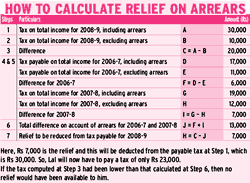
The relief under Section 89(1) is primarily an arithmetic calculation. It involves determining the tax for two different amounts. The first is the amount of tax applicable to the total income, including the extra sum in the year of receipt. The second is the amount of tax to be calculated by adding the arrears to the total income of the years to which they relate. The difference between these two amounts is the extent of deduction that is allowed.
If the taxpayer is required to pay an additional tax (in the year of receipt), more than what he would have paid had he received the money in the year(s) that he was supposed to have got it, this extra tax can be reduced from the payable tax.
Procedure for claiming benefit
The process of claiming tax benefits is simple. Government employees can claim relief in the income-tax returns that they file for the financial years in which the arrears are received. In this case, it will be for 2008-9 and 2009-10. There is a special facility for government employees or those of public sector companies for claiming relief. This can be worked out and allowed at the time of deduction of tax at source by their current employers.
For this purpose, the employee has to provide the necessary details and documents pertaining to the salary arrears to his current employer in Form 10E. However, the income-tax officer has the right to ask for an authentic statement of the total income of the earlier years to which the arrears pertain.
The authors are senior tax professionals with Ernst & Young.