
 If Richard Branson is to be believed, a whole new species has recently been discovered —the jetrosexual. These are folks who share a rare kinship with birds.
If you live out of suitcases, spend more time in an airplane than walking on the ground, and more time in an airport lobby than your own home, then you get that tag, irrespective of whether you are a business executive, a housewife, whose children live in different cities, or a modern day ibn Battuta.
An unexpected benefit of being a jetrosexual is the sheer number of frequent flyer programmes (FFPs) you automatically get enrolled in. At last count there were just short of 200 airline mileage FFPs worldwide. Indian passengers have it good too.
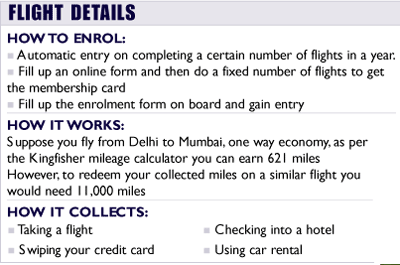
You can gain entry into the loyalty club by flying an airline just three times in a year, as is the case with Kingfisher Airlines, or collecting frequent flyer miles by swiping your credit card, utilising car rental services or checking into a hotel, like with Jet Airway’s FFP.
The truth is that mileage accrual these days depends less on the frequency of your flights, and more on how much you spend— both on your ticket and other partner services linked to your programme.
 So what’s the deal behind theFFPs? The good news is that FFPs offer perks such as increased baggage allowance, online conveniences, lounge access, priority for seat upgrades and free award tickets and a host of special offers when you’ve accumulated the prescribed threshold limit of brownie miles.
All the Indian airlines offering FFPs have all the details up on their websites, including a mileage calculator.
But do keep in mind that not every flight you take will earn you mileage points. That discounted economy ticket might make your wallet happy, but it may gather no miles. For instance, on most FFPs, the promotional fares earn 70% of the normal economy mileage points. The rule of the thumb is to look out for the fine print. The terms and conditions may be tedious to read but they could spell the difference between a savvy traveller and a disinterested moron.
Also look out for the distinction between reward miles and “tier” miles. Most FFPs work along similar principles. Air miles (earned by flying or buying services from FFP partners) make up the “currency” you need to redeem tickets. Tier miles, on the other hand, collected by actually flying, take you to higher membership levels. The higher your level, the more the benefits. While air miles remain valid for up to three years (if you don’t encash your free tickets in that block they expire), the tier miles are valid for a year and are reviewed annually. In order to retain tier status, members would require to fly a specified minimum number of times on the airline.
You have the miles. Now you need to book your flight. But with millions of frequent flyer air miles competing for a limited number of available redemption seats, this can be tricky. Redemption tickets occupy limited quotas on various flights and busy sectors can be hard to get onto; so pre-plan and book early. Airlines have reportedly awarded more than 19 trillion frequent flyer miles in the past 25 years. Are you getting your share?
Uncommon places, the affordable way
The destination: Rivertrail Eco-Camp, located in Roha. Just 114 km from Mumbai, this is a unique retreat focused on giving visitors a “back to the basics” holiday while encouraging the locals to participate in ecotourism. Reclining on the banks of the river Kundalika, Rivertrail is only accessible by a boat and once there, you get a feeling of almost living on an island.
Why go there: This is an ideal weekend break for nature lovers and adventure seekers. Take your pick from watersports like kayaking, riverrafting, canoeing and rivercrossing or birdwatching/ trekking or nature meditation or even playing with snakes. Oh yes, there are hammocks for the lazybones too.
Don’t miss: The chance to explore the tribal lifestyle of the Konkan region. The living quarters: The eco-friendly campsite has been built with nontoxic housing materials.There are two types of accommodation on offer: some river-facing cottages with attached baths and the waterproof tents with external toilet facilities.
How to get there: The camp is about a two-and-a-half hour drive down the Mumbai-Goa highway. Alternatively, you can take a train directly to Roha.
Damage to the wallet: A two-day package costs Rs 2,500 per person, all inclusive. Customised packages can also be arranged. Call 022-65248646 for more information.
(Next issue: All you need to know about co-branded travel cards.)













