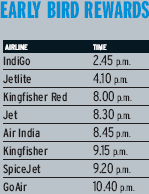
Yes, yes, we know taxes mean that even the cheapest Rs 9 fare works out to around Rs 2,000. But when everything else is costing the earth, it's good to see such down-to-earth fares, isn't it? Things are only going to get better. The industry consensus is that this year will see air fares come down significantly, courtesy lower aviation fuel prices and bottomed-out demand.
According to Dhruv Shringi, CEO and co-founder, yatra.com: "Lower air fares are here to stay, for this year at least. To get the volumes, fares have to be in the Rs 3,000-3,500 range, and that is starting to happen. Also, in 2009, we will see surcharges being lowered and extra taxes being waived." The Rs 200-400 shaved off the fuel surcharge, the pruning of base fares by 20-80% and a free or discounted in-flight menu on even the no-frills airlines make for excellent news. You can maximise these gains by following this comprehensive guide to flying smart.
Early bird advantage
| SpiceJet: Advance fares starting at Rs 99 |
| Jetlite: Apex fares starting at Rs 9 |
| IndiGo Airlines: Fly for Re 1 onwards |
| Jet Airways: 21-day apex fares from Rs 250 |
There are travellers who swear that last-minute booking gets you the best deal. Experts, however, disagree. They say that with airlines restarting the zero fare concept, it pays to book early. Airlines offer a better deal to early birds-apex or advance purchase fares in industryspeak- because it helps them to manage their inventories better.
Says Vikas Jawa, director, zoomtra.com, a travel search engine: "If airlines were to lower fares just before flight time, there would be a flood of people at the last minute. But airlines need an accurate estimate of the number of people and amount of baggage on a flight so that they can load the proper amount of fuel, meals and beverages. Hence, booking early is beneficial for both the airlines and the passengers."
In fact, if you book late, you may have to shell out a higher price. Says Michael Burke, general manager, Virgin Atlantic India: "Last-minute bookings typically end up increasing your total costs." That's not to say that you'll never get a good deal on a last-minute booking. It's a gamble and you can lose if the load factor of the flight is good. An impromptu survey conclusively puts this debate to rest. MONEY TODAY trawled five leading travel portals to compare the same-day travel fares of all available airlines with apex fares 21 days later. Here's what we found:
The right booking channel
Today, airlines often reserve their best deals and latest promotions for their own Websites. But, as Sameer Patil, head, marketing, arzoo.com, says, "An airline's Website will show only its own flights, whereas a travel facilitator gives you a much greater choice, allowing you to compare and book the cheapest and most convenient flight." In addition, travel facilitators offer several flexible payment options that an airline does not, ranging from payment pick-up from your doorstep to booking an international flight well in advance by paying25% of the fare and giving the rest in instalments, at no additional cost, right till the day before you board your flight. If you book through an airline, your payment options are limited to credit cards, debit cards and prepaid cards.
But, as the fare survey reveals, an airline's Website will usually quote the lowest fare. This price difference can range from as little as Rs 94 to nearly Rs 700, depending on the airline and flight timing. It's a good idea to use travel portals to research flights, but book directly with the airline. Here, a metasearch engine scores over the traditional portals; they constantly update fares from various sources but let you pay directly on airline sites. If you have a preferred airline, you can save time by directly visiting its Website. This is also the surest way to bag the seat of your choice.
Picking the best seat
The ideal way to get the perfect seat for the lowest possible fare is to sweet-talk your way into a free upgrade. Though Burke maintains that "there's no harm in trying since you never know where your quick wit and personality might take you", most industry insiders tell you to save your breath. One reason, says Amit Kapoor, AVP, business development (leisure), Travelguru, is that airlines usually offer seat upgrades only if their economy class is overbooked and there's room in the business class. "But here they always give preference to frequent fliers," he says. The only other scenario where you can bag a free upgrade, according to Noel Swain, vice-president, marketing and supplier relations, Cleartrip, is if there is a "service issue that the airline needs to compensate you for".
If you are a garden-variety traveller, as most of us tend to be, you need to rely on smart planning. Figure out the seats to avoid and the ones that offer most leg-room, and begin your search at seatguru.com. It offers comparison charts for six leading Indian carriers, with all the details you need. Typically, the best seats to gun for are the bulkhead seats, which are located directly behind the partition separating the economy and premier classes.
The biggest advantage here is that they provide extra leg-room, and with no seat directly in front of you, no one will encroach upon your space by reclining. Incidentally, if the flight has provisions for bassinets, they will be located at the bulkheads. If you are travelling with an infant, remember to specifically request such a seat. While SpiceJet allows you to choose your seat even before you enter your card details, most airlines now offer the web checkin facility that allows you to print your boarding pass up to 48 hours before you get to the airport.
Loyalty programmes
Do the frequent flier programmes really work? Globetrotting business consultant Chaitali Murdeswar has worked her way up to the highest tier of two frequent flier programmes in a year. "I especially appreciate the lounge access, which is a relief from the chaotic and loud lobby, the regular upgrade vouchers and the preferential treatment for seat allocation," she says. However, Kamalesh Chandra is thoroughly disenchanted with the scheme. As a frequent flier, he got free tickets to Goa from Air India, which he gave to his daughter. But the flight was cancelled at the last minute without any warning. "That's when all the talk about preferential treatment went flying out of the window. She was told that only those who had purchased a ticket would be accommodated on the next available flight. Apparently, those with free tickets had to try and use the ticket on the same sector within six months," he says.
The only way to circumvent such problems is to plan and book in advance, opting for lean seasons and low business traffic hours. Read the fine print and ask airline officials to clarify any questions you may have before you sign up for such programmes. Another common mistake is to waste the opportunity to accumulate as well as burn reward miles with partner brands. The Jet Airways' programme now includes Jetlite flights too, which translates to big savings while keeping those miles coming in. If you are travelling abroad, or to places not covered by your airline, opt for one of the partner airlines to make the most of your travel spending and follow it up by checking into a partner hotel. Keep an eye out for new partnerships. For instance, Kingfisher Airlines has recently announced its alliance with Hilton HHonors, the guest reward programme for over 3,000 Hilton properties worldwide. The USP of this alliance is that it lets the members accrue both hotel points and air miles for the same tour.
Plastic pays
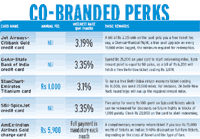
If you don't travel frequently and have been stuck at the basic category of the frequent flier programme for longer than you care to remember, you might find solace in your credit card. One of the surest ways to bag exclusive-and regular- travel privileges is to sign up for a premium credit card. If the colour of your plastic is black or platinum, you not only get access to a 24x7 travel desk but also bag freebies like airport transfers, discounts on your companion's fare, hotel deals and more. The only problem is that you either have to be invited to this club or have to shell out hefty joining and annual fees. So the next best, and infinitely cheaper, plastic option is to sign up for a co-branded travel card. If you are a frequent traveller who prefers to live on credit, it makes sense to look for a rewards programme that gives you maximum airline benefits. Most of these cards come without a joining fee and the reward points you earn can be redeemed for free tickets with the affiliated airline, seat upgrades, even hotel stays.
Ultimately, the rule of thumb is to look beyond the air fare. Because flying smart is not just about landing the cheapest fare, but about travelling in comfort while maximising savings, and, if possible, accruing reward miles along the way.
Tips to bag the cheapest air fares: