
Consider this: you own a three-year-old health insurance policy. Since you haven't filed a single claim so far, you have been enjoying a regular no-claim bonus. If there is no insurance claim, many companies offer a bonus where the sum insured increases by 5% for each claim-free year. Then you learn of a new policy offered by another company that serves your needs better. Of course, you want to jump ship, right? But you can't switch to the new firm taking the accumulated bonus with you because under the present norms, the ability to shift policies between companies—portability, in insurance parlance—is not allowed. So if you pick a new policy, you have to start the bonus accumulation process from scratch.
| What Portability Means |
|---|
| • Policyholders will be able to shift policies between companies. |
| • The insured can carry over the no-claim bonus to a new policy. |
| • Policyholders get immediate coverage of pre-existing ailments from the previous policy. |
| • Group mediclaim policies unlikely to be portable products. |
The good news is that this scenario may soon change. "Insurers have reached a consensus and the recommendations will probably be sent to the regulator (Irda) in January," says M. Ramadoss, chairman of the Oriental Insurance Company and a member of the General Insurance Council. Insurance portability will come into effect by April 2009, he adds.
Once in place, the portability clause would introduce spillover benefits for policyholders. For instance, if a policy covers pre-existing ailments only after four years and a policyholder decides to shift to another company in the fourth year, he will receive an immediate coverage of pre-existing ailments instead of having to wait for another four years. Also, if your original policy did not allow you to file claims for any pre-existing diseases for three years and you switch to another policy in the fourth year, you will be allowed to file a claim on pre-existing diseases in the same year that you take the new policy.
Unfortunately for employees, group mediclaim policies are likely to be a part of non-portable products. This means that an employee covered under a group health policy will be treated as a new prospect when he goes to buy a policy after retirement. "Group policies differ greatly from individual covers. Many group policies have a wide coverage as they cover pre-existing ailments and do not underwrite individuals. Such policies would not be portable or work with individual policies," says Shreeraj Deshpande, head, Health and Travel Insurance, Bajaj Allianz General Insurance.
In addition, if the Insurance Laws (Amendment) Bill 2008 is passed, no insurer will be allowed to reject a claim if the policy has been in existence for five years. This is sure to be music to the ears of scores of life insurance policyholders.
Word's Worth |
|---|
"I would hold back on any asset creation for now. Conserving cash should be the motto." "In the next three to six months, floating interest rates are likely to fall further. Defer buying a house or taking a car loan." "The Indian rupee has a strong potential to outperform other regional currencies by late 2009 and early 2010." Source: Hindu Business Line, Business Standard and Bloomberg |
Spending Is Out
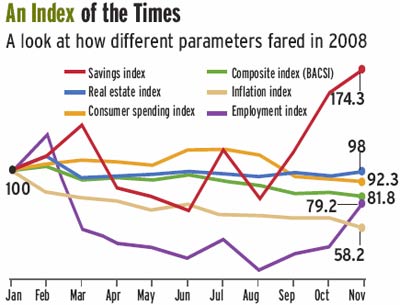 The overall economic slowdown is affecting consumer sentiments too. The Boston Analytics Consumer Sentiment Index, which tracks behaviour of 7,500 consumers across 13 cities, hit a 11-month low in November.
This survey is a monthly barometer of the Indian consumers’ opinion on the current state and expectations of the macro economy, household financial conditions and consumption. Among the sub-indices, while the inflation and savings indices are up, employment and consumer spending indices are down.
"The index has been declining since June, signalling consumer pessimism and fear about the current and expected state of the economy," says Shirin Bagga of Boston Analytics. According to him, an increasing reluctance and indecisiveness in spending on big-ticket purchases such as durables, automobiles and homes is also pulling down the index.
A Sweet Deal
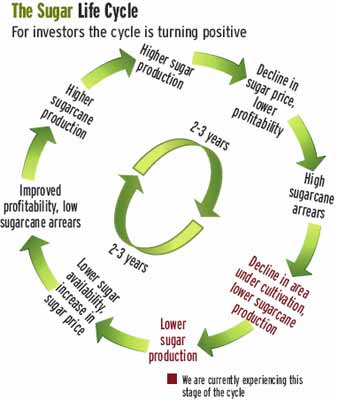 This year may be a bitter one for some as sugar prices are headed upwards. But the corollary is that the mills, and their stakeholders, are in for a treat. According to analysts, the diversion of cultivation area for crops like wheat and paddy is expected to reduce cane acreage by 17% in 2008-9 and a further 6-8% in 2009-10. This is expected to result in lower production of sugar, thereby increasing its price.
While the buffer stock from previous years will help India tide over the impending crunch, the fall in reserve stock will lead to higher sugar prices. "Lower production will continue for a couple of years, firming up the prices of sugar. We expect the average price to be Rs 1,900 per quintal in 2009," says Tushar Manudhane, analyst at Prabhudas Lilladher.
However, not all shareholders of sugar firms are expected to benefit evenly. The mills based outside Uttar Pradesh, like Shree Renuka Sugars, are better off as they don’t have to pay higher cane prices, as is done by Bajaj Hindustan and Balrampur Chini in the state. Also, high debt and huge arrears may curb the earnings capability of UP-based mills. Analysts at India Infoline expect an earnings CAGR of 29.5% over 2008-10 for Shree Renuka. Time to sweeten your portfolio?
Telling Figures |
|---|
| Numbers speak louder than words. MONEY TODAY highlights some numbers with a short- or long-term impact. |
| 43% is the growth in fringe benefit tax collections in 2008, up from 2007. This, despite firms slashing fringe benefits because of the slowdown. |
| 3% is the predicted drop in global air traffic in 2009, the first since the 11 September 2001 shock. |
| 30-40% is the projected recovery in the markets in 2009, according to a Motilal Oswal study. |
| 200% is the growth likely to be notched by the insurance sector by 2009-10, which amounts to Rs 2,000 billion. |
| 5,000 is the number of salaried taxpayers earning over Rs 1 crore in fiscal 2008, up from 2,200 in fiscal 2006. |
Protect Your Cards
Today all banks offer fraud protection on their financial cards. But what about the other cards in your wallet, be it store, loyalty or membership ones? In the face of a growing identity theft threat, all your plastics need protection. Citibank takes the lead here.
Says Sandeep Bhalla, business manager, Cards, Citibank India: "Regulators have strongly urged the banks to introduce a cover to take care of the liabilities arising from lost cards, and we now provide such a solution."
The CPP Card Protection plan, offered in two variants, covers fraud loss up to Rs 1 lakh before notification (up to seven days) and Rs 20 lakh after notification. Other benefits include hotel expense and replacement travel ticket advance. The annual fee is Rs 995 for the Classic plan and Rs 1,295 for the Premium plan.
Triple Advantage
Policy Snapshot | |
|---|---|
| Policy scope | Nine critical illnesses, including cancer, stroke, paralysis or any coronary dysfunctions |
| Applicable load | 2.5% |
| Entry age | Minimum: 18 years Maximum: 45 years |
| Insurance cover | Up to Rs 10 lakh |
| Minimum investment | Yearly SIP (systematic investment) of Rs 10,000 up to the age of 55 years |
After Sebi gave mutual funds the green signal to offer insurance through their investment vehicles, fund houses are now lining up innovative features to enable investors to meet their insurance and investment needs through one product. The latest among them is the Birla Sun Life Tax Relief 96 plan, which, besides offering tax benefits under the Equity Linked Saving Scheme status, has introduced a unique cover for 'critical illnesses' linked to the investment amount in the fund.
"The fund will now take care of three financial planning priorities for investors—tax management, wealth creation and health needs, with insurance for critical illnesses," says Anil Kumar, CEO, Birla Sun Life Asset Management. Through this plan, an investor can avail of critical illness insurance of up to Rs 10 lakh against nine such ailments, including cancer, stroke, paralysis or any coronary dysfunction, till the age of 55 years.
This feature, however, is not available for one-time investments. Investors needs to commit a minimum yearly SIP of Rs 10,000 for the entire tenure of the plan. In the first year, the critical illness cover is only two times the yearly SIP investment. But after the fifth year, the critical illness insurance is 10 times the investment amount. The only additional cost is the applicable load of 2.5% and all investors within the age group of 18 and 45 years can avail of the benefit after signing a good health declaration.
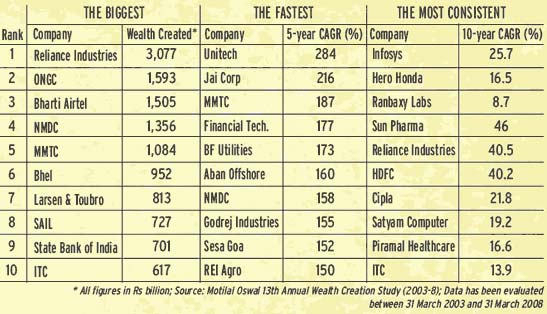
The top 10 wealth creators (2003-8)
A look at the fastest wealth creators shows that, at times, fad investing (like real estate) and momentum investing (like commodities) can make big money in the markets in the long run.













 "The market is like a harem. One can pick and choose from plenty of options... Banking is one sector to watch out for."