By the time you read this, airlines would have tacked on a new fee to their fares. The transaction fee, scheduled to be introduced on 1 November, will add Rs 350 to economy fares, Rs 500 to business class fares and up to Rs 10,000 on international flights. This comes on the heels of at least seven price hikes in this year alone. To compound the consumer misery, there are fewer flights to choose from—domestic airlines scrapped more than 2,000 weekly flights in July alone.
Then again, in a few months’ time, there may be fewer airlines to choose from. The wave of mergers and acquisitions since 2007 is likely to see the demise of smaller players apart from the reduction in flights. In fact, Raghu Menon, chairman, Air India, has gone on record to say that no more than four or five airlines will survive the downturn.
All of this may have come as a nasty surprise given that till June last year the aviation sector was boasting Rs 0 fares, 40% growth in passenger numbers and dizzying expansion. Sure, airlines were posting losses—Jet Airways lost Rs 2.53 billion last year and Kingfisher recently reported a nine-month loss of Rs 1.88 billion—and aviation turbine fuel prices have been an omnipresent worry, up 54% since October 2007 despite the recent cuts. But that is hardly news. So why the sudden brouhaha, pink slips, fewer flights et al?
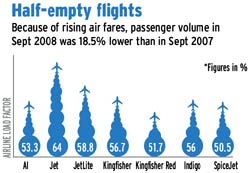 The current state of affairs is a natural progression of events, not an overnight development. The global market contraction just brought matters to a head by inflating the already staggering airline losses. These losses are a result not only of the spiralling ATF prices—made worse by the fact that jet fuel in India is about 60-70% more expensive than in other parts of the world thanks to duties and taxes—but also of nearsighted strategies. These included the decision to wage a fare war to gain market share. It seemed like a reasonable strategy if the volumes went up, but backfired as the demand slumped.
The problem became messier as airlines went shopping for more and more aircraft. The assumption was that supply would create its own demand. But it only led to near-empty flights when the Great Indian Middle Class decided to take a break from holidaying and splurging. The expansion streak had another negative impact: over-hiring and overtly fat pay-packets.
A reality check prompted by the global meltdown forced the airlines to consolidate. Apart from the M&A activity, which saw the birth of JetLite and Kingfisher Red, many carriers are signing agreements with regional players, like the GoAir-MDLR Airlines pact. This is an attempt to adhere to archaic aviation laws—airlines have to reserve a percentage of seats for non-profitable routes like the Northeast and J&K—without investing in low-load, high-cost sectors. Now we are in the second phase of consolidation, which recently saw Jet and Kingfisher sign an alliance to reduce costs. The LCCs are likely to sign similar pacts in a survival bid. Such a decision to pool resources is bound to lead to lay-offs and fewer flights.
It’s a pity that the common man, who had just begun to sprout wings, will be grounded in the process. At least till the market finds its equilibrium, both in terms of fares and capacity.
What the future holds for the...
Consumers
>> Independent, low-cost carriers may be on their way out.
>> Airlines are expected to move away from the no-frills structure.
>> Air fares are likely to continue to remain high in the near future.
>> Flights on some routes may be cancelled, or their timings altered.
>> Options like charter flights and fractional ownership will find more takers.
Investors
>> Industry is likely to be in the red for the next 18 months.
>> Opportunities from potential mergers and takeovers.
Industry
>> Re-evaluation of new aircraft orders.
>> Fleet and route rationalisation to correct excess capacity of over 30%.
>> Mergers and acquisitions and coordination with other airlines to pool resources.
>> Concessions on fuel taxes.
Employees
>> A reduction of at least 10% in staff salaries. Salary costs typically form about 15% of the total operating cost of an airline.
>> Job prospects are likely to fall courtesy fewer flights and staffsharing agreements between the airlines.
— Sushmita Choudhury
Word’s worth — Manmohan Singh, Prime Minister “The firms that performed in the earlier bull run—for example in the capital goods sector—might not be the best bets due to high interest rates, large capex and muted growth.” “Investors want to get out of risky positions and gold has been the beneficiary.” “This is the right time to buy property. High interest rates have kept the prices from going up by at least 15%. Prospective buyers can also bargain for a 15-20% discount. That is a 30% benefit.” Source: The Economic Times, Reuters and Rediff money |
Realty check
In a SlumpThe advance booking amount is falling | |||
| 2006 | 2007 | 2008 | |
| DLF | 21 | 17 | 8 |
| Purvankara | NA | 44 | 17 |
| Sobha Developers | 47 | 9 | 11 |
| Unitech | 180 | 69 | 59 |
| Figures show customer advances as % of capital employed Source: Deutsche Bank | |||
If you thought you’d begin the countdown to 2009 in your brand new flat, you may have to put your plans on hold. The fund crunch in the real estate sector, coupled with the slowdown in sales, has forced many developers, including the bigger ones, to delay their ongoing projects. This, in turn, has pushed back the possession date for those who had bought property in these projects. The situation is equally dismal in the office space segment.
According to the latest CB Richard Ellis quarterly report on office space, “There was a marked slowdown in demand. Office space leasing, that had moderated in the first two quarters of the year, further tapered during the current quarter.” This state of affairs is unlikely to change anytime soon because the fund crunch is becoming increasingly severe. On the one hand the advance booking amount from the customers has gone down substantially, and on the other hand, the equity market or the FDI route is not attractive anymore.
But while developers in India have been facing a hard time, Bollywood’s King Khan has teamed up with a UAE-based real estate firm to launch a $2.17 billion signature beachfront residential project in Dana Island, Ras Al Khaimah. The project, called Shah Rukh Khan Boulevard, will be a beachfront community, comprising 10 residential towers, scheduled for completion in 2012. This is the latest in the series of signature developments that are coming up in Dubai with names such as Brad Pitt, Boris Becker and Tiger Woods regularly doing the rounds.
— Rakesh Rai
End of 0% loans?
Retail Credit CrunchRetail lending has slowed, but these are the worst hit | |||
| Year up to June (Rs cr) | YoY growth | ||
| 2007 | 2008 | ||
| Auto loans | 86,000 | 87,000 | 1.16% |
| Consumer durables | 6,000 | 4,000 | -33.33% |
Most people hoping to buy anything, be it a car or a consumer durable, wait for September and the start of the festive season. For that is when most consumer durable companies announce freebies, running the gamut from price cuts to zero percent finance for their products. However, this time around, your wait has most probably been fruitless. Higher interest rates and the banks’ decision to go slow on lending have combined to apply the brakes on what was, till 2007, the fastest growing segment for loans.
While the growth rate has slowed down across all segments of retail lending, loans for consumer durables and vehicles have been hit the hardest. Worse, most manufacturers, including LG, Haier and Canon, are planning to increase prices after Diwali. “The depreciating rupee has a negative impact on traded products and is putting pressure on the bottom lines. Some of the burden will have to be passed on to consumers,” says George Menzes, COO, Godrej Appliances.
— Rakesh Rai
Telling figuresNumbers speak louder than words. Money Today highlights some numbers that have a short- or long-term personal finance implication.
$450 billion is the amount expected to be spent on the country’s infrastructure over the next eight years. Infrastructure funds are the place to park your money in. $500 billion is the estimated size of equity assets to be managed by Indian mutual funds by 2017, 14 times the current levels, fuelled by a wealthier, risk-tolerant population. $130 million is the number of credit and debit cards circulating in the country. The latest Celent report, Payments in India, estimates that this figure will grow to 210 million by 2010. |
Protecting health and wealth
Policy snapshotEntry age (years): 18-55 for adults and 5-17 for children Premium: Rs 18,000 or nine times the morbidity charge for a policy tenure of 10-14 years or seven times the morbidity charge for a policy tenure of 15-40 years Fund options: Six variants across debt and equity Policy tenure (years): 10-40 Daily hospitalisation (Rs): 500-3,000 |
If you were to land in a hospital for even a short period of time, the rising healthcare costs could throw a spanner in your best laid financial plans. Given the latent demand, it is not surprising that over five long-term health-related insurance plans have been introduced across insurers this year. The latest to join the bandwagon is Tata AIG Life Insurance with its InvestAssure Health policy.
What makes one take a second look at this comprehensive health policy is the whopping 946 surgeries that it covers. Even better, there is no limit to the number of claims for surgery. In addition, there is the hospital cover that offers a lump-sum benefit for each day of stay in hospital—120 days on a yearly basis and 730 days on a lifetime basis. Says Trevor Bull, managing director, Tata AIG Life: “We wanted to create a product that gives policyholders a dual sense of comfort— protecting health and wealth.”
Designed on the Ulip platform, the policy takes future medical inflation into account. This issue can be addressed through the investment component of the premium that one pays. It also comes with maturity bonus that ranges between 2% and 4% of the fund value and offers tax benefits under Section 80C as well as Section 80D. The concept of a morbidity charge is taken into account to arrive at the hospital benefit that an individual can opt for. If you don’t have a health insurance plan, consider looking at this one—it is available for up to 40 years from the date you commence the plan.
— Narayan Krishnamurthy
Your verdictWe bring you the results of Money Today online poll on select and current investing issues. Our question Your answer Only one in three Indians has a retirement plan in place, but clearly they understand its importance Conducted between 2-22 October. Total responses: 668 |