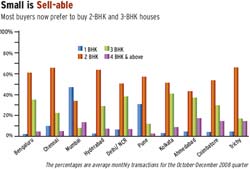
With the economic downturn hitting the housing sector hard, the people aspiring to buy homes must continue to wait and watch. However, when it comes to affordability — whether you are waiting for prices to come down or take a home loan, or even if you are repaying one — this year is turning out to be better than the previous one.
The recent cuts in the repo rate and cash reserve ratio by the Reserve Bank of India have meant that a slew of banks have slashed their home loan interest rates. Until now, the advantage was limited to fresh loan seekers. Not anymore. The LIC Housing Finance has been among the first to extend lower rates to its existing customers—the company recently cut its rates by 0.75%. The interest on floating rate loans ranges between 8.75% and 10.75%, depending on the loan amount. "These revised rates are the lowest in almost two years," Says R.R. Nair, director and chief executive officer, LIC Housing Finance.
More recently, HDFC has reduced its retail prime lending rates by 50 basis points. "In the current environment, there is a time gap between the reduction in the marginal cost of funds and the portfolio cost," says Renu Sud Karnad, joint managing director, HDFC. "The marginal cost of borrowing had come down earlier this year and the same was passed on to our new customers through our special limited period offer (rates beginning at 9.5%). We are now seeing a reduction in the costs on a portfolio level," she adds.
BUYERS GAIN |
|---|
| DLF: Reduced prices for projects in Bengaluru and Chennai. |
| Unitech: Launched low-cost projects in Mumbai at Rs 9,900 per sq ft; market rate in the area is Rs 18,000. |
| Omaxe: Launched projects close to Delhi in Rs 7.25-lakh range. |
| Lodha: Broke the sub-Rs 2,000 per sq ft price barrier in Mumbai with the launch of 6,500-unit project at Dombivili, 50 km from the city, at Rs 1,998. |
After the downswing in the home loan interest rates, the property prices have begun to show a similar trend. While discounts (on the quoted rates) have been offered for six months now, developers have begun reducing the quoted price on new project launches, even if it means refunding part of the amount to investors who had bought earlier at higher rates.
DLF has launched two projects, in Bengaluru and Hyderabad, in the past three months in the price range of Rs 1,850-1,890 per sq ft. "These prices are lower than the prices in 1998," says Rajeev Talwar, executive director, DLF. Similarly, the project launched recently by Unitech in Mumbai is selling at Rs 9,900 per sq ft compared with the market rate in the area, which is Rs 18,000 per sq ft. "Unitech is focusing on the affordable housing segment since the demand for the luxury segment has come down significantly," says a company spokesman.
"The market might not be bouncing back as yet, but because of these project launches, the movement has begun. This is providing confidence to the buyers," says Anshuman Magazine, CMD, real estate consulting firm CB Richard Ellis.
Whether the new projects will actually be delivered on time will depend on how well the companies raise finances to complete them. In the past three years, some developers have bid for prime land and are now paying for their optimism. While the acquired land has been losing value, the sales in existing projects have not picked up.
Recently, real estate developer BPTP Group backed out of the country's most expensive land deal worth over Rs 5,000 crore with the Noida Authority in Uttar Pradesh due to the unavailability of funds. DLF, which has paid large advance payments to various governments for townships and commercial projects, is now looking for refunds. Delhi's mega convention centre to be built by DLF has been scuppered as the government is unwilling to let DLF seek a foreign equity partner. Emaar MGF, the developer for the Commonwealth Games project in Delhi, wants a rescue package from the government because it could not raise enough funds from the sale of flats.
So, as far as the potential property buyer is concerned, apart from looking at the lower rates being offered, it's the track record of the developer that must be factored in.
— By Rakesh Rai and Sushmita Choudhury
AFFECTING BUSINESS | ||||
|---|---|---|---|---|
Total Mcap | FF Mcap* | Change in weightage | ||
Winner | NTPC | 8.15 | 1.94 | -6.21 |
| ONGC | 9.09 | 5.33 | -3.76 | |
| Bharti Airtel | 6.25 | 4.66 | -1.6 | |
Loser | ITC | 3.6 | 8.17 | 4.56 |
| Infosys | 4.13 | 7.81 | 3.69 | |
| HDFC | 2.43 | 5.51 | 3.08 | |
| Companies with high promoter holdings to lose out, while those with high floating stock but lower market cap stand to gain; Figures in % as on Mar 24; free float as per shareholding pattern in Dec 2008. | ||||
EXTENDED MARKET HOURS | ||||
| The current status | ||||
| • Some international exchanges have derivatives trading for 10-15 hours. | ||||
| • In some cases, timings go up to 24 hours through multiple trading sessions. | ||||
| • In India, trading takes place for five-and-a-half hours in a single session. | ||||
| Advantages | ||||
| • Investors will be able to hedge the risk arising from global information flow. | ||||
| • Will reduce volatility owing to global factors. | ||||
| • Will enable investors to take positions over a longer time window. | ||||
| Disadvantages | ||||
| • The cost for brokers will go up by 40-70%. | ||||
After Hours
Market regulator Securities and Exchange Board of India (Sebi) has sought opinion from the public and market players on its proposal to extend trading hours. With cross-border investment a fact, increasing trading hours seems well-intentioned. It will align the Indian markets with other financial hubs, making the country an option for both East (Singapore) and West (North America).
The move comes after a request by the National Stock Exchange (NSE) to Sebi to start the trading of the index contracts futures at 8 a.m. instead of at 9.55 a.m. The reason: NSE futures is also listed on the Singapore Stock Exchange (SGX), where trading starts over two-and-a-half hours before the NSE. The move has resulted in a shift of nearly 40% of Nifty futures volumes from India to Singapore. "Trading could start at 8 a.m. and end at 6:30 p.m. so that Indian markets could align better with Europe, the US and other Asian markets," says Sudip Bandyopadhyay, CEO, Reliance Money.
However, as Nirmal Agarwal, president of the Association of NSE Members (ANMI), says, "Futures volumes shifted to SGX not only because of the differential in trading hours but also due to higher trading costs in India."
He is part of the section that is not in favour of the extension of hours. This group feels that India's trading infrastructure— banking and clearing systems—won't be able to accommodate an increase in the number of hours. While Indian cash and equity derivative markets are open for less than six hours a day, extending market timings past 3.30 p.m. won't matter if the banks that clear transactions are closed.
People also feel that the longer trading session would lead to chaos. The concept of real-time gross settlement of payments is not available at many bank branches. Though higher liquidity is important for financial markets, Sebi should focus on renovating the market structure, which includes market makers, clearing and banking systems that operate at the push of a button. If trading hours are extended without ramping up the infrastructure, trading costs could soar—this would hinder liquidity and defeat the purpose of the move.
— By Narayan Krishnamurthy
Health Planning
If you are looking for value addition or guaranteed products, check out HDFC's SurgiCare and Max New York Life's Unit Builder.
Cash in hospital
HDFC SurgiCare | ||||||
|---|---|---|---|---|---|---|
| Indicative annual premium for initial sum assured of Rs 2 lakh | ||||||
Policy term | ||||||
Option A | Option B | |||||
| Age | 7 yr | 10 yr | 20 yr | 7 yr | 10 yr | 20 yr |
| 30 | 3,992 | 4,024 | 4,044 | 2,536 | 2,542 | 2,562 |
| 40 | 4,992 | 5,090 | 5,610 | 3,256 | 3,348 | 3,848 |
| 50 | 7,948 | 8,344 | NA | 5,258 | 5,648 | NA |
| Excludes service tax and education cess; Option A is with hospitalisation cover, while Option B is without it | ||||||
The increase in the cost of diagnosis, treatment and management of a health problem has meant that buying health insurance is no easy task. But the changing landscape of the insurance industry has made it possible to choose from a plethora of value-added products. SurgiCare, launched by HDFC Standard Life, aims to provide additional value by offering a fixed benefit in the event of hospitalisation, as well as the option to choose a long-term cover.
The policy covers an individual for 82 surgical procedures and provides an assured lump-sum benefit on hospitalisation. "These benefits are paid irrespective of the expenses and irrespective of whether he received payments under any other insurance policy," says Fredrick D'Souza, senior VP, health, HDFC Standard Life. The policy also offers a hospitalisation cash benefit option: the benefit payable per day ranges from 1% to 2% of the annual sum assured. It provides a cashless facility in network hospitals and an automatic increase in health cover by 5% every year, with a cap of 50% of the initial sum assured.
— By Tanvi Varma
Multi-fund option
Unit Builder Factfile |
|---|
| Entry age: 7-50 years |
| Maximum maturity age: 70 years |
| Policy term: 11, 15 and 20 years |
| Minimum premium: Rs.12,000 pa |
| Fund option available: 3 |
Guaranteed products are the flavour of the season and Max New York Life's Unit Builder follows this trend. Like any other Ulip it allows you to choose the premium amount, policy term and investment funds. The insurance takes care of risk cover and investment for wealth creation. It also offers a guarantee of up to 200% loyalty additions to the first-year premium at maturity or death for policies of 20 years or more. The policy offers three fund options: secure, balanced and dynamic.
"This policy is designed for our partnership distribution and bancassurance channel and is a good way to tackle volatility," says Debashis Sarkar, senior director & chief marketing officer, Max New York Life Insurance. The plan is restrictive as only those who go with Yes Bank or Peerless will be able to opt for it initially, though the company plans to extend it. Moreover, with the first-year premium not allocated to investment funds, the benefits start only from the second year after deducting premium allocation charges. Though the dynamic fund option sounds interesting, the discretion of the fund manager to shift between asset classes brings in ambiguity.
— By Narayan Krishnamurthy
Claim clarity
In two separate judgements this month, the National Consumer Disputes Redressal Commission has clarified the basis on which an insurance company can reject a claim. In the first ruling, the commission said that a "categorical finding", not a mere opinion, must be recorded by the surveyor to negate a claim. "The surveyor has not recorded a categorical finding... rather he has used the words ‘might have happened', which is in the realm of conjecture, probability, guesswork or uncertainty," said the bench headed by Justice Ashok Bhan.
In another judgement, the commission said that the concealment of material facts on health can be reasonable grounds for repudiating a policy claim. "LIC was justified in repudiating the claim of the petitioner as the deceased had suppressed material facts while taking the policies, as well as while reviving them," said the commission in its judgement.
— By Rakesh Rai
Inelastic Plastic
The days of being inundated with phone calls for a new credit card may be over, but it could be a mixed blessing. Cardholders now face the prospect of pruning of their existing credit limits. Also, with banks upping their ante on entry norms, new prospects are finding it tough to get cards. So, unlike previously, a salary of less than Rs 20,000 a month is unlikely to net a card. Bankers don't want to lend to customers with a low salary because the risk of default is higher. In fact, foreign banks have set the limit as high as Rs 10 lakh per annum.
The verification process too has been tightened: you can't get a fresh card on the basis of an existing card, or for that matter, past repayment history. With easy availability of credit history with CIBIL (Credit Information Bureau India Limited), one's borrowing history, credit score, defaults, delays and the number of existing credit cards will be taken into account while issuing new cards.
"Overall, the economic slowdown has strained the unsecured lending space. This has increased the risk of overleveraged credit card customers being potential defaulters. These customers were also high revenue contributors to the credit card business," says Subrat Pani, head (business), Kotak Credit Cards.
The belt tightening has also made the banks more cautious on services to the existing cardholders. In the past, a few late payments did not affect the credit limit set on a card; now, card-issuers are taking proactive steps to trim the credit limit for cardholders who have defualted on their payments. Suddenly, it seems that the good old plastic isn't stretching as much as it used to.
— By Narayan Krishnamurthy
Debt gains favour
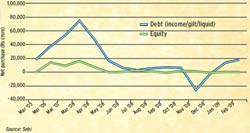
The share of debt in mutual funds has risen from 62% a year ago to 77% in February 2009, indicating a shift in investor preference due to the change in market dynamics.
Word's Worth
"I am confident that because of the stimulus the government has announced, we will see a revival of the economy in the next six to seven months."
- Prime Minister Manmohan Singh
"I have a feeling we are at the bottom and now we are building a base for the next bull market."
- Mark Mobius, Executive Chairman, Templeton Asset Management
"Even if inflation goes below zero for a week, you cannot call it deflation."
- Montek Singh Ahluwalia, Deputy Chairman, Planning Commission
"Use this economic downturn as an opportunity to learn. The world economy will rebound and those who paid attention will gain a headstart."
- Nandan Nilekani, CEO, Infosys
Source: Business Line, Business Standard and Mint