
An ounce of prevention is better than any cure. Yes, it’s something your grandfather and his father said a million times, but those old folks did know a thing or two. When you’ve spent lakhs on a home, and when you trust the safety of your family to the strength of those four walls, don’t you think it makes far more sense to ensure that it’s burglar-proof than to depend on insurance to make good any loss?
The good news is that there’s plenty of choice available in the country today. The bad news is that burglars seem to have kept pace with technology. It makes sense, therefore, to get a home security system that can be upgraded or updated. But what is available? And what would you need to keep your home safe? Well, like most things in the world, it depends on what you need and how much you are willing to pay for it.
 On offer. The home security market in India is at a nascent stage and only a handful of companies are present. However, demand is growing; Santonu Choudhury, CEO, Zicom Electronic Security Systems, estimates that the demand for home security devices is growing at around 40% annually.
Despite the relatively small size of the market, the range of home security products available is large. Depending on your budget and needs, you can get anything from extremely basic magnetic buzzers to sophisticated motion detectors and cutting-edge surveillance equipment.
At the moment, you can get home security equipment from the manufacturers—Zicom, Zeos Infotech, Active Total Security Solutions (ATSS), Honeywell and a few others. You can also buy these devices at comprehensive electronics retailers, such as Tata’s Croma. Shop around to see what meets your requirements and budget. Also, ask what the company recommends. E Shanmugam, managermarketing of Chennai-based ATSS, says: “We assess the site where the security system is to be installed and then advise the customer about what would suit him best.”
What it costs. The more you pay, the more you get. And that’s true of home security systems as well. At the entry level, you can get a basic burglar alarm for around Rs 8,000. Or, for around the same price, you can get an auto dialler, a useful little gadget that dials pre-set numbers and transmits a recorded message in case of a security breach.
Once you install a security system, you might want to subscribe to a central monitoring station (CMS) service; the monthly subscription is Rs 199 for metros and Rs 149 for mini metros. The moment an alarm is triggered, the CMS is alerted and the information is immediately sent to the police or relevant contact person.
Closed-circuit TV surveillance cameras are also popular and are available from Rs 3,500 to over Rs 1.5 lakh. Video door phones, motion sensors and the like are also useful gadgets to have.
While shopping for a security system, remember to ask if there are wired options—these generally cost less than the wireless kinds. They might look a little unsightly, but if it’s a choice between aesthet -ics and security, we hope the latter takes precedence. Also, ask about how upgradable the device is, and if it has a sufficient battery life.
Looking ahead. In the movies, you end up with a soft spot for the burglars, who are almost always good looking, suave and are technologically savvy. We don’t know much about the looks of the guy who tried to break in to your neighbour’s flat, but we do know that he’s likely to be up-to-date with the latest gadgets meant to keep him out.
The good news is that there are newer and more innovative products hitting the market almost by the day. Already, there are gadgets such as pet immune detectors, which means Fido will not be able to trigger a passive infra-red motion detector.
Better late than never. While James Bond-style gizmos are still some time away, make a start on securing your home with at least the basic security devices for now. One day, perhaps, as Zicom’s Choudhury hopes, “home security systems will be included in the must-buy list of home owners, along with appliances, paint and furniture”.
Burglar Alarm System
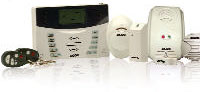 Cost: Rs 4,500
Features: Depending on the brand, a basic unit comes with two or more of the following devices—motion sensor, gas leak detector, glass break sensor, control panel, hooter, magnetic sensor, remote keys, panic button…
Usage: Sensors are placed at strategic points and transmit a signal to the control panel from where the hooter sounds an alarm
Auto-dialler System
 Cost: Rs 7,000
Features: The unit comprises an auto-dialler and certain devices of the burglar alarm system. Stand-alone diallers are also available for Rs 5,000
Usage: Feed in numbers to be called in an emergency, and record a message. When the alarm is triggered, the number will be dialled and the message delivered
Door Phones
 Cost: Rs 7,990
Features:This is for the monochrome version; the colour screen comes for Rs 17,495. For a little less, you can get an audio door phone, but it’s really not half as useful
Usage: Confirm a caller’s identity before letting him into the house; this is particularly useful if there’s an aged person or young children at home alone
Closed-Circuit Television Surveillance
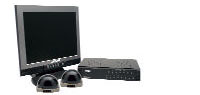 Cost: Rs 3,500
Features: From dome cameras to night vision and zoom, CCTVs cater to almost any security need. Depending on the level of sophistication, you can end up paying as much as Rs 1.5 lakh
Usage: These cameras can be attached to your TV or your computer. Movable cameras allow you to scan a wider area. You can also get a video recorder and check the tapes at leisure
Fingerprint Door Locks

Cost:Rs 13,990
Features: Can store up to 120 fingerprints, so only selected people can enter. Highend fingerprint locks for Rs 29,990 are also available
Usage: These doors can be operated by using your fingerprints, 11-digit personal identification number or a mechanical key. They need alkaline batteries to work
Safety on wheels
You’ve got your home as safe as Fort Knox. But what about your car? In many cities, parking is not a priority—you are more often than not provided parking space on the street. Which does not bode well for the safety of your dream machine. Most of us would like to believe that it’s enough to install a gear lock and a car security alarm that screeches if a wrong key is used. We couldn’t be more wrong. Cars have been sim -ply towed away—making a mockery of the gear locks, engine immobilisers and loud burglar alarms.
The good news is that there are top-of-the-line security devices available in the market today. A vehicle black box (offered by Micro and ChipSilicon) serves as an alarm if your car is tampered with, and also tracks the movement of the vehicle. Depending on the model you buy (which can cost anything from Rs 9,000 to Rs 16,000), you get additional devices and features.
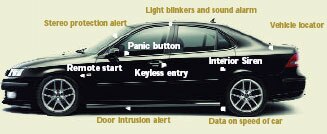 Those who fear car-jacking will be more than delighted to get the version that includes panic buttons inside the car; once activated, the buttons send a text message to a registered user about a forced entry. There are also sensors placed in and on the body of the car, which alert the owner if there’s a security breach.
Then, there’s a tracking system, which enables you to track the exact location of your car and its speed through a global positioning system (GPS) network. Once you’ve tracked down your vehicle, you can send a text message to the car, which immobilises the engine.
There are plans to soon introduce a mobile breathalyser—a device that calculates the alcohol fumes in the driver’s breath and sends an alarm to the owner if permissible limits are crossed. That should come in handy if you’re the kind who lends your car, or if you have wild teenagers using the vehicle on weekends.
Of course, you can continue to rely on steering locks, motion sensors, buzzers, and engine immobilisers. The good news is that if these gadgets are on an approved list, you could get up to Rs 500 off on your car insurance premium.













