






 Photo: ReutersPhoto: Reuters
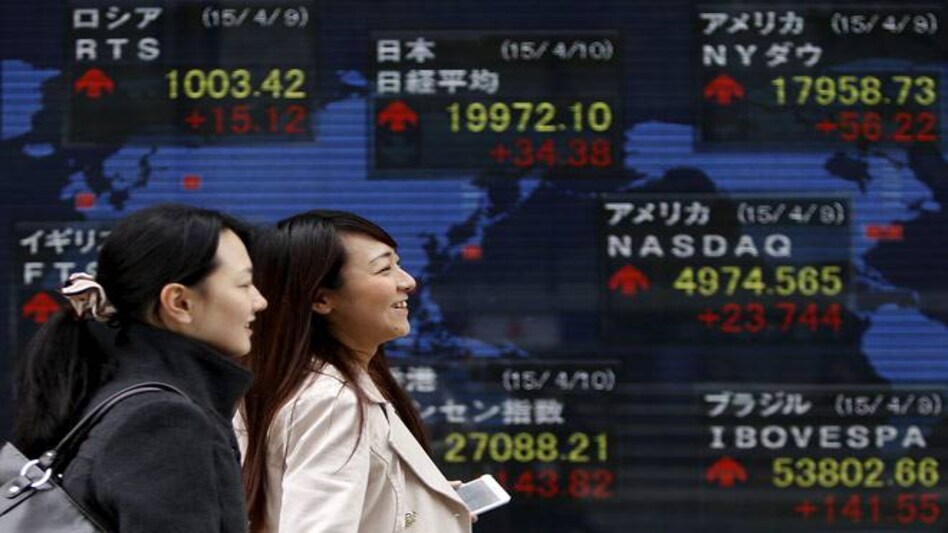
Asian stocks rose to their highest levels in more than four months on Thursday and regional currencies weakened led by the Singapore dollar as hopes grew that more central banks will join the city state in easing monetary policy in the comiing months.
MSCI's broadest index of Asia-Pacific shares outside Japan rose 0.3 per cent, reaching its highest level since Dec. 2. The index has risen 4.7 per cent since Friday, breaking above several resistance levels to signal further gains.
Singapore's central bank on Thursday surprised markets by setting the rate of appreciation of the Singapore dollar policy band at zero per cent after data previously showed economic growth stalled in the first quarter.
"The MAS is delivering a strong message by returning policy to post-GFC settings," Westpac strategists wrote in a note, referring to the Global Financial Crisis.
"As one of the world's most trade-sensitive economies, Singapore's concern over a "less favourable external environment" should be noted by the likes of the RBA and RBNZ," they said referring to the central banks of Australia and New Zealand.
Notwithstanding the optimistic trade data out of China on Wednesday, Singapore's policy decision is yet another reminder of the headwinds facing the global economy.
Earlier this week, the IMF cut its global growth forecast for the fourth time in the past year, citing a bunch of factors including chronic weakness in advanced economies.
Stock markets across the region were a sea of green led by Japan and Hong Kong as investors interpreted this as sign of more policy easing by the trade-dependent economies of South East Asia and a shallower trajectory of interest rate increases by the US Federal Reserve in the coming months.
Overnight, US S&P 500 Index gained 1 per cent to a four-month high after JPMorgan Chase's first quarter earnings fell less than expected, helping to lift the S&P 500 financial sector 2.2 per cent.
That came after bank shares in Europe did even better, surging 6.3 per cent, as investors scooped up Italian banks, re-evaluating a state-orchestrated plan to set up a 5 billion euro ($5.7 billion) fund to shore up weaker banks.
Bond yields predictably swung lower with the yield on the 30-year Japanese government bond falling a record low of 0.385 per cent. US debt followed with yields on ten-year notes easing to 1.75 per cent.
In the currency markets, rising risk appetite and the hunger for yield spurred the dollar to turn the table against the lower-yielding euro and yen.
The euro slipped 1.0 per cent, its biggest fall in about 5 months, on Wednesday and last traded at $1.12605, off Tuesday's six-month high of $1.1465.
The dollar bounced back against the yen to 109.49, extending the recovery from its 17-month low of 107.63 touched on Monday despite softer-than-expected US producer prices and retail sales numbers last month.
In Asia, the Singapore dollar weakened 0.6 per cent after the city state's central bank eased its policy, triggering a downdraft in other Asian currencies. The Korean won fell more than one per cent against the greenback in early deals.
Oil futures hit four-month highs in choppy trading on Wednesday before edging back as comments from Russia's energy minister added to doubts a producer meeting set for Sunday in Doha to discuss freezing output would yield a positive outcome
Prices fell after Reuters reported that Russian oil minister Alexander Novak told a closed-door briefing that a deal on an oil output freeze scheduled to be signed this month in Doha will be loosely framed with few detailed commitments.
"The biggest focus for now is the Doha meeting. I suspect an agreement will be difficult and we could see some setback," said Takeru Ogihara, chief strategist at Mizuho Trust Bank.
Brent crude futures fell 1.4 per cent in early Asian trade on Thursday to $43.58 per barrel after having scaled a high of $44.94 on Wednesday.
 Cyber attacks, AI misuse and data privacy rules emerge as top boardroom risks for India Inc
 'India has played it pretty safe, deal is very balanced': Top agri economist on India–US trade agreement
 NSE IPO may unlock mega gains for billionaire investors RK Damani, Premji
 'The real sting is the monitoring': Brahma Chellaney flags risk for India in Trump's Russian oil order
 Moltbook hype unravels: Viral posts were human-written, not AI, finds MIT Technology Review
 BT Golf 2025-26 Kochi, Kerala Awards Ceremony Marks A High-Energy, Successful Conclusion
 Golf Is An Addiction. We Eat And Sleep Golf!
 The Fairway Fixes Everything. Mindset, Life, Relationships
 BT Golf LIVE: Join AU Small Finance Bank Presents BT Golf 2025-26 For Its 4th Leg In Kochi, Kerala
 AI Will Change MBAs, Not Leadership: IMD President On India’s Global Education Rise
 RIL, SBI, Kotak Bank, Kalyan, HAL, BEML, BDL among stocks in focus next week; here’s whyNSE IPO may unlock mega gains for billionaire investors RK Damani, Premji
 SBI Q3 Results: Profit jumps 24% to Rs 21,028 crore; asset quality improves
 IDBI Bank stake sale: Kotak Mahindra Bank says ‘has not submitted a financial bid’
 BDL, Mazagon Dock, MRF, Hindustan Copper, RVNL, others to turn ex-dividend next week