









 The report noted that Systematic Investment Plan (SIP) inflows remained steady through bouts of volatility, reinforcing the growing role of household savings in capital markets.

 The report noted that Systematic Investment Plan (SIP) inflows remained steady through bouts of volatility, reinforcing the growing role of household savings in capital markets.
 The defining feature of Indian financial markets in 2025 was not a blockbuster rally or a flood of foreign capital, but a quiet yet decisive shift in who truly drove market stability. According to the report, From Reflection to Readiness: The Road Ahead for ’26 by Wealth Company, even as foreign investors steadily pulled money out of Indian equities, domestic capital emerged as the dominant force—absorbing selling pressure, supporting valuations, and reshaping the ownership structure of the market.
Foreign portfolio investors withdrew close to $18 billion from Indian equities during the year, putting 2025 on track to become the worst year for foreign outflows in nearly two decades. As per the report, high relative valuations, trade-related uncertainty, geopolitical risks, and better opportunities in other global markets led overseas investors to reduce exposure. Yet, despite this sustained selling, Indian equities avoided a sharp drawdown.
The reason lay in the strength of domestic flows. Mutual funds, insurance companies, pension funds, and retail investors collectively invested a record $83 billion in equities during 2025, more than offsetting foreign exits. The report noted that Systematic Investment Plan (SIP) inflows remained steady through bouts of volatility, reinforcing the growing role of household savings in capital markets. This marked a structural transition—domestic investors were no longer merely cushioning volatility but actively determining market direction.
Equity vs gold, silver
While equities showed resilience rather than exuberance, 2025 clearly belonged to bullion. Gold and silver outperformed every major asset class by a wide margin, delivering returns rarely seen in decades. Gold surged around 65% during the year, its best annual performance since 1979, while silver jumped nearly 133%, marking its strongest rally in over four decades. An equal-weighted basket of gold and silver comfortably eclipsed equities, bonds, and cryptocurrencies, the report observed.
This surge in precious metals was driven by a confluence of global factors. A weakening US dollar, persistent geopolitical tensions, rising protectionism, and a shift toward more accommodative monetary policy by central banks pushed investors toward safe-haven assets. The analysis in From Reflection to Readiness: The Road Ahead for ’26 also points to renewed interest in inflation protection and currency hedging, as traditional correlations across asset classes began to weaken.
2026 outlook
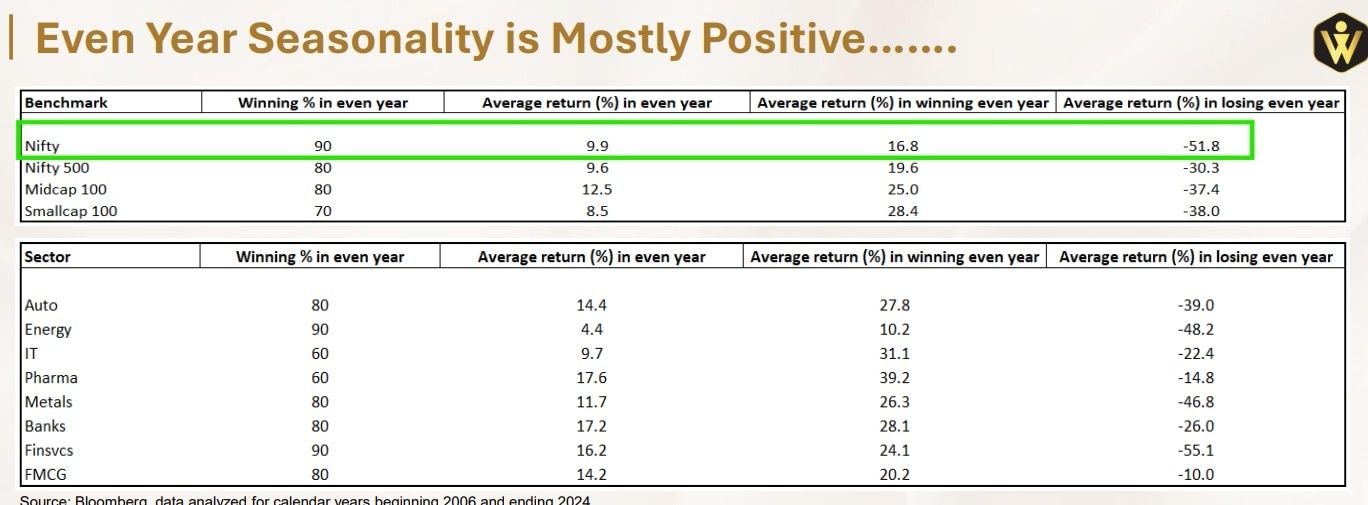
As markets transition into 2026, expectations are being recalibrated. While historical trends suggest that even-numbered years tend to be positive for Indian equities, the outlook is far more measured, the report cautions. Growth across major global economies is expected to remain uneven, trade frictions are unlikely to fade quickly, and the scope for aggressive monetary easing appears limited.
For Indian markets, this means returns are likely to be moderate rather than spectacular. Leadership is narrowing, with large-cap stocks, balance-sheet strength, and earnings visibility taking precedence over liquidity-driven rallies. The report warns it is no longer episodic but structural, driven by shorter and sharper market cycles.
In this environment, diversification emerges as the central investment takeaway. The contrasting experiences of 2025—where domestic capital offset foreign exits and bullion delivered outsized gains—underscore the importance of spreading risk across asset classes, sectors, and geographies. Investors heading into 2026 will be better served by realistic return expectations and well-diversified portfolios, rather than chasing narrow themes.
As markets evolve, the lesson is clear: resilience now matters more than momentum, and diversification is no longer optional—it is essential.
 Delhi EV policy 2026: Should you buy these premium electric SUVs & MPVs under ₹30 lakh?
 Big news for commercial petrol, diesel buyers: India lifts emergency curbs on retail sales from July 1
  'Never seen so many tankers': India's Russian crude imports may hit record high in June
 Delhi EV Policy 2026 Explained: What's changing for car, bike and auto buyers
 Why Jio BlackRock feels hybrid long-short is the perfect fund to launch now as it enters the SIF space
 Why Jio BlackRock AMC Is Launching Hybrid Long-Short As It's First SIF
 Delhi Unveils ₹15,000 Crore EV Policy: What It Means For Auto Companies And Consumers
 Gold, Silver Or Crude? Where Should Investors Bet Now? | Vandana Bharti
 How India Strategically Managed LPG & Crude Oil Supplies During West Asia War | K. Surana Explains
 Delhi’s Green Revolution: CM Rekha Gupta Unveils Massive ₹15,000 Crore EV Policy To Combat Pollution
 Why Jio BlackRock feels hybrid long-short is the perfect fund to launch now as it enters the SIF space
 Where should investors put their money? PL Wealth CEO has some tips
  Axis Bank CFO Puneet Sharma steps down; stock likely in focus on Tuesday
 Apollo Hospitals, Medanta, Healthcare Global, Max Healthcare, Artemis Medicare: Check target prices, outlook
 Polycab: Amid record FII buying, shares at all-time high but brokerages expect more upside