










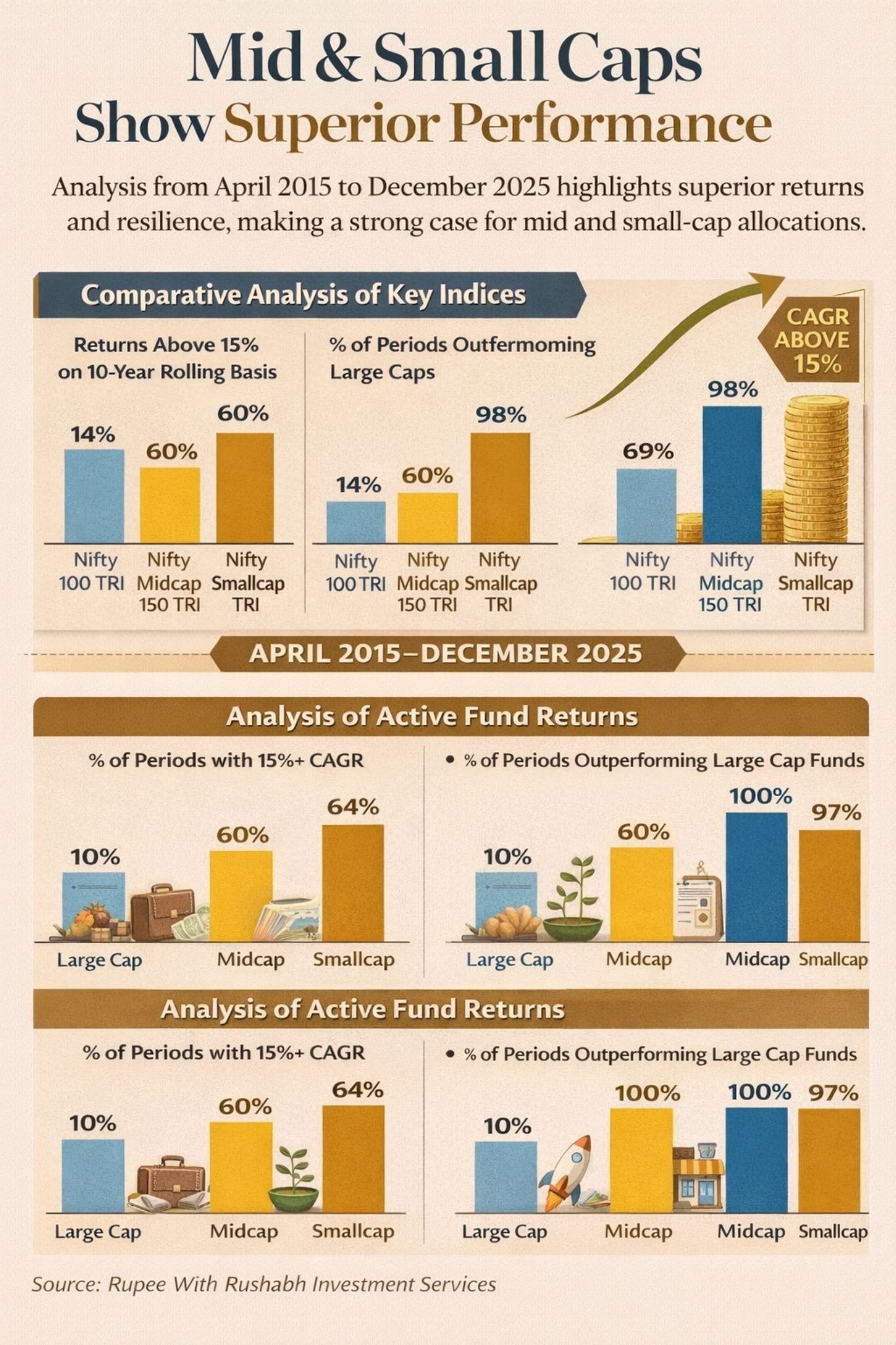



 Profit growth among mid- and small-cap companies has outpaced that of large caps in recent quarters, reflecting a healthy earnings cycle.
Indian equity mutual fund investors have increasingly recognised the significance of mid and smallcap funds in their portfolios, as recent data demonstrates these categories' consistent outperformance relative to large cap funds. Mid- and small-cap funds continue to play a vital role in long-term wealth creation, says Rushabh Desai, Founder of Rupee With Rushabh Investment Services, citing a decade of data that shows their superior performance and resilience across market cycles.
Desai points to a detailed analysis of index and active fund returns between April 2015 and December 2025, which highlights how mid- and small-cap strategies have consistently delivered stronger outcomes than large-cap investments. “The numbers clearly reaffirm why these segments are indispensable for investors seeking long-term growth,” he says.

 'Every great airline is built over decades': Tata Sons Chairman says Air India's turnaround is a 5-10 yr mission
  HDFC Bank penalises top officials, including CEO and CFO, in MSRDC case. Here’s why
 Only 26 of every 100 young Indian graduates have salaried jobs; just 4 enjoy basic employment benefits: Report
 Where are the jobs: Youth unemployment remains high; fewer jobs for those with higher education in India
 Indian Army launches internship offering up to ₹75,000 stipend in Delhi. How to apply?
 Infosys Fined In France: 70-Hour Work-week Debate Returns After €175,000 Labour Penalty
 I.T. Sector Outlook: Is the Worst Over for Indian I.T. Stocks After Long Underperformance?
 France And Spain Wildfires Threaten Cap Ferret Mansions And Bordeaux Wine Country
 Maruti Suzuki Eyes 25-30% SUV Growth, Says CNG Demand Has Overtaken Diesel
 "Don't Divert Focus From Students' Future": Rijiju Urges Oppn To Debate Anti-Paper Leak Bill
 Tata Power Q1 profit rises 11% to Rs 1,176 crore; revenue up 6%, capex tops Rs 5,300 crore
 HDFC Bank concludes internal review into MSRDC deposit arrangements; CEO, CFO among 3 fined Rs 1 lakh
 How Narayana Murthy's era, Vishal Sikka's stint and Salil Parekh's tenure differed; big task awaits next Infosys CEO
 BEL Q1 results: Net profit rises 9%, revenue at Rs 5,533 crore
  Sensex, Nifty snap five-session losing run; investors add Rs 5.1 lakh crore in wealth'Every great airline is built over decades': Tata Sons Chairman says Air India's turnaround is a 5-10 yr mission Indian Army launches internship offering up to ₹75,000 stipend in Delhi. How to apply?
 India adds 1.18 lakh hectares of mangroves in 40 years, second-highest gain globally: ReportOnly 26 of every 100 young Indian graduates have salaried jobs; just 4 enjoy basic employment benefits: Report
 Apple iPhone 18 vs Google Pixel 11: Which flagship model should you wait for?