“Healthcare inflation in India has been hovering in double digits, often around 12–14%, far above general consumer inflation,” Bahl observes. “For a middle-income household, a single hospitalization can wipe out years of savings.”
Here’s what patients, attendants and policyholders need to understand.
1. Healthcare Inflation
Healthcare inflation in India has consistently remained in double digits, often between 10–14% annually — significantly higher than general consumer inflation.
Bahl notes that itemized billing often includes multiple layers of charges — procedure fees, room rent, diagnostics, consumables, specialist visits, and pharmacy margins — making it difficult for patients to assess reasonableness in real time.
“The opacity of billing structures means families only fully understand the cost burden at discharge, when the bill is presented,” he says.
What this means for you:
Treatment costs rise every year.
Insurance premiums increase.
Coverage purchased 3–5 years ago may no longer be adequate.
A Rs 5 lakh health policy that felt sufficient earlier may now fall short for major surgeries or prolonged ICU stays in metro hospitals.
2. Escalating hospital bills
Many families assume the biggest cost is the surgery itself. In reality, the bill is made up of multiple components:
Room rent (which can determine overall package pricing)
ICU charges
Doctor and specialist visit fees
Nursing charges
Diagnostics and lab tests
Pharmacy and consumables (gloves, masks, syringes, PPE kits)
Equipment usage
Procedure charges
Consumables often surprise families. During critical care or infection-controlled procedures, usage can be high. However, the absence of real-time transparency means many families only see the full financial impact at discharge.
Tip: Ask for interim bills every 24–48 hours to avoid last-minute shocks.
3. Insurance does not mean zero payment
Cashless hospitalisation reduces immediate cash outflow, but it does not eliminate all expenses.
Common reasons for additional payment:
Non-medical items not covered (gloves, PPE, registration fees, etc.)
Sub-limits on room rent or specific treatments
Policy exclusions
Co-pay clauses
Exhaustion of sum insured
If your room rent exceeds policy eligibility, it can proportionately reduce claim settlement across the entire bill.
Tip: Always check:
Room rent eligibility
ICU limits
Disease-specific caps
Waiting periods
Co-pay percentage
4. Insurance effect
Healthcare economists refer to a phenomenon called “third-party payer distortion.” “The presence of a third-party payer can distort pricing discipline,” Bahl says. “When insurers negotiate later and patients aren’t directly paying upfront, transparency weakens.”
This dynamic can lead to higher initial billing, discharge delays, and partial claim settlements.
When an insurer is involved:
The patient is not directly negotiating prices.
The hospital bills the insurer.
Final negotiations happen between hospital and insurer.
This can result in:
Higher initial billing
Delays in discharge approval
Partial claim settlement
Post-discharge recovery demands
This also contributes to rising claim ratios and, ultimately, higher insurance premiums.
5. Corporate hospitalisation and investment-driven growth
In recent years, many leading hospital chains have attracted investments from private equity and global funds. This has enabled expansion, advanced technology adoption, and improved infrastructure.
While PE capital has enabled rapid expansion, improved infrastructure, and access to advanced technology, Bahl suggests the ownership shift may also alter incentive structures.
Hospitals today track metrics such as:
Bed occupancy rates
Revenue per occupied bed
Procedure volumes
Operational efficiency
Patients may not see these metrics directly, but they influence pricing frameworks and service structuring.
However, hospitals are also businesses. They track:
Bed occupancy
Revenue per occupied bed
Procedure volumes
Operational margins
This does not automatically imply overcharging. But financial performance metrics influence pricing strategies, especially in metro markets with limited competition. “Private equity operates on defined return expectations and exit timelines,” he explains. “That doesn’t mean hospitals compromise care, but it does introduce financial performance metrics — such as occupancy rates and revenue per bed — that influence business decisions.”
6. Uninsured families -- most vulnerable
India still has high out-of-pocket healthcare expenditure. Without insurance:
Families may rely on savings or loans.
Gold or assets may be liquidated.
Long-term financial stability may be disrupted.
A prolonged ICU stay can cost several lakhs per week in private hospitals.
7. How patients and families can protect themselves
Before Hospitalisation:
Review your insurance coverage annually.
Increase sum insured in line with healthcare inflation.
Consider a super top-up plan.
During Admission:
Request a cost estimate in writing.
Seek clarity on packages and exclusions.
Ask for daily billing updates.
At Discharge:
Review itemised bills carefully.
Cross-check non-medical exclusions.
Raise discrepancies immediately before payment.
What's the bigger issue
Healthcare is an essential service. Yet it operates within a capital-intensive, high-cost ecosystem. Without transparent billing, strong regulation and informed patients, financial stress after discharge may continue to be common. Being medically prepared is important. Being financially prepared is equally critical.



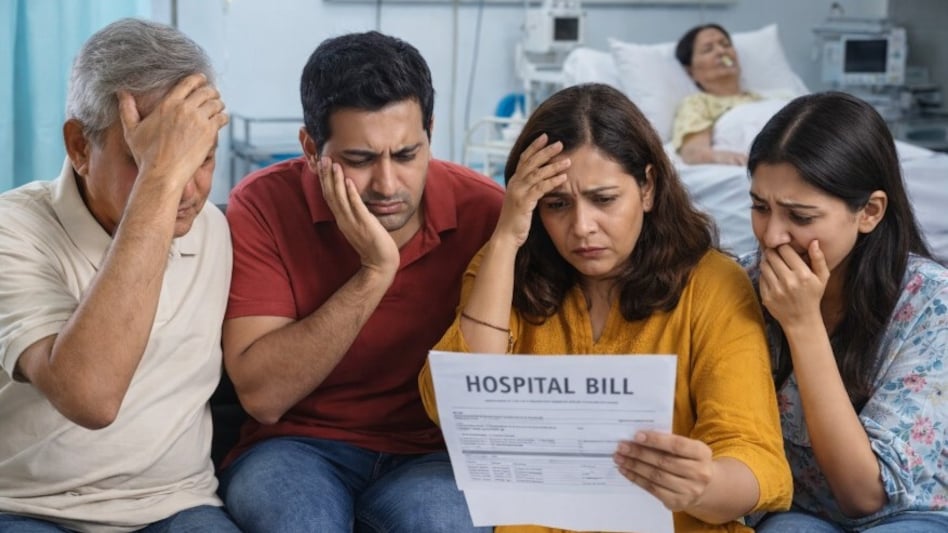 Experts say even insured patients are not immune to financial strain. Industry data show rising claim ratios for health insurers, partly attributed to higher hospitalization bills
 90% EVs exported out of India are from Maruti Suzuki: MD & CEO Hisashi Takeuchi
 India's $30 trillion goal needs 8-10% growth, $400 billion more annual investment: Jayant Sinha
 1.1 billion barrels gone: IMF warns that global oil market is running out of safety cushions
 From Devbhoomi to industrial destination: Uttarakhand’s manufacturing moment
 India’s deep-tech startups face a new test: Crossing the valley of death
 #IndiaAt100 : Adipen Bose Nandhiji On Conscious Capitalism- Can Profit & Purpose Coexist?
 #IndiaAt100 : Hisashi Takeuchi On Driving India’s Manufacturing Revolution
 #IndiaAt100 : Manufacturing For Viksit Bharat | Can Industry Power India’s $30-Trillion Dream?
 #IndiaAt100 : Tarun Garg On Hyundai & India’s Manufacturing Powerhouse Ambition
 #IndiaAt100 : CM Pushkar Singh Dhami On Uttarakhand’s Industrial Growth & India’s Next Leap
 Cupid, NTPC Green, NTPC, Raymond Realty, HAL shares: Key technical levels to watch
 Defence stock with Rs 2,654-crore order book hits record high; here's why
  GACM Technologies: FII holding jumps to 29%; penny stock in focus
 Puravankara shares rise 5% on fresh order win
  20 high-conviction ideas for up to 95% upside | stocks to buy
  Panvel adds 42,330 homes outpacing Navi Mumbai as airport-led realty boom takes shape
 NHAI’s ₹350 monthly toll pass now available: who can apply? Check eligibility and benefits
 90 million litres of glacier water every day: How Ladakh is reviving 1,000 acres of farmland












