The report notes that global gold ETF inflows are on track for their strongest year on record, totalling $77 billion up to November, led predominantly by Asian markets. Jewellery demand declined sharply, nearing pandemic-era lows as elevated gold prices and cautious consumer sentiment weighed on purchase volumes. Nevertheless, high price levels ensured that the total value of jewellery spending remained elevated across all quarters. Technology-related demand remained broadly stable, supported by gold’s applications in AI, electronics and other industrial uses.
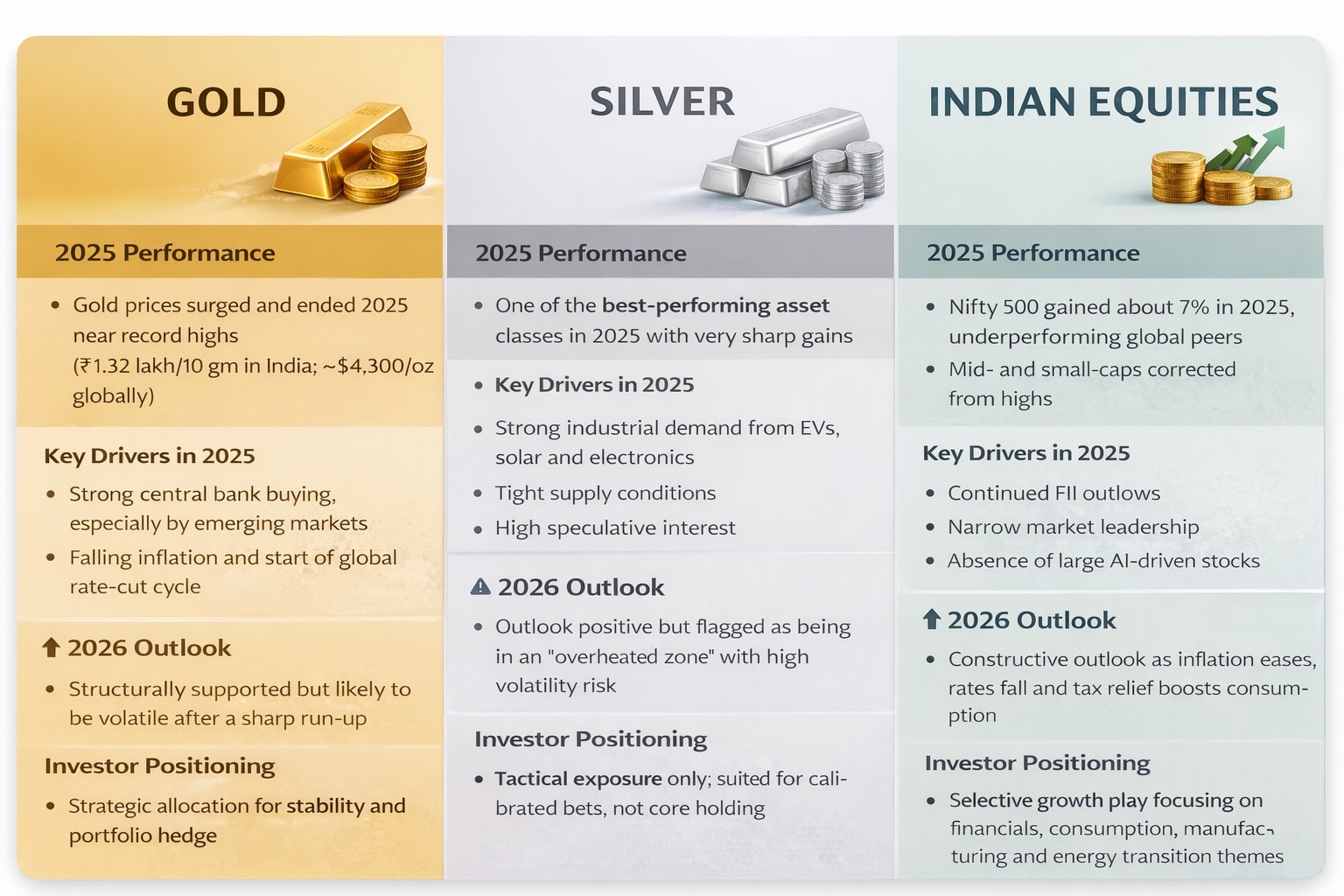
For the 2026 outlook, the report says with global inflation softening and major central banks — including the US Federal Reserve and the Reserve Bank of India — firmly in easing mode, gold continues to benefit from a low interest-rate environment. While prices ended 2025 near historic highs, the report sees gold’s role in 2026 primarily as a portfolio hedge and stabiliser, rather than a vehicle for aggressive returns.
Silver
Silver, by contrast, carries a very different risk profile. The silver market experienced one of its most dramatic years in 2025, marked by record prices, tight physical supply and major policy shifts in the US. Silver’s designation as a critical mineral lifted its strategic importance, while prices surged nearly 147%, far outpacing gold and copper. Investor interest intensified, with global ETFs adding substantial holdings and physical demand concentrated in the US, India, Germany and Australia.
After delivering one of the strongest performances across asset classes in 2025, silver has entered what the report describes as an overheated zone. The outlook for 2026 remains structurally positive due to energy-transition themes, but the report cautions that silver is far more sensitive to shifts in global growth and investor sentiment than gold.
The report noted:
> Strong industrial demand will continue to provide support, led by increased usage in the green and renewable energy space.
> Strong investment demand has made silver one of the best-performing asset classes in CY25, with gains of over 145%.
> A fifth consecutive year of demand–supply mismatch strengthens the case for a continued bullish outlook on silver.
> The gold–silver ratio, currently below 70, is in line with historical averages, leaving limited room for silver to outperform gold.
> The debasement trade, along with US stockpiling following silver’s recent designation as a critical mineral, has contributed to the sharp price rise and is expected to remain supportive.
> Silver’s dual role as both a precious and an industrial metal gives it a unique position within the metals space.
Equity market
Indian equities present a third, more nuanced narrative. While domestic markets underperformed several global peers in 2025, weighed down by continued foreign outflows and the absence of large AI-driven stocks, the underlying fundamentals are improving. The report points to easing inflation, rate cuts and income tax relief as major tailwinds for consumption and corporate earnings in 2026.
The report noted equities lagged major global markets in CY25 after strong gains in 2023–24, weighed down by high starting valuations, the absence of large AI-driven stocks, delays in the India–US trade deal and sustained foreign portfolio outflows. However, steady domestic inflows from mutual funds, insurers and pension funds helped cushion the impact.
To revive growth, the government rolled out tax cuts, GST rationalisation, labour reforms and export support, while the RBI eased rates and lending norms.
In 2026, investors will track earnings upgrades, trade deal progress and capital flows, with the Nifty seen offering moderate upside by March 2027.
"In 2026, markets will be tracking the impact of these measures on Corporate revenue and earnings growth and whether the ratio of upgrades to downgrades continues to move higher. Progress on the India-US trade deal will also be closely watched and its consequent impact on FPI flows and the INR. Based on projected FY27E Nifty50 EPS of 1346 and a PE of 22x (10-year avg), indicates a Nifty level of around 29,700 by March 2027, i.e. an upside of around 13%."
For mutual funds, the report noted: "Valuations remain higher than long-term averages for the broader market, although the extent of overvaluation has moderated following the sideways to negative market movement over the past 15 months. Large-cap–oriented diversified strategies, including large-cap, flexi-cap and multi-cap funds, along with hybrid funds such as balanced advantage and multi-asset schemes, appear better placed on a risk-reward basis. Mid- and small-cap allocations may be considered in a staggered manner."
It added: "Investors should also consider diversifying a portion of their portfolios (around 10–15%) into global equities to benefit from opportunities across diverse sectors such as technology and healthcare."
Gold and silver in 2025
Precious metals closed 2025 on a strong note, with both gold and silver posting exceptional gains in India and overseas markets. In the domestic market, gold finished the year at Rs 1,37,700 per 10 grams on December 31, while silver settled at ₹2,39,000 per kg. Compared with a year earlier, gold generated a 74.4% return, rising from Rs 78,950 per 10 grams at the end of 2024. Silver delivered an even sharper rally, soaring 166.4% in 2025 from Rs 89,700 per kg to nearly Rs 2.4 lakh per kg.
International prices mirrored the surge. Gold ended 2025 at $4,308.30 per ounce, up 65.3% from $2,605.77 per ounce on December 31, 2024. Silver climbed to $71.67 per ounce, more than doubling from $28.97 per ounce a year earlier.
Together, the report paints a clear message for 2026: gold offers stability, silver offers opportunity with risk, and equities offer growth — but only for investors willing to be selective in a changing market landscape.
















 Precious metals closed 2025 on a strong note, with both gold and silver posting exceptional gains in India and overseas markets.
 IDBI Bank employees and pensioners have nothing to fear: DIPAM Secretary
  'I wish I was 20 years younger': Sunil Mittal on India's next 20 years, recalls OneWeb pitch to Rishi Sunak
 RIL group to become India's largest conglomerate by m-cap after Jio IPO: Uday Kotak
 NDMC announces two-day closure of Connaught Place's Central Park ahead of CJP's 'Lehra Do Tiranga' march on Friday
 IDBI Bank sale to Fairfax faces union resistance, black-badge protest on October 16
 Jio Platforms IPO: ₹30,000 Crore Issue Opens October 21, Valuation At ₹10.3 Lakh Crore
 Weekend OTT Releases: The Diplomat 4, Aasha, Sacrifice And More
 How Jio Transformed India From Data Scarce to Data Abundant! | Akash Ambani | Jio Platforms IPO
 Akash Ambani Decodes Jio's Financial Muscle | Reveals The 5 Key Business Drivers | Jio Platforms IPO
 From Dhirubhai’s 1977 IPO to Jio's Mega Launch | Uday Kotak Calls Jio IPO a ‘Moment in History’
 Gold eyes sharp recovery; can MCX prices hit Rs 1.5 lakh? Vandana Bharti explains
 Tech Mahindra Q2 results: PAT rises 33% YoY to Rs 1,586 crore; recommends 1:1 bonus issue
 Jio Platforms IPO: How HFCL promoter Mahendra Nahata's investment could rise over 110 times
 South Indian Bank shares hit 52-week high on Q2 earnings, close higher
  Akasa Air, IndiGo extend suspension of flight to Saudi Arabia till October 24
 Top 5 Biggest IPOs In India: Jio Set To Break Hyundai’s Record With ₹30,213 Crore Issue
 PM Modi Meets Indian Athletes After Asian Games 2026, India Wins 85 Medals
 Supreme Court Strikes Down ₹8,415 Crore AT-1 Bond Write-Off For Yes Bank | What Happened?


