












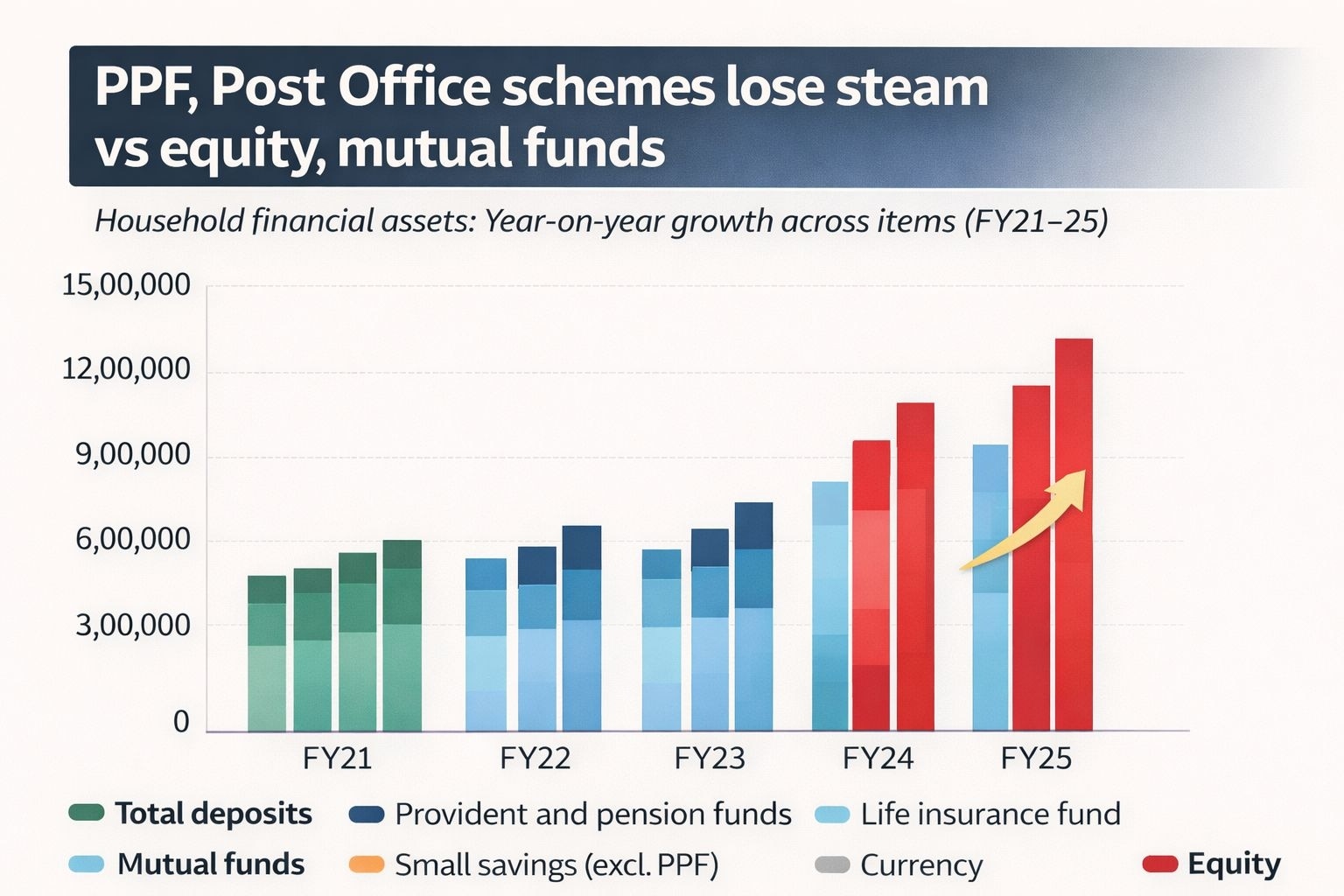



 According to the RBI’s December monthly bulletin, small savings schemes excluding the Public Provident Fund (PPF) saw inflows shrink by nearly 24%.
Indian households are steadily redrawing their savings playbook as lower interest rates erode the appeal of traditional fixed-income products. Latest data from the Reserve Bank of India (RBI) shows that in FY25, savers pulled back from bank deposits, insurance and small savings schemes, while channelling a growing share of their money into equities and mutual funds.
This reallocation gathered pace as banks and small finance banks cut fixed deposit (FD) rates repeatedly through 2025, following a series of repo rate reductions by the RBI. The central bank lowered the policy rate by a cumulative 125 basis points during the year, squeezing returns on deposits and prompting households to seek higher-yielding investment avenues.

 Nifty’s festive comeback: Can the bulls keep the party going?
 Jio IPO listing to make it India’s 4th most-valued firm after RIL, Airtel, HDFC Bank
 Jio has filed 7,220 patents: Akash Ambani pitches technology as competitive edge ahead of mega IPO
 SIR row: Supreme Court issues notice to EC; seeks response from Gyanesh Kumar, 2 other ECs
 Jio IPO: Meta, Google, ADIA, 7 others eye Rs 3.2 lakh crore stake value, gains on investment
 Netanyahu, MBS And The Houthis: Is A New Middle East War Brewing?
 Jantar Mantar Protest Ban: Are Delhi’s Alternative Sites Fit For Protests? | Ground Report
 K Annamalai’s Political Test: Can We The Leaders Make An Electoral Mark?
 LIVE What’s Hot: Stocks, Gold & Big Money Moves | Daily Markets Show | October 15 | Business Today
 CEAT Q2 Results | CFO Kumar Subbiah on Profit Fall, Margins and Growth Outlook
 South Indian Bank shares hit 52-week high on Q2 earnings, close higher
  From Rs 228 per GB to mass-market 5G: How Jio transformed India's data economy
 TCS launches Industrial Intelligence Foundry for industrial AI; completes BBY Services India acquisition
 Bharat Dynamics wins order worth Rs 1,307 crore from Indian Navy
 Wipro Q2 profit slips slightly YoY to Rs 3,201 crore; revenue climbs 9%South Indian Bank shares hit 52-week high on Q2 earnings, close higher
  Apple Pay in India: HSBC app update hints at another bank joining Apple’s payment serviceFrom Rs 228 per GB to mass-market 5G: How Jio transformed India's data economy
 Nepal PM Balen Shah plans India visit in November, first bilateral trip since taking officeTCS launches Industrial Intelligence Foundry for industrial AI; completes BBY Services India acquisition


