









 Real estate price growth slows down in top eight cities, says report
 Real estate price growth slows down in top eight cities, says report
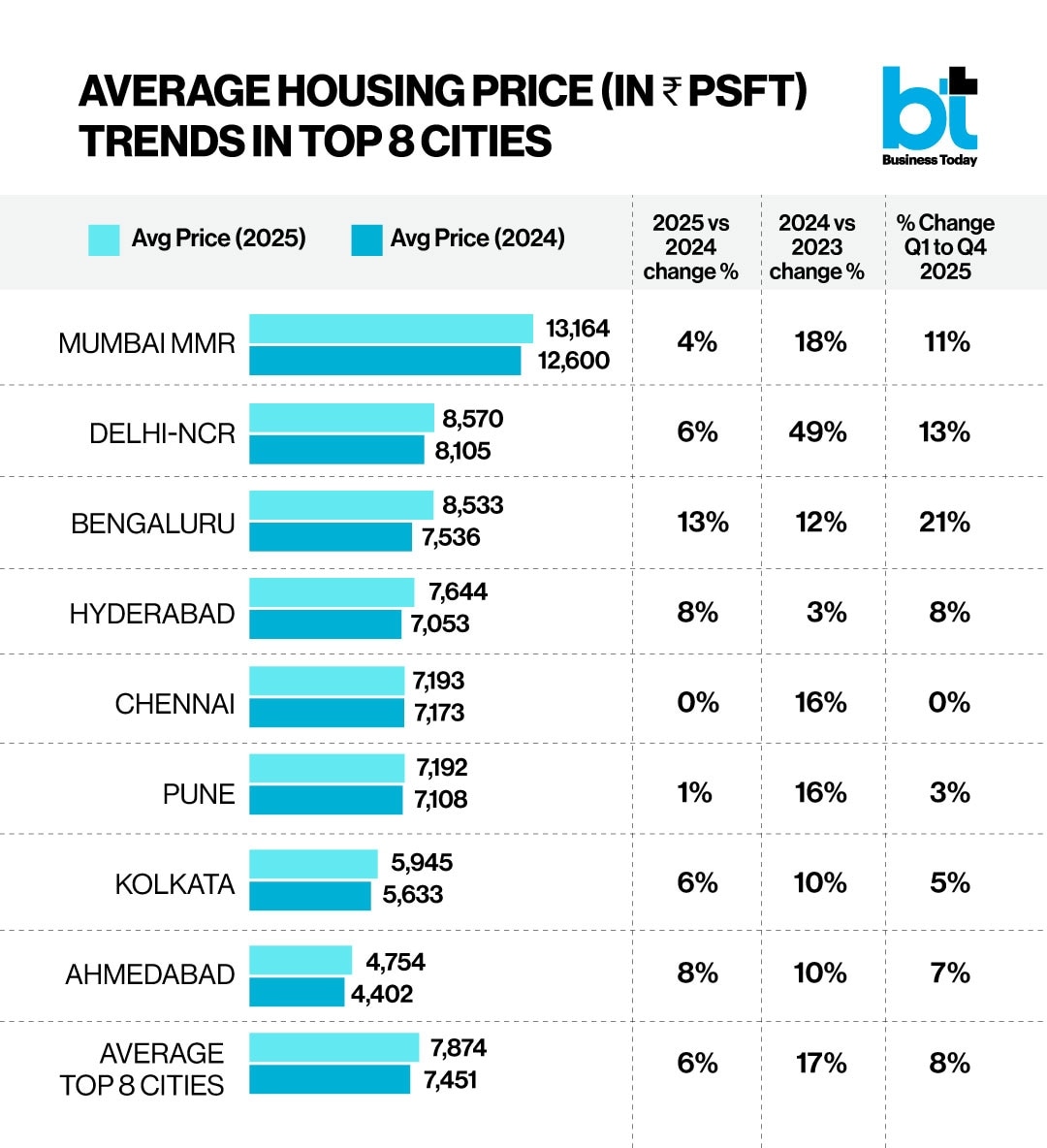
Average housing price growth across India's top eight cities slowed to 6 per cent in 2025, a notable decrease from the 17 per cent growth recorded in 2024, according to the Real Insight – Residential CY 2025 report by PropTiger.com. The report showed that the market has entered a phase of normalisation, with price increases in line with supply and demand fundamentals amid a disciplined approach from developers.
The report highlighted that while overall price growth moderated, Bengaluru emerged as a standout market, registering 21 per cent annual growth and reaching Rs 9,500 per sq. ft. in Q4 2025. This positioned Bengaluru as the second most expensive housing market after Mumbai Metropolitan Region (MMR), which stood at Rs 14,000 per sq. ft. in Q4. Delhi NCR followed with Rs 9,167 per sq. ft., reflecting continued urban demand.
According to PropTiger.com, price growth in Hyderabad reached 8 per cent in 2025, up from 3 per cent in 2024, and Bengaluru recorded 13 per cent, compared to 12 per cent in the prior year. In contrast, other cities saw a significant slowdown: Mumbai MMR at 4 per cent (down from 18 per cent in 2024), Pune 1 per cent (16 per cent in 2024), Ahmedabad 8 per cent (10 per cent in 2024), Delhi NCR 6 per cent (49 per cent in 2024), Kolkata 6 per cent (10 per cent in 2024), and Chennai remaining flat (16 per cent in 2024).
Onkar Shetye, Executive Director of Aurum PropTech, stated, "Mumbai MMR price trends through 2025 reflects price consolidation in the region's premium market while that of Pune and Ahmedabad remaining broadly stable. Delhi NCR and Kolkata also saw measured price increases amid selective demand. Bengaluru and Hyderabad showed steady end-user demand and balanced absorption."
Analysts pointed out that the market's resilience was underpinned by a disciplined supply approach. The report noted that resilient pricing alongside moderating sales volumes highlighted a disciplined, supply-calibrated market, where developers protected price integrity and inventory remained well managed-creating a stable pricing base heading into 2026.
Inventory overhang remained within comfortable limits throughout the year, suggesting that supply did not significantly outpace demand. The report observed that unsold inventory growth was more visible in higher ticket-size segments, with mass and mid-income housing maintaining favourable liquidity and quicker sales cycles.
Shetye added that the combination of rising prices, stable quarterly increments, and controlled supply additions indicated that inventory levels remained well managed through 2025. “The market continued to operate within a comfort zone, with developers prioritising price integrity and project viability over volume-led liquidation,” said Shetye.
These trends indicate that, despite the slowdown in price growth, India’s housing market in 2025 operated within a stable framework, with developers focusing on maintaining price discipline rather than boosting volumes, supporting a balanced environment heading into the next year.
 ED searches Vedanta Group premises in FEMA case: Report
 Oracle’s Larry Ellison races past Bezos and Brin to become world’s third-richest person
 IREDA shares fall 8% in two days post Q4 – Brokerage target price hints at 45% upside
 What is an AI PC and why is Nvidia betting on it?
 Maya Tata, daughter of Noel Tata, may exit Tata Digital: Report
 Piyush Goyal: Most India-U.S. Trade Issues Already Resolved
 India’s $11 Billion Semiconductor Plan | Extreme Summer Gadget Tips + MacBook Neo Review
 "Complete Nonsense…": NVIDIA's Jensen Huang Explains Why AI Won't Steal Software Engineering Jobs
 Gold Demand Falls 70% After Duty Hike; What Lies Ahead For Gold And Silver Prices?
 India Inc. Posts 15% Profit Growth In Q4FY26 As Revenue Expands At Fastest Pace
 IREDA shares fall 8% in two days post Q4 – Brokerage target price hints at 45% upside
 NMDC shares: Brokerages raise target prices after Q4 earnings; NMDC Steel turns profitable
 Vedanta share price recovers 3% amid reports of ED raids; key details
 TCS, Infosys, HCL Tech, Wipro, Coforge, Mphasis, TechM: IT stocks to buy— Fresh targets
 Jeena Sikho shares gain 14% today after Q4 results - Key details