Equity markets are at all-time high. Experts say they may rise further. When asked what is leading the rally, most use a term that not many people are aware about - high beta stocks.
Let's understand the concept and see which high beta stocks are likely to lead what some people are already calling a bull market.
Beta shows the relationship between the movement of a stock and the overall market. A beta higher than one means the stock rises more than the market in bullish conditions and slips more when markets are falling.
In the BSE 100 index, out of 50 high beta (beta more than one) stocks, 48 have outperformed the market in the one month to April 3. Housing Development & Infrastructure rose 44.32% to Rs 59.75, followed by Union Bank of India (40.22% to Rs 142.6), Bank of Baroda (38.55% to Rs 755.95), Unitech (32% to Rs 14.56) and Steel Authority of India (30.94% to Rs 72.15). The Sensex rose 7.4% during the period.
Sampath Reddy, chief investment officer, Bajaj Allianz Life Insurance, says, "The outlook for India's equity market is bright. The slowdown is behind us and corporate earnings growth is likely to accelerate. In this backdrop, companies with higher operating and financial leverage are likely to do well. One should accumulate high beta stocks."
Rajesh Cheruvu, chief investment officer, RBS Private Banking, says, "We think with the market touching new highs supported by external liquidity, it is the right time to focus on high beta stocks. We suggest that investors consider cyclical sectors as well."
MARKET VALUATION
If you fear that the latest stock rally is overdone and stocks may fall again, just like in 2008, take a look at the market's valuation, which seems fair at this stage.
The Sensex was trading at a price to earnings, or PE, ratio of 28.57 on 9 January 2008 as against the five-year average of 18.24. But now, it is reasonably valued, and was trading at a PE ratio of 18.36 on April 3, near its historical five-year average of 18.95. Deutsche Bank believes the Sensex may touch 24,000 by December. Bank of America Merrill Lynch, in a report on April 3, said, "We expect markets to rally another 5-10% by the end of the year depending upon how stable the next government is."
Rahul Shah, vice president, group leader, equity advisory group, Motilal Oswal Securities, says, "The market is nowhere near the expensive or bubble zone. This is likely to limit the downside. This is the time to invest in high beta stocks."
FACTORS TO WATCH
There are three things one must factor in while buying a high beta stock. First, whether the downside for the broader market or the sector is limited or not? Second, whether the upside is significant or not? Lastly, sectors chosen should have a record of running parallel to the market.
"Prefer large-cap companies with established record of financial growth, robust balance sheets and strong managements," says Shah.
However, Dipankar Choudhury, head of research (institution), Centrum Broking, warns that investors should get into these stocks only if they have the stomach for disappointment.
STOCKS TO BET ON
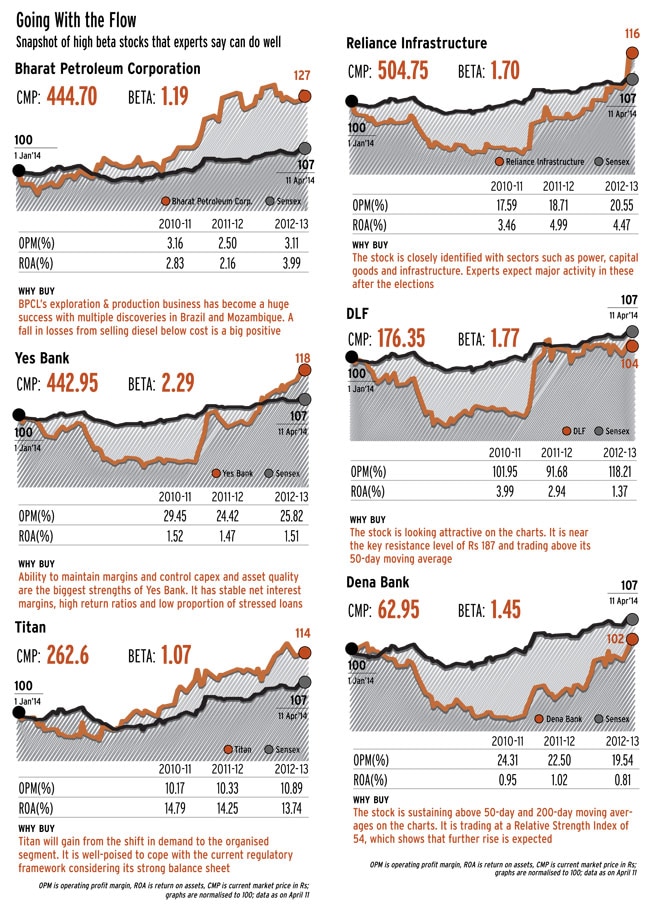
Yes Bank: The stock has been performing better than the market since January 1. It rose 12.7% to Rs 422 this year till April 4. The Sensex rose 5.7% to 22,359 during the period.
Shah of Motilal Oswal says, "Ability to maintain margins and control capex and asset quality are the biggest strengths of Yes Bank. It has stable net interest margins, high return ratios and low proportion of stressed loans (0.3%). Diversification of the balance sheet towards granular retail and small business is essential for the stock's re-rating. Improvement in the macroeconomic scenario will provide comfort. We believe the stock can touch Rs 515."
Yes Bank reported a net profit of Rs 1,300.68 crore for financial year ended March 2013, up 33.13% from Rs 976.99 crore in the previous financial year
Bharat Petroleum Corporation (BPCL): The BPCL stock rose 16.55% to Rs 443.65 in the one month to April 4. The Sensex rose 5.42% during the period.
The company had Rs 2,849.83 crore cash in hand as on March 2013. The debt-to-equity ratio was 1.98.
BPCL's exploration & production business has become a huge success with multiple discoveries in Brazil and Mozambique. A sharp decline in losses from selling diesel below cost is also a big positive.
Deutsche Bank is positive on the stock. The valuation is attractive. On April 4, the stock was trading at a PE of 6.70 as against the industry average of 10.88.
Reliance Infrastructure: The stock has a beta of 1.72, which is considered quite high. Shrikant Chouhan, head, technical research, Kotak Securities, is positive on the company. "The stock is closely identified with sectors such as power, capital goods and infrastructure. We expect major activity in these both before and after the coming elections. The stock is forming a falling wedge on the charts, which suggests that it will rise to Rs 560-600 if it can remain above Rs 465."
Falling wedge is a bullish pattern that begins wide at the top and contracts as prices move lower. On April 4, the stock was trading at Rs 455.
Dena Bank: The stock has witnessed decent buying since March. It rose 17.11% to Rs 60.90 in the one month to April 4.
Rohit Gadia, founder and chief executive officer, CapitalVia Global Research, says, "Dena Bank can find support at Rs 49. It is facing resistance of Rs 65. It is sustaining above 50- and 200-day moving averages on daily charts. It is trading at an RSI (Relative Strength Index) of 54, which shows that further rise is expected. The stock may touch Rs 80-85 in the next few sessions."
RSI is a momentum indicator that compares recent gains to recent losses to determine overbought and oversold conditions. The reading ranges from 0 to 100. An asset is deemed to be overbought once the RSI approaches 70. Likewise, if it approaches 30, it is an indication that the asset is getting oversold and, therefore, is likely to become undervalued.
Titan Company: The government has decided to allow five domestic private sector banks, HDFC Bank, Axis Bank, Kotak Mahindra Bank, IndusInd Bank and Yes Bank, to import gold, though within limits. The limits will be decided on the basis of the number of export-oriented customers each bank has.
Ac ICICIdirect.com report in March said this was the first step by the government to ease norms for gold imports. It is likely to boost supply, bringing down prices.
"We believe that after the imposition of various restrictions on import of gold, Titan has been among the better performers. We expect it to be a beneficiary of the shift from unorganised to the organised jewellery segment. The company is well-poised to cope with the current regulatory framework considering its strong balance sheet. The stock can touch Rs 280 in the next few months."On April 7, it was at Rs 262.
DLF: The DLF stock has fallen 54.55% since 1 October 2010 and was at Rs 176.25 on April 4. However, it has risen 31.38% in the past two months till April 4.
Gadia of CapitalVia Global Research says, "The stock is looking attractive. It is near its resistance level of Rs 187 and trading above its 50-day moving average. Further, it is at an RSI of 57.70, which indicates that further buying can be expected. Traders can take a long position in the stock above the resistance level for a target of Rs 215 with strict stop loss at Rs 162."