A money changer's dark and musty office in a posh market bustling with locals and tourists might look out of place; to some, an outright eyesore. If you have paid close attention to the board hanging outside the office, you must have noticed the new currency rates every day. This decrepit office is part of one of the biggest financial markets in the world-the
forex market.
Even as newspapers and television channels are busy talking about equities, mutual funds, real estate and commodities such as gold and silver, the world trades around $4 trillion in the currency market daily. "India accounts for a minuscule 1 per cent of this enormous market. This fact alone illustrates the enormous potential of this market for a country like India. There is no doubt that the market will grow exponentially over the next few years as it has done over the past two years," says T.S. Narayanasami, chief executive officer and managing director, United Stock Exchange.
INVESTMENT OPPORTUNITYLike any commodity, the value of a currency fluctuates with changing market dynamics and economic environment. This volatility is the very reason for the existence of currency derivatives-futures and options-which offer a great opportunity for investment besides hedging forex risk.
| Evaluate the macroeconomic factors that influence the valuation of a currency before taking a position on currency movements. |
In India, the forex market came into existence only after the launch of currency futures in August 2008. "The Indian currency market has grown phenomenally since its inception, when it was generating an average daily trading volume of around Rs 800 crore. It is currently generating around Rs 45,000 crore daily, which is higher than the commodities market," says Pramit Brahmbhatt, CEO, Alpari Forex (India), one of the leading forex brokers in the country.
Currency derivatives can be traded on the National Stock Exchange, the Multi Commodity Exchange and the United Stock Exchange. "An individual can use futures or options to gain from currency movements. However, the currency market in the country is still at a nascent stage. With passage of time, we will see maturity in the Indian currency markets. Hence, one can consider it as an alternative investment," says Pankaj Pandey, research head, ICICI Direct, the retail trading and investment services arm of ICICI Securities.
FUTURES VS OPTIONSCurrency futures are exchangetraded contracts for buying or selling a specified quantity of an underlying currency on a fixed date at an agreed price. You need to pay margin money to enter into a futures contract. In contrast, an options contract is more flexible as it grants the holder the right, but does not make it mandatory, to buy or sell currency at a fixed rate on a specified date.
The investor has to pay a premium for the options right. An options contract limits the holder's risk to the amount of premium paid. In contrast, if you sell an options right, the risk is unlimited as you are under an obligation to buy or sell the currency if the holder of the contract opts to do so. In futures contract, there is no premium but margin money needs to be paid and is constantly adjusted on a mark-to-market basis.
"Considering the upfront requirement and inflows during the life cycle of trade, it is advisable for retail investors to trade in options as it has, in most cases, a predefined risk-reward ratio. Also, the upfront commitment to enter a position is relatively smaller when compared with futures," says Pandey.
TAKING CUES"The movement of any currency depends on the local and global economic environment and other global developments," says Suken Dhami, head of research, currency brokerage firm MRC India. Taking a position on currency movements requires a detailed evaluation of the macroeconomic conditions that influence the valuation of a currency.
The main factors that affect currencies include economic growth, inflation, trade balance, foreign reserves with the central banks, investment flows, industrial production, crude oil prices, interest rates and government policies.
WHY FOREX?Though several brokers and banks, such as State Bank of India (SBI) and Axis Bank, offer the currency trading platform, the participation of retail investors is yet to pick up. "Currently, the awareness level is extremely low and currency futures are viewed as an asset class that is meant only for banks, traders and corporations. Worldwide, retail is very active in the forex market, but a lot of education is needed in India," says Narayanasami.
The Indian currency market has grown phenomenally since its inception. It is currently generating Rs 45,000 crore daily, higher than the commodities market.
Pramit Brahmbhatt
CEO, Alpari Forex |
Investing in currencies may seem to be a daunting task, but it isn't more difficult than picking a stock. Under ordinary conditions, currency markets are less volatile compared with equities. This makes currencies a relatively less risky asset class.
"The biggest advantage of the currency market is that it is very transparent. It is devoid of any insider trading and manipulation. To a certain extent, it is easier to predict this market and take positions," says Brahmbhatt.
Trading in currency derivatives also requires relatively lower capital as you need to pay a small premium or deposit a margin of 3-5 per cent of contract value. If margin requirement is 3 per cent, you can enter into a contract worth Rs 33,000 with an investment of Rs 1,000. However, a small decline in the currency can make a big dent in your investment.
TRADING STRATEGYA currency derivative can be used for hedging forex risks, speculation or arbitrage. Companies and financial institutions enter the forex market primarily for minimising the risks due to exposure to foreign currencies. However, an investor can take a position in the market for trading or sell immediately to benefit from the variation in the forex rates on different exchanges. Currently, only resident Indians (including individuals, companies and financial institutions) can trade in the four currency pairs available in the local market-dollar/rupee, pound/rupee, euro/rupee and yen/rupee.
So if you expect oil prices to rise and inflate India's import bill, you can buy dollar/rupee in expectation that the rupee will depreciate. Alternatively, if you believe that an increase in exports from the information technology sector, combined with strong investment inflows, will translate into a stronger rupee, you can sell the dollar/rupee pair. You need to square off all currency positions by entering into an opposite contract for the same pair within the contract period. If you fail to do so, the contract will be automatically squared off on the last day.
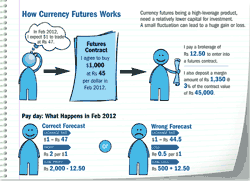
Currency futures require you to keep a margin of the value of contracts in your account. If the margin required is 3 per cent and you enter into a dollar/rupee contract for two lots of 1,000 at Rs 50 (total worth Rs 1 lakh), you will have to keep Rs 3,000 in your currency trading account. If the value of the rupee falls to Rs 55 a dollar, you will have to supplement your trading account as the margin required goes up to Rs 3,300. If the margin requirement is not met, the broker will sell your contract on the basis of the Reserve Bank of India's reference rate.
Some banks, such as SBI, let you earn interest on the margin amount. The margin money is marked as lien in your bank account without actually being transferred to the trading account.
ENTERING THE MARKETUnderstanding your risk appetite and tolerance is important before entering the high-leverage currency trading. "First-time traders should start with very small ticket sizes. Only when you have gained confidence about the nature and working of these instruments should you look to increase your ticket size," says Pandey.
You can get a forex trading account with any registered bank or brokerage. "Individuals should be associated with only registered members. Knowledge of market would also be a definite plus, especially with certifications such as one from the National Institute of Securities Markets," says Narayanasami.
"If the government can take steps to increase liquidity in the market by introducing crosscurrency pairs and by opening doors for other players like foreign institutional investors to trade in this market, we will soon see it challenging the stock market," says Brahmbhatt.