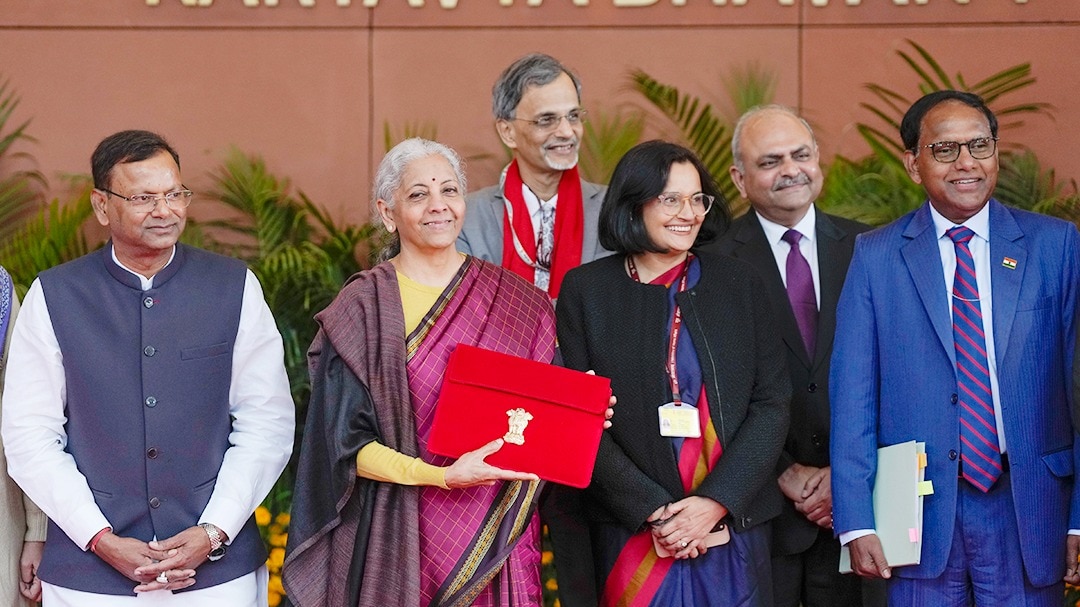
As Sitharaman prepares to present the Union Budget in Parliament, there have been demands for deeper tax reforms. IUnion Budget 2026 is set to be a landmark moment for Finance Minister Nirmala Sitharaman. In an hour, FM Sitharaman will present the Union Budget for FY 2026–27, becoming the first woman finance minister to deliver the annual exercise for a ninth straight year.
As Sitharaman prepares to present the Union Budget in Parliament, there have been demands for deeper tax reforms. Income tax is once again at the centre of attention as expectations build ahead of the Union Budget 2026, particularly among salaried and middle-class taxpayers grappling with rising household expenses and uneven wage growth. While demands for relief are loud, many experts believe Finance Minister Nirmala Sitharaman is more likely to opt for calibrated tweaks rather than sweeping tax overhauls.
A key proposal being pushed by taxpayers and financial experts is the introduction of joint income tax filing for married couples, a change seen as particularly beneficial for dual-income families facing mounting cost-of-living pressures in urban India.
India’s current tax regime requires spouses to file returns individually, regardless of marital status. This approach often complicates tax planning and limits the ability of households to efficiently use deductions and exemptions, especially where incomes between partners are uneven. For tax purposes, married individuals are treated as completely separate entities.
Supporters of joint filing argue that India is out of step with several advanced economies, including the United States, where couples can opt for “Married Filing Jointly” and benefit from more favourable tax treatment. With middle-class finances under strain, proponents see Budget 2026 as a potential inflection point for aligning the tax system with modern household economics.
Several tax professionals expect targeted relief for salaried employees and retirees. Suggestions include raising the standard deduction from ₹75,000 to ₹1 lakh, easing retirement taxation by increasing the tax-free portion of NPS withdrawals, and enhancing the exemption limit for long-term capital gains. Such measures, experts argue, would provide meaningful relief without straining fiscal arithmetic.
There is also a strong push to modernise existing frameworks. Professionals have flagged that presumptive taxation under Section 44ADA no longer reflects today’s cost structures, with calls to reduce the deemed profit rate from 50% to 40%. At the same time, the lack of home loan benefits under the new tax regime remains a sore point, especially for first-time buyers, prompting demands for limited deductions to restore balance between the old and new regimes.
Housing-related relief features prominently on the wishlist. Experts want HRA rules revisited, arguing that more large cities should qualify as “metros” for higher exemptions. Senior citizens, too, are seeking differentiated treatment, including higher basic exemption limits and additional medical deductions under the new regime, given rising healthcare costs.
On the compliance side, the Institute of Chartered Accountants of India has proposed simplifying the TDS structure by cutting the number of rates to reduce disputes and ease administration. Market-linked demands include lower capital gains tax, rationalisation of securities transaction tax, and tax parity for debt instruments to boost investor sentiment.
Beyond income tax, suggestions range from real-time income tax refund tracking to measures supporting gold demand amid high prices. Overall, the consensus is clear: Budget 2026 is expected to focus on fine-tuning and stability rather than “big bang” tax announcements, balancing taxpayer expectations with fiscal discipline.
FM Nirmala Sitharaman announced a significant increase in capital expenditure for FY27, raising the allocation to ₹12.2 lakh crore to sustain the government’s infrastructure-led growth push. Presenting the Budget, she said public capex has risen sharply over the past decade—from about ₹2 lakh crore in 2014–15 to ₹11.2 lakh crore in the Budget Estimates for FY26—and the proposed hike for FY27 is aimed at maintaining this momentum.
Divam Sharma, Co Founder and Fund Manager at Green Portfolio PMS, said: "The government has announced a capital expenditure (capex) target of ₹12.2 lakh crore for the upcoming fiscal, marking a substantial increase from ₹10 lakh crore in FY26. This represents robust double-digit growth, signaling a strong policy focus on infrastructure development as a key driver of economic expansion. Higher capex allocation typically translates into increased spending on roads, railways, airports, energy, and urban development projects, which not only stimulates demand in construction and ancillary sectors but also creates a multiplier effect across the economy. In long term, such aggressive capex can have several long-term implications. Infrastructure and heavy engineering companies are likely to see improved order books and revenue growth. Sectors like steel, cement, power, and transportation could benefit from sustained demand. While short-term market reactions may be influenced by macro factors and liquidity conditions, consistent capex-led growth can support higher long-term equity valuations, especially for cyclical and capital goods stocks. Over time, this approach may foster investor confidence in growth-oriented sectors, creating a positive structural impact on the equity market."
As expectations build ahead of Budget 2026, Gen Z taxpayers—first-jobbers and early-career professionals—are hoping Finance Minister Nirmala Sitharaman delivers measures that meaningfully lift take-home pay rather than just offering complex deductions. According to Ramachandran Krishnamoorthy, Director – Payroll Services at Nexdigm, recent reforms have already moved in that direction, but there is room to go further.
Check LIVE coverage here: Budget 2026 LIVE Updates: Rare earth corridors to be established, ₹10,000 cr for biopharma sector -- Nirmala Sitharaman
One of the biggest gains for young earners has been the sharp rise in the tax-free income threshold under the new tax regime. With the Section 87A rebate and standard deduction, salaried individuals earning up to around ₹12 lakh effectively pay no income tax. For Gen Z, this translates into higher disposable income right from their first job.
The increase in the standard deduction to ₹75,000 has also directly boosted monthly take-home pay by reducing taxable income without requiring additional investments or paperwork. Looking ahead, experts expect Budget 2026 to focus on refining tax slabs—possibly widening lower-rate bands or easing rates in middle slabs where many young professionals fall.
Further simplification of TDS thresholds could also help by preventing excess tax deductions during the year, reducing the need to wait for refunds. Finally, easier compliance and filing processes would lower stress and errors, ensuring tax administration does not quietly erode disposable income. For Gen Z, simplicity may matter as much as savings.
How much tax are you paying now
Full report read here: Union Budget 2026: What are your tax slabs and how much goes to the Income Tax Department
₹12 lakh income
Taxable income: ₹11.25 lakh
Tax slab: ₹8–12 lakh
Final tax payable: ₹0
₹15 lakh income
Taxable income: ₹14.25 lakh
Tax slab: ₹12–16 lakh
Final tax payable: ₹97,500
₹20 lakh income
Taxable income: ₹19.25 lakh
Tax slab: ₹16–20 lakh
Final tax payable: ₹1,92,400
₹25 lakh income
Taxable income: ₹24.25 lakh
Tax slab: ≥ ₹24 lakh
Final tax payable: ₹3,19,800
₹30 lakh income
Taxable income: ₹29.25 lakh
Tax slab: ≥ ₹24 lakh
Final tax payable: ₹4,75,800

Income tax slabs explained: What Budget 2025 changed and how it affects you
Budget 2025 reshaped India’s income tax landscape by significantly widening slabs under the new tax regime and raising the basic exemption limit to ₹4 lakh. The move was aimed at simplifying taxation and offering broader relief to salaried taxpayers by reducing dependence on exemptions and deductions.
Under the old tax regime, the basic exemption limit continues to differ by age. For individuals below 60 years, income up to ₹2.5 lakh remains tax-free. Resident senior citizens (60–79 years) enjoy a higher exemption of ₹3 lakh, while super senior citizens aged 80 years and above get the highest relief, with income up to ₹5 lakh exempt from tax.
New tax regime slabs (FY 2025–26)
Under the revised new regime, income is taxed progressively as follows:
Income up to ₹4 lakh: Nil
₹4 lakh to ₹8 lakh: 5%
₹8 lakh to ₹12 lakh: 10%
₹12 lakh to ₹16 lakh: 15%
₹16 lakh to ₹20 lakh: 20%
₹20 lakh to ₹24 lakh: 25%
Above ₹24 lakh: 30%
Old tax regime slabs
The old regime retains fewer slabs but higher jump points:
Up to ₹2.5 lakh: Nil
₹2.5 lakh to ₹5 lakh: 5%
₹5 lakh to ₹10 lakh: 20%
Above ₹10 lakh: 30%
What changed in 2025
A key attraction of the new tax regime is the higher standard deduction of ₹75,000, compared with ₹50,000 under the old regime. In addition, the deduction on family pension income has been increased to ₹25,000, offering relief to pensioners.
From FY 2025–26, individuals with taxable salary income of up to ₹12.75 lakh can effectively pay zero tax under the new regime after factoring in deductions and rebates. Even higher earners stand to gain: those earning up to ₹25 lakh are expected to save over ₹1 lakh by opting for the new regime, while reduced surcharge rates make it more attractive for incomes above ₹50 lakh as well.
Taxpayers are advised to use an income tax calculator to compare both regimes and assess which option delivers the maximum savings based on their income and deduction profile.