


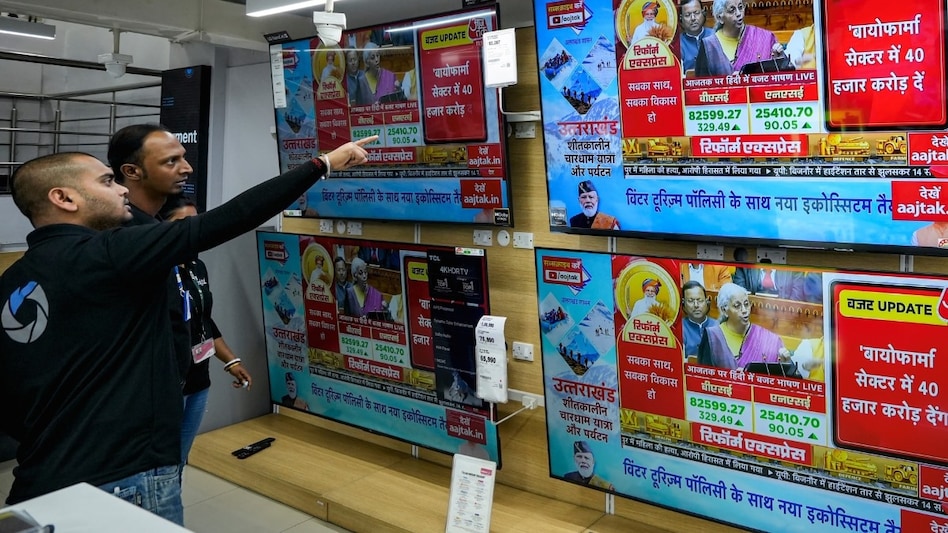
 To address concerns around quality and standardisation, the Finance Minister announced upgrades to regulatory infrastructure.
In a bid to strengthen the AYUSH ecosystem and position India as a healthcare and wellness destination, the government, in the Union Budget 2026, has outlined a series of measures focused on quality certification, research capacity and export readiness for traditional medicine systems, particularly Ayurveda.
“Post-COVID, Ayurveda gained a similar global acceptance and recognition,” Finance Minister Nirmala Sitharaman said while presenting the Budget in Parliament on Sunday. She said the growing global demand for Indian traditional medicine presents both an economic and healthcare opportunity. “Exporting quality Ayurvedic products helps farmers who grow the herbs and the youth who process the products,” she added.
Follow live coverage on Union Budget 2026 here
A key element of the plan is the creation of five Regional Medical Hubs, to be set up by states in partnership with the private sector. “To promote India as a hub for medical tourism services, I propose to support states in establishing five Regional Medical Hubs,” Sitharaman said. These hubs will function as integrated healthcare complexes combining medical services, education and research facilities.
“The move recognises the immense potential of medical tourism and is likely to spur additional investment in the hospital and diagnostics sector,” said Siddharth Iyer, Sector Lead – Industrials at Equirus.
According to the Budget announcement, the hubs will include AYUSH centres, Medical Value Tourism Facilitation Centres, and infrastructure for diagnostics, post-treatment care and rehabilitation. These hubs are seen as a way to improve patient experience for international and domestic visitors while creating employment for doctors, allied health professionals and support staff.
The Budget also laid out steps to strengthen the AYUSH ecosystem itself, with a focus on quality and regulation. “I propose to set up three new All India Institutes of Ayurveda,” Sitharaman said, adding that the move is aimed at expanding education, clinical services and research capacity in traditional medicine.
To address concerns around quality and standardisation, the Finance Minister announced upgrades to regulatory infrastructure. “AYUSH pharmacies and Drug Testing Laboratories will be upgraded for higher standards of certification ecosystem, and to make available more skilled personnel,” she said. Industry stakeholders have long flagged gaps in testing capacity and certification as barriers to exports, particularly in regulated overseas markets.
“Stronger standardisation and research support could help brands develop safer, export-ready formulations and build consumer trust in domestic and international markets,” said Pawanjot Kaur, Co-Founder of Ayuvya Ayurveda, adding that the Budget creates a clearer framework for the sector.
The Finance Minister also announced the upgradation of the World Health Organization (WHO) Global Traditional Medicine Centre at Jamnagar to bolster evidence-based research, training and awareness for traditional medicine. The centre, set up with support from the WHO, focuses on documentation and validation of traditional medicine systems and their global integration.
The renewed policy thrust comes as exports of AYUSH products continue to grow. According to government data, exports of AYUSH products, including Ayurvedic medicines and herbal formulations, have crossed ₹6,000 crore annually. Exporters, however, have pointed to the need for stronger testing infrastructure, consistent certification and globally accepted standards to sustain growth in key markets.
By emphasising laboratories, certification systems and institutional capacity, the government aims to address these gaps while linking the AYUSH sector’s expansion to agriculture, employment and healthcare services.
“The push on AYUSH and Ayurveda is timely. Global interest is growing, but it will last only if it is backed by proof, quality and consistency,” said Sanjaya Mariwala, Executive Chairman and Managing Director of OmniActive Health Technologies.

 CBDT issues new crypto reporting guidance: No new tax, but exchanges must track and report all transactions
 Did Cockroach Janta Party's 'Chalo Sansad' 2.0 threat trigger Dharmendra Pradhan's resignation? What we know so far
 'Will discharge my responsibilities with complete humility': Pralhad Joshi after being appointed Education Minister
 Curious about Pralhad Joshi's wealth? A closer look at his assets, investments and liabilities
 On Cockroach Janta Party's lines, now E20 Janta Party demands choice of 100% petrol
 Best Healthcare Stocks: Gaurang Shah's Outlook On Apollo Hospitals, Fortis & The Manipal Health IPO
 Is Indo-MIM's IPO Valuation Justified? Here's Why The Company Sees Strong Growth Ahead
 Treasury Bills Explained: Why T-Bills Are One Of The Safest Short-Term Investment Options
 FDs vs Markets: Where Should You Keep Your Short-Term Money?
 Why Term Insurance Is Essential for Every Earning Member | Sum Assured & Coverage Explained
 Gland Pharma stock: Price target of Rs 3,250 likely in medium term, says analyst
  Metal recycling stocks to buy: Gravita, Pondy Oxides, Jain Resource among top picks
 TRIL shares: Should you average the falling stock? Here's 'fixed and final' stop loss
 Adani Power: 45 GW target, Rs 2 lakh crore capex plan among conference call highlights
  ITC Hotels, Chalet, Ventive, IHCL, SAMHI: Hotel stocks to buy despite travel disruptions
 'This is the behaviour of...' : Congress leader Kanhaiya Kumar detained by Delhi police after Kerala House altercation
 'You can do whatever you want?': Delhi HC questions EC over mandatory election duty for school teachers
 Mayor Zohran Mamdani taps tech-slayer Lina Khan to reshape New York City’s economy
 Planning a Nepal trip? You can now carry up to ₹25,000 in Indian cash. Here's what changedGland Pharma stock: Price target of Rs 3,250 likely in medium term, says analyst









