


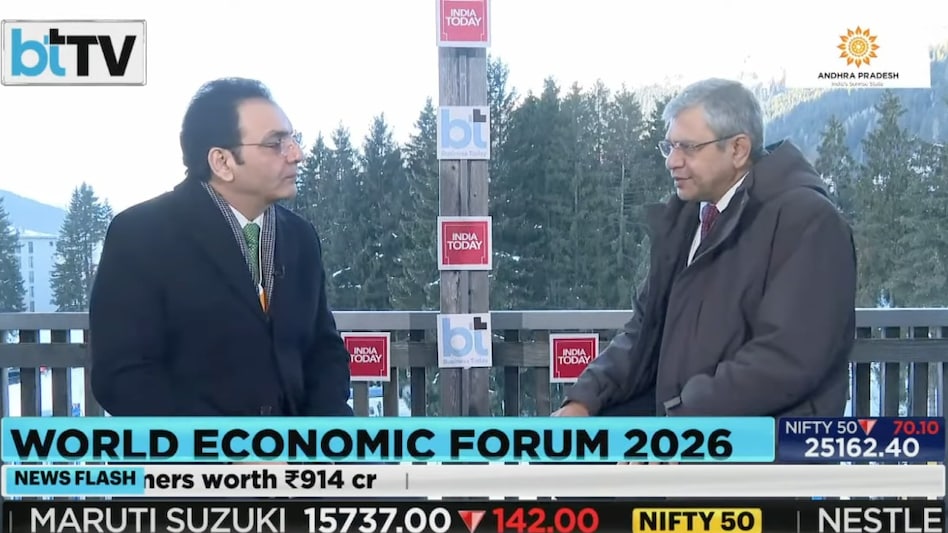
 Ashwini Vaishnaw, in conversation with Business Today
 India expects to run most of its artificial intelligence (AI) work on home-grown models within a year as it pushes to become a sovereign power in compute and digital infrastructure, according to Ashwini Vaishnaw, minister for electronics and information technology.
Speaking to Business Today in an exclusive interview on the sidelines of the World Economic Forum in Davos, Vaishnaw said India is no longer merely reacting to global technology trends but is actively shaping them through a combination of heavy infrastructure investment and a digital-first economic strategy.
“In one year from now, most of our AI-related work, we should be able to do with our sovereign models,” Vaishnaw said.
India has launched an ambitious national AI mission aimed at building domestic compute capacity, models and applications at scale. Vaishnaw said the government is focused on democratising access to advanced technology by building a shared national backbone.
“We will come with a complete series of AI applications, which will be used by our people and we'll come with a common compute facility, which is already there with 38,000 GPUs, we'll expand it significantly,” he said.
The minister said India’s size, diversity and industrial complexity position it as what he described as the “use case capital of the world”, arguing that while large language models (LLMs) will increasingly become commoditised, real value will be created through large-scale deployment.
“Where the LLMs will become a commodity, the real value will be in the use cases,” Vaishnaw said, pointing to opportunities across governance, healthcare, education, agriculture and manufacturing.
Alongside AI, Vaishnaw highlighted rapid progress in India’s semiconductor and electronics manufacturing push, which has become a cornerstone of the country’s broader industrial policy.
He said India’s chip ecosystem is moving beyond basic assembly and testing into advanced design and fabrication.
“Today we are designing 2nm chips in our country, there are 24 startups that have started designing their own,” he said.
According to Vaishnaw, India now has a presence across the entire semiconductor value chain, from design and packaging to fabrication and electronics manufacturing.
“Electronics export has become the 3rd largest exported item,” he said.
The government has rolled out production-linked incentive schemes, capital subsidies and long-term policy support to attract global chipmakers and electronics manufacturers, positioning India as an alternative manufacturing hub amid geopolitical realignments and supply-chain diversification.
Vaishnaw said the shift is also changing how global investors and technology companies view India.
He added that stable and predictable policies are encouraging long-term investment across both digital and physical infrastructure, from data centres and telecom networks to fabs and electronics factories.
Vaishnaw concluded that India is now seen as a trusted global partner, combining scale, talent and policy continuity to build what he described as a new model of technology-led development.

 Dharmendra Pradhan resigns, says decision taken to protect students' future amid NEET row
 All about Dharmendra Pradhan's educational qualification, wealth, assets and more
 UK Cabinet: 3 Indian-origin MPs join UK PM Andy Burnham's front bench; Kanishka Narayan gets AI portfolio
 Adani's airline push: Letter shows group wants to launch carrier, says report
 Should you buy every IPO? Research suggests patience may be the smarter strategy
 Why Term Insurance Is Essential for Every Earning Member | Sum Assured & Coverage Explained
 Pakistan's Alleged Terror-Politics Nexus: Lashkar Links Spark Questions Over Fazlur Rehman
 Think Life Insurance Is Optional? Here's Why Every Indian Family Needs It Today
 FD Vs Arbitrage Fund: Which Is Better For High Taxpayers?
 Manipal Health Enterprises Sets Price Band For Rs 9,275 Crore IPO, Opens July 29
 Adani Power: 45 GW target, Rs 2 lakh crore capex plan among conference call highlights
  ITC Hotels, Chalet, Ventive, IHCL, SAMHI: Hotel stocks to buy despite travel disruptions
 ITC shares: Rs 307 a key short-term level to watch; here's target price
 Mphasis shares: FY27 guidance maintained; brokerages keep 'Buy' after Q1; check target priceShould you buy every IPO? Research suggests patience may be the smarter strategyAdani Power: 45 GW target, Rs 2 lakh crore capex plan among conference call highlights Why Term Insurance Is Essential for Every Earning Member | Sum Assured & Coverage ExplainedDharmendra Pradhan resigns, says decision taken to protect students' future amid NEET rowUK Cabinet: 3 Indian-origin MPs join UK PM Andy Burnham's front bench; Kanishka Narayan gets AI portfolio
 India's first REIT mutual fund is here. Can it change how Indians invest in real estate?









