


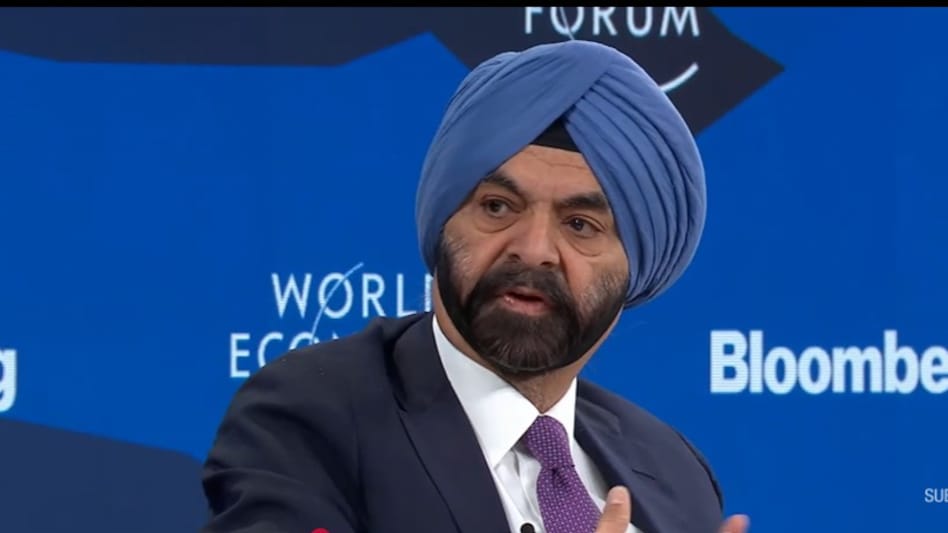
 WEF Summit 2026: Banga said stronger physical and human infrastructure, along with business-friendly policies, are vital as the private sector creates jobs while the government enables growth.
The job market is set to get even more competitive over the next 12-15 years. World Bank Group President Ajay Banga said at the World Economic Forum in Davos that around 1.2 billion youngsters would be competing for around 400 million jobs.
"Over the next 12-15 years, 1.2 billion young people in the emerging markets will become eligible for a job in the sense that they will come to the age of 18. And yet those very same economies are currently projected to produce around 400 million jobs," Banga told Bloomberg.
He also stated that AI and/or some other technology in the future could lead to some change, but the World Bank is "unlikely to be wrong about 800 million people".
During the conversation, he further mentioned that Singapore President Tharman Shanmugaratnam offered to help Banga in his mission on one condition -- the drive to put effort, energy, money and capital to work.
Banga said stronger physical and human infrastructure, along with business-friendly policies, are vital as the private sector creates jobs while the government enables growth.
Citing the example of Singapore, he said, "Even an outstanding government like Singapore enables the private sector in Singapore to create jobs, and then if you provide the right catalytic financing for that private sector, particularly micro and small enterprises, which is where the majority of jobs get created, then you create the virtual flywheel the positive flywheel that you want."
The World Bank Group President, however, said that emerging markets should not rely only on the outsourcing of jobs from developed countries as a primary source of job generation due to political and geopolitical concerns. Furthermore, he said that AI can also help farmers, healthcare workers, and education workers do a better job.
Furthermore, he outlined the 5 specific sectors that the World Bank Jobs Council is focusing on, with the top three being infrastructure, primary healthcare, and agriculture for small farmers.
Talking about the agricultural sector, Banga went back to his days in India and at Nestlé.
"I have grown up in India. You know I'm a sort of son of Punjab, even though my father was an army officer, and I worked in Nestle for the first few years of my life. We were based in the Punjab, collecting milk from farmers. The tragedy is that farmers today don't want to be farmers if they're microsized. They sell their farm, and they end up as urban poor. An objective to make them access scalable pricing and commodities and technology and markets, and get them the benefit of scale, which otherwise they don't lack, is our third category."
He added that the fourth and fifth categories that create the highest number of jobs are tourism and value-added manufacturing.

 Exam reforms: Tech titan Nandan Nilekani picked by PM Modi to fix national public examination system
  'Tax officers struggled for own land': Nirmala Sitharaman slams laidback attitude of govt depts
 CBDT issues new crypto reporting guidance: No new tax, but exchanges must track and report all transactions
 Did Cockroach Janta Party's 'Chalo Sansad' 2.0 threat trigger Dharmendra Pradhan's resignation? What we know so far
 'Will discharge my responsibilities with complete humility': Pralhad Joshi after being appointed Education Minister
 AI Data Centers, Aerospace & Gas Turbines: What's Powering Indo-MIM's Future Growth?
 Best Healthcare Stocks: Gaurang Shah's Outlook On Apollo Hospitals, Fortis & The Manipal Health IPO
 Is Indo-MIM's IPO Valuation Justified? Here's Why The Company Sees Strong Growth Ahead
 Treasury Bills Explained: Why T-Bills Are One Of The Safest Short-Term Investment Options
 FDs vs Markets: Where Should You Keep Your Short-Term Money?
 Gland Pharma stock: Price target of Rs 3,250 likely in medium term, says analyst
  Metal recycling stocks to buy: Gravita, Pondy Oxides, Jain Resource among top picks
 TRIL shares: Should you average the falling stock? Here's 'fixed and final' stop loss
 Adani Power: 45 GW target, Rs 2 lakh crore capex plan among conference call highlights
  ITC Hotels, Chalet, Ventive, IHCL, SAMHI: Hotel stocks to buy despite travel disruptions
 Beyond mutual funds: Why analysts see SBI Funds' alternative asset business as a long-term growth engine
 'Ashamed of it...': Manoj Muntashir calls Adipurush his biggest mistake, seeks country's forgiveness Exam reforms: Tech titan Nandan Nilekani picked by PM Modi to fix national public examination system 'Tax officers struggled for own land': Nirmala Sitharaman slams laidback attitude of govt depts
 Delhi targets traffic bottlenecks on Aruna Asaf Ali Marg with ₹1.97 crore elevated road study









