


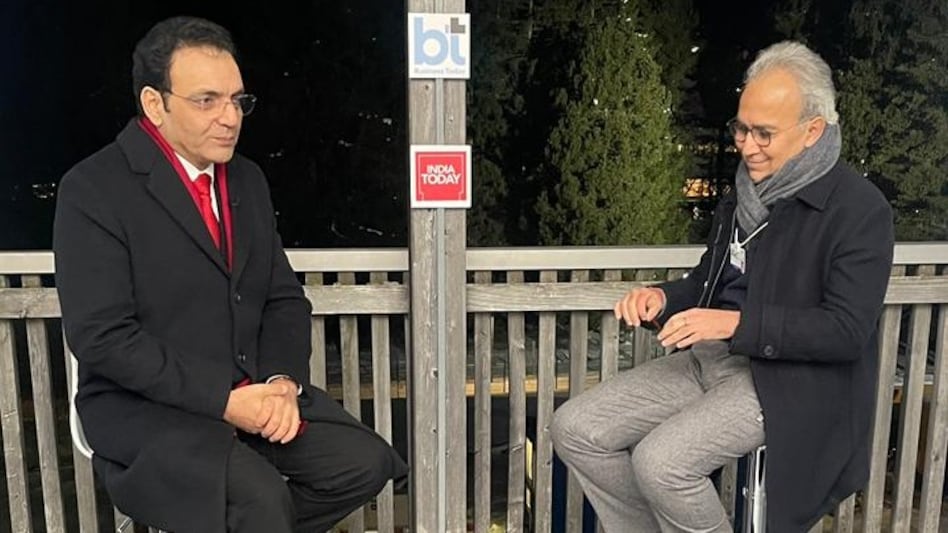
 WEF Summit 2026: Memani dismissed the idea that Indian companies are holding back on investments.
At Davos 2026, amid the din around artificial intelligence, Rajiv Memani, President of the Confederation of Indian Industry (CII), cut through the noise with a grounded message: for CEOs, the bigger concern isn’t just AI — it’s geopolitics, trade volatility, and tough investment calls in an unpredictable world.
“Every week has new twists and turns. So what does it mean for your business? How do you plan investments? How do you plan for the midterm and long term?” Memani said in an exclusive interaction with Business Today TV.
On the stalled India-US trade deal, Memani admitted expectations were higher last year. “If you would have asked me last year at this time, I would have said that that’ll happen,” he said. But any agreement, he stressed, must be “fair, equitable, transparent and respectful of all sides.” He added that India remains engaged and open to a deal on balanced terms, while progress with other partners—like the UK, Middle East, and EU — offers a solid cushion.
Despite the deadlock with the US on trade, investments are flowing in. “A market that they cannot ignore,” is how Memani described India, citing tech-led US investments in AI, data centres, and semiconductors. Yet he noted a clear split — services and consumption are thriving, but manufacturing exports remain vulnerable to external shocks.
“Open market access matters,” he said, especially if India wants a deeper seat in global value chains. Indian companies, he added, continue to prioritise domestic opportunities, with most major groups keeping capital allocation focused at home.
Memani dismissed the idea that Indian companies are holding back on investments. “Private investment has picked up,” he said, though global volatility and China’s surplus capacity are posing serious challenges. “The Chinese exports around the world have gone up massively,” he warned, pressing for quicker trade remedies and anti-dumping measures. “We have to play a faster game.”
On domestic reforms, Memani supported the intent behind quality control orders but urged smarter execution. “QCO per se was not the wrong thing to do,” he said, encouraging better alignment with export goals and local capabilities.
Labour reforms, while adding short-term costs, were described as necessary for long-term flexibility. He also offered a pragmatic view on the gig economy and delivery-time debates. Whether it’s 10 or 20 minutes, he said, the model will evolve as cities and consumers push for safer, cleaner options.
On AI, Memani highlighted visible productivity gains but warned against quick returns. “AI is a longer-term play,” he said, pointing to automation already underway in tax, audit, and legal services. “You have to move fast, but the returns will take time.”
Looking ahead, Memani called for a laser focus on boosting manufacturing in the upcoming Union Budget. With a $450 billion import bill and AI infrastructure poised to drive up imports further, domestic capacity building is now urgent. “We have to start very proactively working and saying that we have to bring that down,” he said, calling for clear strategy, cross-ministerial coordination, and a focus on building sectoral champions.
The Davos takeaway, in Memani’s words: India’s macro story is strong, reforms are real, and business sentiment is resilient — but to stay competitive, the country must move faster on trade, manufacturing, and policy execution.
Watch the full interview here

 US-Iran pause attacks for second day; Trump 'giving talks some space' as Hormuz deal discussed
 New paper leak bill in Lok Sabha today, proposes harsher punishment; MPs given draft
 Which ITR form should NRIs use? Why filing ITR-1 could be a costly mistake
 Top stocks in news: NTPC, Jindal Steel, Bank of Baroda, NBCC, IDFC First, TCPL, SBI Cards, REC
 SIFs, mutual funds, PMS or AIFs: Which investment route deserves a place in your portfolio?
 AI Data Centers, Aerospace & Gas Turbines: What's Powering Indo-MIM's Future Growth?
 Best Healthcare Stocks: Gaurang Shah's Outlook On Apollo Hospitals, Fortis & The Manipal Health IPO
 Is Indo-MIM's IPO Valuation Justified? Here's Why The Company Sees Strong Growth Ahead
 Treasury Bills Explained: Why T-Bills Are One Of The Safest Short-Term Investment Options
 FDs vs Markets: Where Should You Keep Your Short-Term Money?
 Hindustan Zinc share price: HZL targets by Jefferies, HSBC, Citi & other stock brokerages
 Nifty, Sensex, Nifty Bank outlook for today: GIFT Nifty up 140 points; key levels to watchTop stocks in news: NTPC, Jindal Steel, Bank of Baroda, NBCC, IDFC First, TCPL, SBI Cards, REC
 Gland Pharma stock: Price target of Rs 3,250 likely in medium term, says analyst
  Metal recycling stocks to buy: Gravita, Pondy Oxides, Jain Resource among top picksNew paper leak bill in Lok Sabha today, proposes harsher punishment; MPs given draft
 Think a marriage certificate makes you husband and wife? Gujarat HC explains why registration alone cannot prove a valid Hindu marriageHindustan Zinc share price: HZL targets by Jefferies, HSBC, Citi & other stock brokerages
 A scooter in Coimbatore was slapped with 249 traffic challans worth ₹3.69 lakh — but there's a twistUS-Iran pause attacks for second day; Trump 'giving talks some space' as Hormuz deal discussed









