 US-Israel-Iran War: Iran launched ballistic missile strikes on Qatar's Ras Laffan Industrial City, the world's largest LNG export terminal
US-Israel-Iran War Updates: The US-Israel-Iran war has entered a dramatically sharper and more dangerous phase, with Iran warning of the "complete destruction" of US and allied energy facilities after Israeli strikes targeted the South Pars gas field.
Moreover, Tehran is considering a proposal to levy transit fees on vessels passing via the Strait of Hormuz to reportedly monetise the country's newfound control over the strategically vital waterway through which around 20 per cent of the world's oil and liquefied gas passes.
Previously, Iran launched ballistic missile strikes on Qatar's Ras Laffan Industrial City, the world's largest LNG export terminal, triggering extensive damage and a violent shock across global energy markets.
Back home in India, the Centre has ruled out any LPG shortage, stating that commercial supplies remain normal, even as it warned states to stay vigilant against hoarding and black marketing.
Sujata Sharma, Joint Secretary (Marketing & Oil Refinery), Ministry of Petroleum & Natural Gas, added that online bookings have further gone up to 94 per cent, adding that around 83 per cent of refill deliveries are being made using the Delivery Authenticate authentication code.
European natural gas futures surged as much as 35% on Thursday, crossing more than double their pre-war levels, as markets brace for prolonged supply tightness from a facility that accounts for roughly a fifth of the world's LNG output. The energy shock is spreading further, with Kuwait confirming that a drone attack sparked a fire at the Mina Al-Ahmadi refinery, one of the Middle East's largest, though no injuries were reported.
QatarEnergy confirmed widespread damage across multiple facilities at Ras Laffan, in what is widely seen as retaliation for Israel's earlier strike on Iran's South Pars Gas Field, an attack President Donald Trump said was carried out "out of anger," adding that Washington had no prior knowledge of the operation.
Also read: West Asia war: South Pars, Ras Laffan under the line of fire; All about the gas sites
US Defence Secretary Pete Hegseth said on Thursday that America will carry out the "largest attack on Iran" today. He said that US objectives have remained constant since the conflict began on February 28, adding operations are progressing as planned and targets are being met.
Furthermore, he said that Iran's ability to produce new ballistic missiles has taken a major blow after sustained US-Israel strikes on Tehran's military infrastructure. Hegseth also claimed that there was instability within the Islamic Revolutionary Guard Corps (IRGC) and went on to call its senior leadership a "temporary role".
He further suggested that Iran's submarine fleet has been wiped out as part of the ongoing war.
Abu Dhabi National Oil Company (ADNOC) CEO Sultan Al Jaber criticised Iran over the attacks on energy infrastructure across the Gulf, including facilities linked to the ADNOC. He called Iran strikes "unjustified, unprovoked, and illegal".
In a LinkedIn post, he warned that the incident is more than a regional dispute, calling it "global economic warfare."
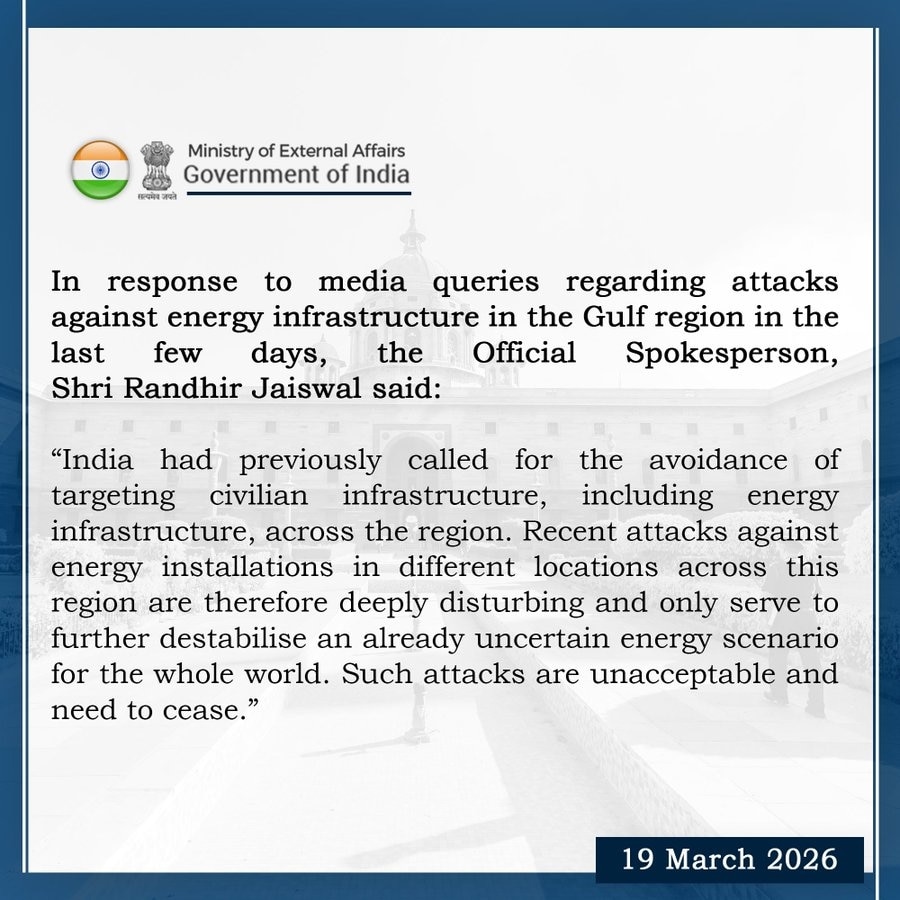
The Ministry of External Affairs (MEA) has expressed deep concern over the recent attacks on energy installations across West Asia, calling them “deeply disturbing.” The MEA warned that such incidents would further destabilise an already uncertain global energy scenario. Emphasising its strong stance, the ministry said that these attacks are unacceptable and must cease immediately.
Prime Minister Narendra Modi spoke with French President Emmanuel Macron on the ongoing conflict in West Asia. PM Modi stressed on the urgent need for de-escalation and a return to dialogue and diplomacy. "We look forward to continuing our close coordination to advance peace and stability in the region and beyond," he added.
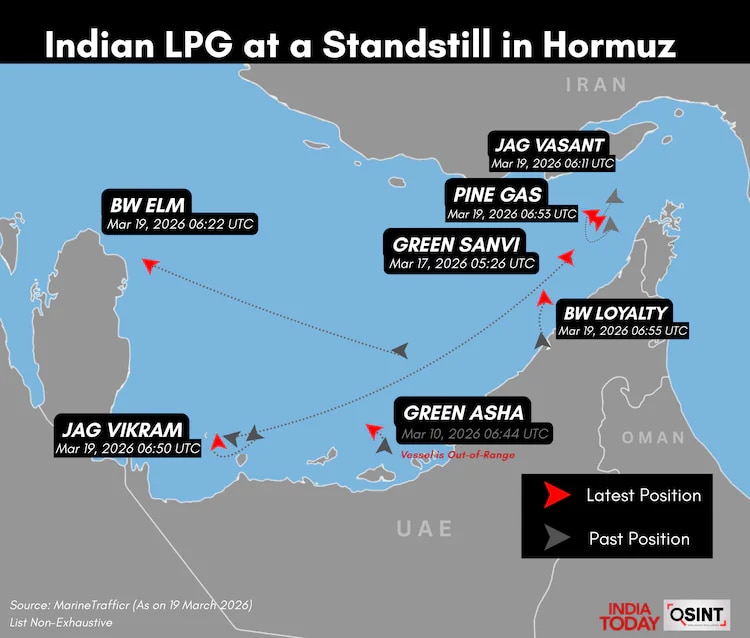
According to India Today's Open Source Intelligence Team (OSINT), 6 tankers carrying critical LPG supplies are stranded in the Strait of Hormuz. These are Jag Vasant, BW Elm, BW Loyalty, Pine Gas, Green Sanvi, Jag Vikram and Green Asha. All of these are positioned west of the Gulf, apart from Shivalik and Nanda Devi.
(With inputs from Bidisha Saha)
Prime Minister Narendra Modi on Thursday spoke to Sultan Haitham bin Tariq of Oman and his Malaysian counterpart Anwar Ibrahim, and discussed with them the West Asia situation, favouring de-escalation of the conflict in the region and subsequent restoration of peace and stability.
In his separate telephonic conversations with the two leaders, Modi also stressed the need for safe and free navigation through the Strait of Hormuz.
"Had a productive conversation with my brother Sultan Haitham bin Tariq and conveyed advance Eid greetings to the people of Oman. We agreed on the need to prioritize dialogue and diplomacy for de-escalation and subsequent restoration of peace and stability," Modi said in a post on X.
The PM reiterated India's condemnation of the violation of Oman's sovereignty and territorial integrity and appreciated its efforts to facilitate the safe return of thousands of people, including Indian nationals.
"India and Oman stand for safe and free navigation through the Strait of Hormuz," he said.
-- PTI
Iran is considering a proposal to levy transit fees on vessels passing through the Strait of Hormuz, a lawmaker said on Thursday, a potential bid to monetise Tehran’s newfound grip over the critical waterway through which a fifth of global oil and liquefied gas passes.
Since the start of the US-Israeli war on Iran, Tehran has disrupted maritime transit through the strait for vessels it says are linked to its war adversaries and their allies.
-- Reuters
Iran issued a stern warning on Thursday, threatening the "complete destruction" of US and allied energy facilities following recent escalations. After Israeli strikes targeted the South Pars gas field, Iran responded by attacking energy sites across the Gulf.
The Khatam Al-Anbiya military command released the following statements via the Fars news agency: “We warn the enemy that you made a major mistake in attacking the energy infrastructure of the Islamic Republic of Iran, and the response is underway and not yet finished.”
The military further cautioned: “If it is repeated, subsequent attacks against your energy infrastructure and that of your allies will not stop until their complete destruction, and our response will be far more severe than last night's strikes."
According to Al Jazeera, Iraq’s Civil Aviation Authority has closed the country's airspace to all flights until Sunday at 12:00 PM (09:00 GMT) due to regional security concerns. The closure applies to all arriving, departing and overflying aircraft.
Sujata Sharma, Joint Secretary (Marketing & Oil Refinery), Ministry of Petroleum & Natural Gas said, "Online bookings have further increased to 94%. Furthermore, approximately 83% of refill deliveries are being made using the Delivery Authenticate authentication code. Panic bookings are declining. Yesterday, approximately 57,000 refill bookings were received. Furthermore, LPG cylinder deliveries are normal. Approximately 17 state governments have issued allocation orders for commercial LPG. Commercial LPG supplies have been allocated to all states and union territories. Similarly, approximately 15 states and union territories have issued orders for additional kerosene allocations..."
The central government has moved to reassure the public that there is no LPG shortage across the country, stating that commercial supply currently remains normal and that a recent wave of panic booking is beginning to subside. The clarification came during an inter-ministerial briefing on the West Asia situation.
However, the government acknowledged that reports of hoarding and black marketing continue to trickle in from several parts of the country. In response, the Centre has issued directives to 17 state governments to closely monitor supply distribution, while urging all states and Union Territories to keep a close watch on panic-driven behaviour, hoarding, and the circulation of rumours , particularly on online platforms, to prevent any artificial disruption to LPG availability.
A drone attack caused a fire at Kuwait's Mina Al-Ahmadi refinery, which is one of the largest in West Asia with a production capacity of approximately 730,000 barrels per day. This is the second refinery fire in Kuwait reported after a drone strike. No injuries were reported.
Iranian missile strikes on Qatar's Ras Laffan Industrial City sent European natural gas prices into a sharp upward spiral on Thursday, with benchmark futures climbing as much as 35% and crossing more than twice their pre-war levels. The surge reflects deep market anxiety over a potential long-term squeeze on global gas supplies, given that the targeted facility is responsible for approximately one-fifth of the world's total LNG output.
Commerce Secretary Rajesh Agrawal on Thursday acknowledged that the ongoing West Asia crisis is beginning to weigh on India's trade environment, with exporters facing mounting challenges in their dealings with the region. Agrawal noted that shipments destined for the West Asian markets have failed to reach their destinations, while future export pipelines are also being disrupted, creating a growing sense of anxiety among businesses with exposure to the region.
Addressing the operational difficulties, the Commerce Secretary highlighted specific concerns around stranded cargo that needs to be rerouted or returned, as well as rising warehousing pressures. He added that the government is in daily coordination with all relevant stakeholders and ministries to actively work through these challenges.
In a bid to provide relief and sustain trade momentum, Agrawal announced a new scheme under the Export Promotion Mission, specifically targeting exports to 18 to 19 West Asian countries, signalling the government's intent to shield Indian exporters from prolonged disruption.
In a post on X, QatarEnergy confirmed that Iran launched ballistic missile strikes on Ras Laffan Industrial City, Qatar's primary liquefied natural gas production hub north of Doha and the world's largest LNG export terminal, causing widespread damage across multiple facilities.
The attack marks the second consecutive strike on the site. QatarEnergy stated that following an initial assault on Wednesday, March 18, which caused extensive damage to the Pearl GTL (Gas-to-Liquids) facility, a fresh wave of missiles struck several LNG facilities in the early hours of Thursday, March 19, triggering sizeable fires and further structural damage. Emergency response teams were deployed immediately to manage the situation, with no casualties reported. The company said it would continue providing updates as more information becomes available.
Note: Ras Laffan sits above the North Field, Qatar's side of the world's largest natural gas reservoir, shared with Iran, where it is known as South Pars. Iran's strike on Qatar's LNG infrastructure is widely seen as a retaliatory move following Israel's earlier attack on the South Pars Gas Field.
In a post on X, the UAE Ministry of Economy and Tourism firmly rejected circulating social media claims that the country has imposed restrictions on capital movement or is blocking foreign investors from transferring and managing their funds, clarifying that all financial activities remain fully governed by existing laws and regulations.
The Ministry reaffirmed the UAE's steadfast commitment to open economic policies and the free flow of capital in line with international best practices, urging the public and media to turn exclusively to official sources for accurate information.
American officials detected unidentified drones flying over Fort McNair, a US Army installation in Washington where Secretary of State Marco Rubio and Defense Secretary Pete Hegseth reside, according to a Washington Post report citing three people briefed on the matter.
The origin of the drones remains unknown, with authorities yet to determine where they were operated from, according to the report.
The incident prompted officials to discuss relocating both Rubio and Hegseth as a precautionary measure. However, neither secretary has moved from the base, a senior administration official confirmed to the Post.
The report noted that US military surveillance of potential threats has been stepped up in recent weeks, amid a heightened state of alert linked to the ongoing American and Israeli campaign against Iran.
President Donald Trump acknowledged that Israel carried out a strike on Iran's South Pars Gas Field, describing the attack as an emotionally driven response to escalating tensions in the region. Trump was quick to distance Washington from the operation, stressing that the United States had no prior knowledge of or involvement in the strike.
The remark came after Iran publicly accused Israel of targeting the strategically vital gas facility, an accusation that rattled energy markets and pushed oil prices sharply upward, signalling serious concerns over a broader escalation.
In a post on Truth Social, Trump stated that Israel had acted out of frustration over the deteriorating situation across the Middle East, adding that only a limited portion of the facility had been affected. He also moved to clear Qatar of any involvement, asserting that the Gulf nation had neither a role in nor advance knowledge of the attack.
The Trump administration is exploring significantly strengthening its military presence across West Asia. Internal deliberations suggest that several thousand additional American troops could be sent to the area, as Washington continues to assess its strategic approach in the ongoing standoff with Tehran.
People with knowledge of the matter say discussions are centred on broadening President Trump's options as the conflict moves into its third week. A variety of military courses of action are reportedly being weighed at senior levels.
One US official, along with three others familiar with the situation, confirmed to Reuters that troop reinforcements are under active consideration to support ongoing American operations in the region.
Among the scenarios on the table is a bolstered air and naval operation aimed at protecting commercial oil vessels navigating the Strait of Hormuz, a narrow waterway that serves as one of the most strategically vital energy corridors on the planet. Alongside maritime security measures, the possibility of deploying ground forces is also being examined, underscoring the increasingly













