 US Israel Iran War LIVE: Sharma added that since March 9, domestic LPG production has gone up to 28 per cent on Thursday.
West Asia Crisis: As the conflict involving the US, Israel and Iran entered its 13th day, Sujata Sharma, Joint Secretary (Marketing & Oil Refinery), Ministry of Petroleum & Natural Gas, said at a press conference on Thursday that the government has decided to release some units of liquefied petroleum gas (LPG) for commercial LPG beneficiaries.
She also said that 48,000 kilolitres of kerosene will be released for delivery to enterprises, adding that state governments will play a big role in supplying LPG and kerosene effectively. Sharma mentioned that LPG would be freed up for priority consumers, including households, hospitals and educational institutions.
Sharma added that since March 9, when the order under the Essential Commodities Act was issued, domestic LPG production has gone up to 28 per cent on Thursday. She said that no dry out of LPG has been reported at retail outlets operated by public sector oil marketing companies.
Previously, Union Minister for Petroleum and Natural Gas Hardeep Singh Puri said in the Lok Sabha that the panic over LPG supply is driven by consumer anxiety rather than supply shortage.
"Field reports indicate hoarding and panic-booking at the distributor and retail level, driven by consumer anxiety rather than any actual supply shortage," Puri told the Lok Sabha. He also said that alternate fuel options are being activated to ease LPG supply pressures.
Besides this, the Union Minister reiterated that there is no shortage of petrol, diesel and kerosene in the country. He added that domestic LPG supply is being prioritised, while adding that India's crude oil supply is secured.
He added that domestic LPG supply is fully protected, and energy sourcing has now been diversified from countries outside of the OPEC+ alliance.
Previously, the Ministry of External Affairs (MEA) spokesperson Randhir Jaiswal said on Thursday that the Indian Embassy is in constant touch with Indian students in Iran and is extending all possible assistance to ensure their safety amid the ongoing crisis.
He added that the mission is closely monitoring the situation and coordinating with students and Indians on the ground. Moreover, he said that many of the 9,000 Indians in Iran have returned to India after the ministry's February 24 advisory. These include students and seafarers, businessmen, and pilgrims.
He added that Indian nationals based in Tehran have been shifted to other safer locations and cities in the country. Jaiswal further mentioned that the government is also helping Indian nationals who wish to travel to Azerbaijan and Armenia and take commercial flights from there to return home.
Meanwhile, Indraprastha Gas Limited (IGL) has confirmed that PNG (home cooking gas) and CNG (vehicle fuel) supplies will remain uninterrupted. According to a company statement, this follows the government’s Natural Gas (Supply Regulation) Order issued on March 9. This new order officially classifies domestic PNG and CNG as top-priority sectors to ensure a steady supply for consumers.
Moreover, gig workers have claimed that Swiggy and Zomato deliveries have gone from 30 to 5 per day because of the war in the Middle East. Gig workers fear that the situation that migrant labourers faced during the coronavirus pandemic could play out for gig workers this time around, Nirmal Gohana, national co-ordinator of the Gig & Platform Service Workers Union, told Aaj Tak.
Also Read: Brent oil tops $100 again! What is fuelling the crude rally?
Also Read: Strait of Hormuz disruption: Iranian oil continues to flow at a ‘near-normal’ pace
US-Israel-Iran war LIVE: Check out the latest updates on BusinessToday.In
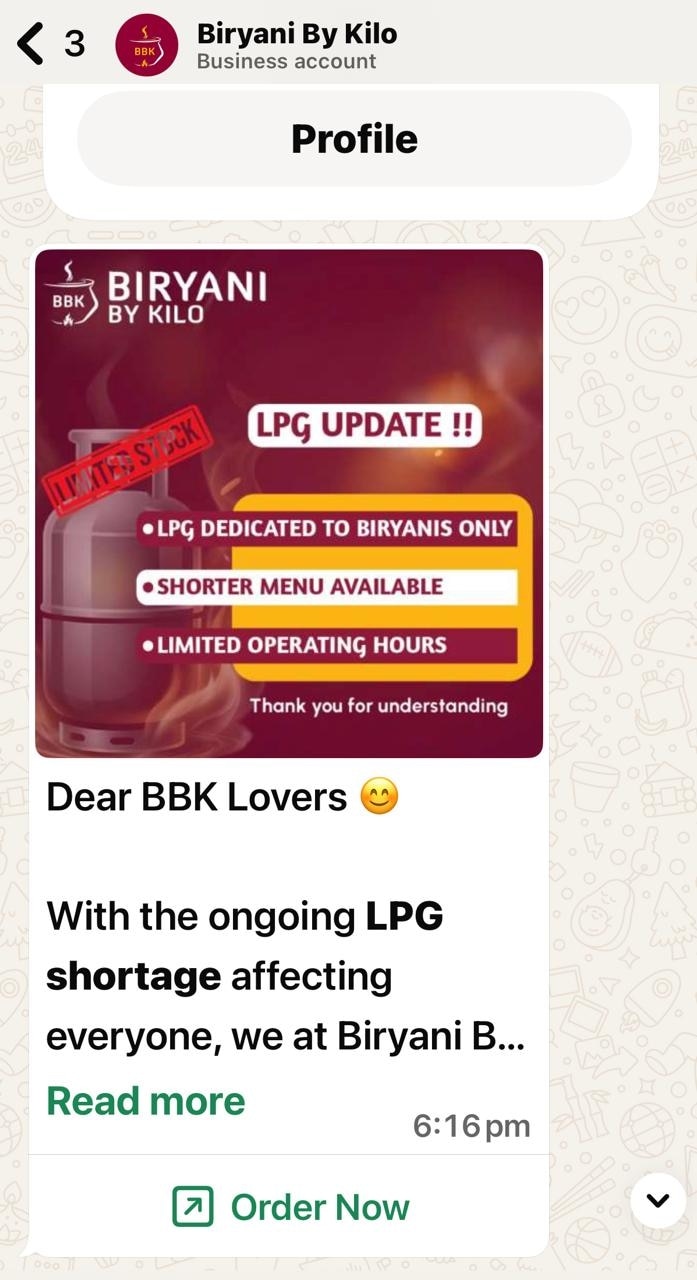
Popular biryani maker Biryani By Kilo said in a message to customers that it is tweaking its store timings to utilise more heat towards preparing its biryani. They also said that they simplified the menu to save LPG primarily for biryani cooking. In its message, Biryani By Kilo added that they are switching to backup methods for sides and other items.
US Energy Secretary Chris Wright told CNBC in an interview that the American navy is "not yet" ready to escort oil tankers through the strategically important Strait of Hormuz. He said, "It'll happen relatively soon but it can't happen now."
Wright added, "We're simply not ready. All of our military assets right now are focused on destroying Iran's offensive capabilities and the manufacturing industry that supplies their offensive capabilities."
Italian Defence Minister Guido Crosetto told the news agency Reuters that the airstrike on the Italian base in Iraq's Kurdistan was "deliberate".
Anwar Gargash, advisor to the UAE President, said on Thursday in a post on X that Gulf countries are on the verge of a decisive breakthrough in the West Asia conflict.
C Senthil Rajan, Secretary of the Ministry of Information & Broadcasting, urged TV channels to provide date and time stamps with visuals of panic situations. He also urged citizens to not indulge in panic buying of LPG cylinders, adding that over 50 lakh cylinders are being provided across India on a daily basis.
Furthermore, Rajan said that state- and district-level monitoring committees are being put in place.
Aseem R. Mahajan, Additional Secretary (Gulf), MEA, said that around 130,000 passengers have returned to India from West Asia through various flights. He added that regular flights to India are operating from Dubai, Saudi Arabia, Jeddah, and Riyadh. Mahajan further mentioned that 5-7 flights to India are available from Qatar.
MEA spokesperson Randhir Jaiswal said that around 2 dozen Indians have been injured in the GCC region so far as the West Asia conflict continues to rage on. He added that 3 Indian nationals have died and one is missing, stating that Oman and Dubai consulates are in constant touch with Indian nationals.
Sujata Sharma, Joint Secretary (Marketing & Oil Refinery), on Thursday requested the state governments to identify the list of beneficiaries of commercial LPG cylinders and ensure that deliveries of cylinders are made on a priority basis.
The government has decided to release some units of LPG for commercial LPG beneficiaries, says Petroleum Ministry Secretary.
Before being stopped by Lok Sabha Speaker Om Birla, Rahul Gandhi talked on the US' recent announcement of giving India a 30-day waiver to obtain Russian oil.
"The foundation of every single nation is its energy security. Allowing the United States to decide who we buy oil from, who we buy gas from, and whether we can buy oil from Russia or not...Our relationship with different oil suppliers can be decided by us. This is what has been bartered," the Congress MP said.
Commenting on claims of petrol and diesel shortage, Hardeep Singh Puri said in the Lok Sabha, "There is no shortage of petrol, diesel, kerosene, ATF or fuel oil. The availability of petrol, diesel, aviation and fuel oil is fully assured."
In the Lok Sabha, Union Minister for Petroleum and Natural Gas, Hardeep Singh Puri, says, "...The world has not faced a moment like this in modern energy history...India's crude supply position is secure, and the volume secured exceeds what the Hormuz would have delivered. Before the crisis, approximately 45% of India's crude imports transited through the Strait of Hormuz route. Thanks to the Prime Minister's outstanding diplomatic outreach and goodwill, India has secured crude volumes that exceed what the disrupted state of Hormuz could have delivered in the same period."
Bakery operations across Mumbai have been disrupted due to the lingering commercial LPG cylinder shortage triggered by the West Asia conflict. Bakery owners told India Today that many units have halted production as they struggle to procure commercial LPG cylinders required to run ovens.
The bakeries are facing this challenge due to the Brihanmumbai Municipal Corporation's (BMC) order to shift from wood-and coal-fired ovens to cleaner fuels such as LPG, piped gas, or electric ovens after a Bombay High Court order.
“It cost me around Rs 20 lakh to replace my wood-fired ovens with LPG ovens. For two days, I somehow managed cylinders, but since yesterday, my bakery has stopped operating,” said Ashfaque Siddique, Vice-President of the Bombay Bakers Association.
It claimed that around 2,500-3,000 bakeries in Mumbai are facing similar challenges. They also warned that if LPG supply does not improve soon, bread availability in Mumbai could be affected, particularly impacting migrant workers.
(With inputs from Mustafa Shaikh)
Sensex and Nifty continued their downward trajectory for the second consecutive day on Thursday as the war between Iran and US-Israel led to a rise in crude oil prices.
At close, the Sensex declined 829.29 points, or 1.08 per cent, to settle at 76,034.42, taking its two-day decline to 2,171.56 points. While the Nifty slipped 227.70 points, or 0.95 per cent, to close at 23,639.15, it slipped 2.56% in two sessions.
The International Energy Agency (IEA) has sharply lowered its global oil supply growth forecast. This change comes as the ongoing war in the Middle East chokes off major shipping routes, creating the largest supply disruption in history.
The Paris-based organization now expects oil supply to grow by only 1.1 million barrels per day (bpd) this year. This is a massive drop from the previous estimate of 2.4 million bpd. Supply is expected to plunge by 8 million bpd this month, hitting its lowest level since early 2022.
Most growth is now expected to come from countries outside the OPEC+ alliance, as Gulf producers are forced to cut output.At least 10 million bpd of production has been cut in the Gulf, with nearly 8 million bpd shut in this month alone.
The Strait of Hormuz, which handles about 20% of the world's oil, is effectively closed. Attacks on cargo ships and energy infrastructure have forced producers like Kuwait and Iraq to curb output, while Saudi Arabia searches for alternative routes.
Experts warn that it could take weeks or months for production to return to normal once the crisis ends.
Rupee recovers from its lowest level; settles 16 paise down at 92.17 (provisional) against the US dollar.
-- PTI
Auto and auto component companies are seeking a restoration of LPG and PNG allocation. In a letter to the Ministry of Petroleum and Natural Gas, the Society of Indian Automobile Manufacturers (SIAM) mentioned that any restrictions on the supply of LPG, PNG and propane to the sector and its ancillary industries might adversely impact supply chains of companies, leading to reduction in manufacturing.
Ministry of External Affairs (MEA) spokesperson Randhir Jaiswal on Thursday said that there are 9,000 Indians in Iran, including Indian students, seafarers, businessmen, and pilgrims. He added that many of them have returned after the February 24 advisory.
He added that students have been shifted to safer locations and the government is facilitating the repatriation of all Indians who are willing to come back.













