






With fixed deposits rates on a downward trajectory, investors are constantly looking at other options which can fetch better returns.
For instance, returns from FDs are at multi-year lows of 7 percent or less or even less.
Taking into account 30 per cent taxation (the highest tax bracket), the returns fall nearly to 5 percent which hardly beat inflation.
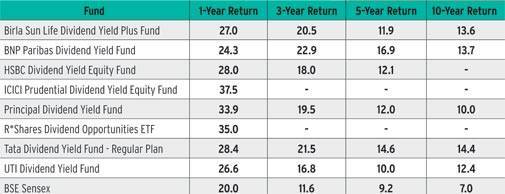
We look at funds high dividend paying funds/ stock which also have minimal risk.
A thorough diligence in before investing in these stocks /funds is critical.
"Investors must check the business in which these companies are, and whether these businesses have a viable and sustainable growth outlook," says Siddharth Purohit, Senior Equity Research Analyst, Angel Broking. They also need to see if the earnings momentum that these companies show can be maintained.
Promoters' shareholding pattern should also be checked as firms with larger promoter holdings tend to reward investors with regular dividend payouts. "Market capitalisation, average dividend yield, average profit growth and valuation parameters are some of the good indicators for you to select the best dividend yielding stocks," says Dinesh Rohira, Founder & CEO, 5nance.com.
Investors usually compare dividend yield on equity investments with their savings bank interest rates.
"Therefore, any stock with consistent dividend yields in excess of savings bank interest rate, offering decent capital appreciation, while belonging to a credible promoter group is a sound investment option," says Pankaj Pandey, Head of Research, ICICIDirect.
Hence, dividend yielding stocks appear most lucrative in a low-interest rate scenario where fixed income yield is lower.
It must be noted that high dividend yielding stocks with consistent track record usually do well in most market conditions, but underperform in extreme bull markets due to lower growth probability.
Generally, mature companies that have passed their stage of explosive growth tend to offer high dividend yields. On the other hand, high-growth companies tend to plough back their surplus cash into the business, thus offering higher growth and, hence, more appreciation in a bull market.
Read full story here: Taking Stock
 India-US BTA: Harley Davidson bikes to get 0% duty, gradual tariff reduction on luxury cars
 India-US interim trade agreement: 'No GM modified product allowed, agri sector protected,' says Piyush Goyal
 'Decided to give 0% tariff on some cancer medications, neuro treatment': Piyush Goyal on what US got
 Cyberattack impact on Tata Motors PV earnings crosses Rs 3,200 crore; losses still mounting
 India-US interim trade pact: 'Boeing, Airbus looking at India as largest OEM partner,' says Piyush Goyal
 BT Golf 2025-26 Kochi, Kerala Awards Ceremony Marks A High-Energy, Successful Conclusion
 Golf Is An Addiction. We Eat And Sleep Golf!
 The Fairway Fixes Everything. Mindset, Life, Relationships
 BT Golf LIVE: Join AU Small Finance Bank Presents BT Golf 2025-26 For Its 4th Leg In Kochi, Kerala
 AI Will Change MBAs, Not Leadership: IMD President On India’s Global Education Rise
 RIL, SBI, Kotak Bank, Kalyan, HAL, BEML, BDL among stocks in focus next week; here’s why
 NSE IPO may unlock mega gains for billionaire investors RK Damani, Premji
 SBI Q3 Results: Profit jumps 24% to Rs 21,028 crore; asset quality improves
 IDBI Bank stake sale: Kotak Mahindra Bank says ‘has not submitted a financial bid’
 BDL, Mazagon Dock, MRF, Hindustan Copper, RVNL, others to turn ex-dividend next week