








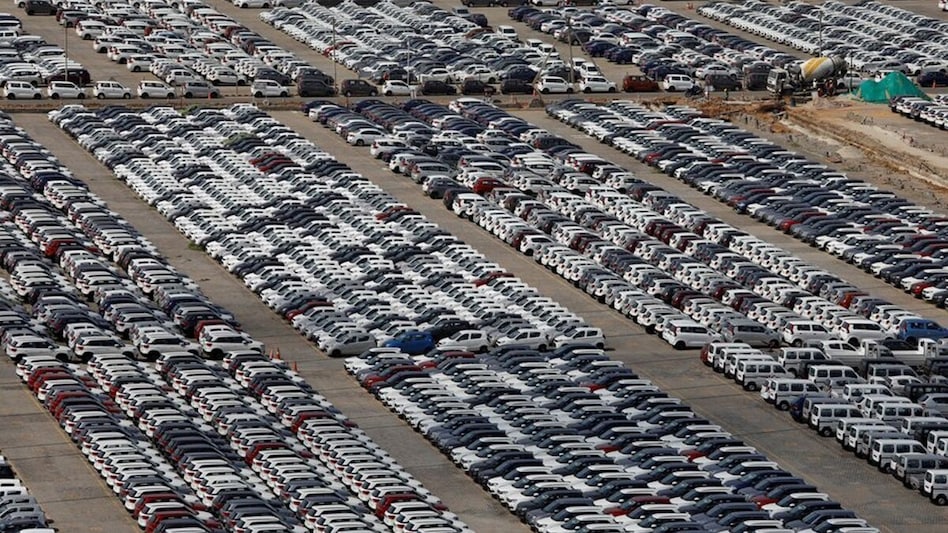
 VECV is a 16-year-old joint venture between the US-based Volvo Group and domestic commercial vehicle manufacturer Eicher Motors, which manufactures heavy-duty commercial vehicles. VECV is a 16-year-old joint venture between the US-based Volvo Group and domestic commercial vehicle manufacturer Eicher Motors, which manufactures heavy-duty commercial vehicles.
After a sluggish calendar year in 2024 for the commercial vehicle segment, the industry is expected to grow faster due to government support and infrastructure projects in CY25, said a top official at Volvo Eicher Commercial Vehicle (VECV) in an interaction with Business Today.
“Despite the significant allocation of money by the government on the capex and infrastructure projects, the ground-level situation was that the (infrastructure) spends have been not to the extent it would have happened in the normal course. I think that has started happening now,” says Vinod Aggarwal, MD & CEO, of Volvo Eicher Commercial Vehicle and the immediate past president of SIAM (Society of Indian Automobile Manufacturers).
“The government is very keen to break up all the shortfalls and capex spending in the last quarter. We will see more traction coming from the interest expense. I'm sure the government will continue focusing on the interest returns and allocate more money in the coming budget. So that is one reason why the commercial vehicle industry will continue to have a good future based on the infrastructure projects,” he added.
Notably, VECV aims to grow faster than the industry, according to Aggarwal. VECV is a 16-year-old joint venture between the US-based Volvo Group and domestic commercial vehicle manufacturer Eicher Motors, which manufactures heavy-duty commercial vehicles.
As per Aggarwal, VECV’s market share in light and medium-duty trucks currently stands at 36%. In heavy-duty vehicles, the company’s market share currently stands at 10%. The company’s market share in the heavy bus segment stands at 21% and in the light and medium buses, VECV’s market share stands at 24%, discloses Aggarwal. “We are continuously growing our market share. We have grown almost 10x in our top line. So that is what our track record is. We would like to keep this track record. We would like to become a very significant player in the commercial vehicle segment based on our joint venture strength and operation areas. So, the potential for us is very large,” says Aggarwal.
According to Sofia Frändberg, Chairperson, VECV, India is a key market for the Volvo Group. “India is a very important market, and we are very excited looking ahead for the future. We strongly believe in good development both for India, and India for the world. So, India has high focus and attention for the Volvo Group,” says Frändberg.
In FY24, VECV’s revenue from operations stood at Rs 21,868 crore, witnessing a growth of 15.38% as against Rs 18,952 crore in FY23. The company’s EBITDA grew by 25.27 % to Rs 1,715 crore in FY24.
Going ahead, the heavy-duty truck segment will be a key area of interest for VECV, as per Aggarwal. “We are still at around 10% (in terms of market share) for the heavy-duty truck segment. Heavy-duty trucks constitute a very large market, both in terms of numbers and value because the truck costs are prices are very high. It is an essential part of the commercial vehicle industry. So, there we have huge growth potential,” notes Aggarwal.
Notably, VECV forayed into the 2.5-3 tonne small commercial vehicle category by launching its first electric vehicle for last-mile delivery. “2 to 3.5 tonne is the largest segment of the commercial vehicle market. This segment is more than 300,000 units, which means this segment constitutes more than 30% of the overall commercial vehicle industry. Now we are entering this segment with our two electric vehicles in line with our sustainability,” says Aggarwal.
Apart from electric vehicles, the company also has LNG products in its portfolio. Despite a growing debateabout the presence of diesel powertrains in the heavy and commercial vehicle segment, VECV remains committed to “fossil fuel-free products,” according to Frändberg.
“We have been very clear from the Volvo group standpoint that we believe that, of course, the shifts will have to happen, and it will come and there will need to be different options, electric vehicles, fuel cell vehicles, and alternative fuels. So, our sort of strategy is to develop products in all these areas. Our mission is to provide only fossil-free products in the future. The shift is not happening as fast as we would have wanted it to, but it will come,” says Frändberg.
 Claims of sovereignty loss in India-US trade deal ‘absolute nonsense’: Piyush Goyal
 SEBI draws line between listing norms and RBI rules in guidance to PNB
 India’s US oil imports are strategic decisions, not trade pact obligations: Piyush Goyal
 Domestic airfares set to rise as IndiGo capacity cuts hit summer schedule: Report
 'True luxury is here to stay’: Isprava’s Dhimaan Shah
 BT Golf 2025-26 Kochi, Kerala Awards Ceremony Marks A High-Energy, Successful Conclusion
 Golf Is An Addiction. We Eat And Sleep Golf!
 The Fairway Fixes Everything. Mindset, Life, Relationships
 BT Golf LIVE: Join AU Small Finance Bank Presents BT Golf 2025-26 For Its 4th Leg In Kochi, Kerala
 AI Will Change MBAs, Not Leadership: IMD President On India’s Global Education Rise
 Stocks in news: RIL, Tata Steel, IREDA, Kalyan Jewellers, BEML and more
  RIL, SBI, Kotak Bank, Kalyan, HAL, BEML, BDL among stocks in focus next week; here’s why
 NSE IPO may unlock mega gains for billionaire investors RK Damani, Premji
 SBI Q3 Results: Profit jumps 24% to Rs 21,028 crore; asset quality improves
 IDBI Bank stake sale: Kotak Mahindra Bank says ‘has not submitted a financial bid’