

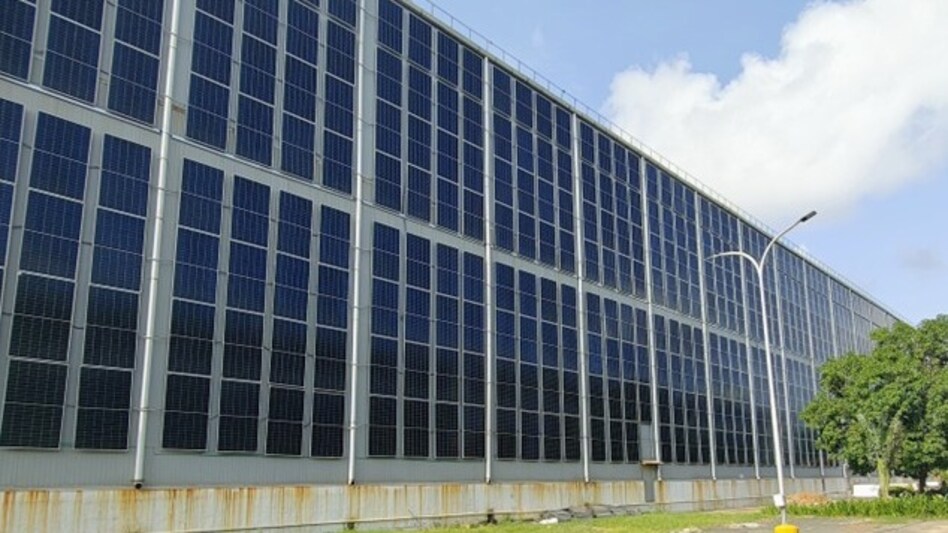
 Becquer’s Heterojunction solar technology with industrial building façade integration
Becquer, with its Heterojunction (HJT) technology already deployed in the field to power different kinds of factories with a core cell efficiency of 26.3% and module efficiency varying with the module packing designs, has been developing the infrastructure both at the upstream and downstream to enable the lowest cost of solar hardware globally, it has recently commissioned India’s first and largest solar industrial façade to power a major home textile brand , thereby enhancing the contribution of solar electricity apart from the existing solar panels on the roof and validating a new way to integrate solar technology into the building materials that also reduces the overall temperature inside the building, and reduces the air conditioning bills naturally. The solar façade has capitalized on the existing pillar strengths of the factory shed and ensured no visible cabling of the solar modules to maintain the aesthetics. All the major industrial brands that have factories in India to manufacture automobiles, steel, cement , engineering products and food and FMCG goods, are employing its solar hardware for captive power needs and meeting their sustainability initiatives.
Becquer’s manufacturing processes are now capable of integrating cells with any building material thereby expanding the use case of the solar panels across various types of buildings, factories and superstructures. For power hungry data centres, it has developed a cladding technique that utilizes every square inch available for clean and green power generation that not only reduces the building material costs for the developers but also the operating temperature inside the data center, and ofcourse the landed cost of electricity, that is the most important metric for the economic viability of a data center. For residencies, Becquer has demonstrated “zero-grid-bill” possibilities for various residents in Maharashtra, whereby the consumer only paid a basic connection charge to the grid and used the solar roof for its daily power needs.
 Why Zerodha Fund House is bullish on life cycle funds
 Ex-IMF economist Surjit Bhalla backs 7.8% GDP number: 'No evidence of exaggeration'
 Air India sacks Phuket-Delhi pilot after psychoactive substance test comes back positive
 BT Explainer: Why Volkswagen Group plans to axe 12% of its workforce in India
 NSE IPO update: SEBI approval likely next week; Check expected dates of price band and listing
 #DemocraticNewsroom | '800 Million People On Subsidies': Siddharth Zarabi On India’s K-Shaped Economy
 #DemocraticNewsroom | India Inflation Data: Are Official Numbers Hiding The Real Economic Picture?
 GDP Real Or Fudged? Siddharth Zarabi Defends India’s Growth Numbers With Data
 Financial Planning For Couples: How To Build A Strong Financial Plan, Budget & Wealth Together
 “High Sugar, Salt, Fat”: FSSAI CEO On Proposed Red Warning Labels On Food Packs
 56% rally in TBZ stock: Upper circuit led to record high today; here's why
  Sensex, Nifty snap four sessions of losing streak; RIL, Tata Steel, Bajaj Finance boost sentiment
  Physicswallah shares jump 9% as Motilal Oswal sees 66% upside
 KEC International: At 52-week low, Geojit expects more downside in infra stockNSE IPO update: SEBI approval likely next week; Check expected dates of price band and listing
 Royal Enfield Himalayan 440 launched at Rs 2.29 lakh with 443cc engine, 6-speed gearbox
 PM Modi to join Shri Ram College of Commerce centenary celebrations on Teachers’ Day
 Dreaming of the cockpit? Here’s what it really takes to become a pilot in India
 Blue Aadhaar explained: What changes when your child turns 5
 54 years later: ‘Pakeezah’ returns in 4K after a restoration battle












