


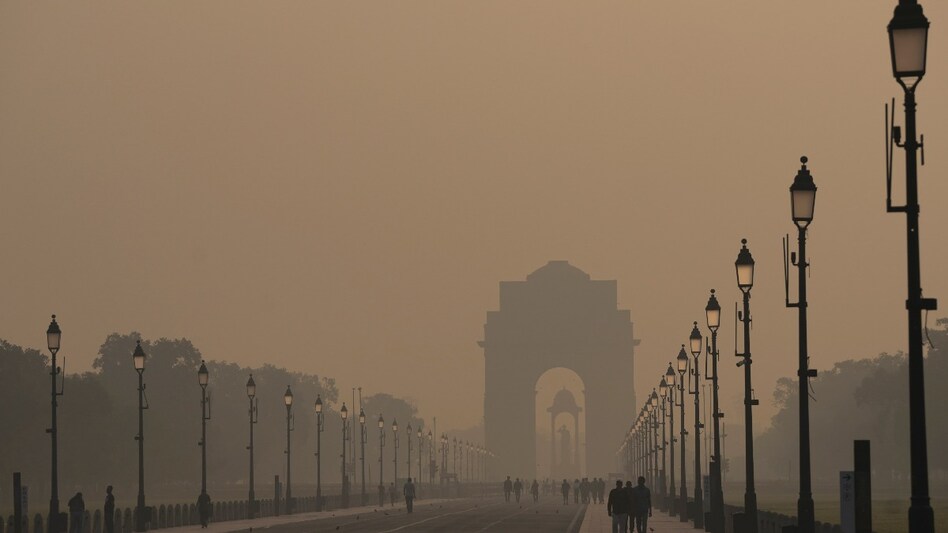
 By Saturday evening, the smog had grown so thick that even India Gate faded from view.
Delhi woke up to a thick cloud of toxic smog on Sunday, as the city’s overall Air Quality Index (AQI) spiked to a hazardous 405, real-time data showed. The sharp deterioration came just a day after the capital recorded a 24-hour average AQI of 303 in the “very poor” category, according to the Central Pollution Control Board (CPCB).
Data from the pollution monitoring portal showed PM2.5 levels at 277 µg/m³ and PM10 at 359 µg/m³, while carbon monoxide (CO) spiked to 489 ppb, marking a dangerous escalation in particulate and gaseous pollutants.
At 8:30 am, temperatures hovered around 20°C with mist and 83% humidity, while wind speed remained low at 10 km/h, impeding pollutant dispersion.

 Setback for Subhash Chandra: NCLT puts media baron's repayment plan on hold, seeks CBI response in 4 weeks
 NSE IPO: Sunil Munjal, RK Damani, Raamdeo Agrawal, Dolly Khanna, Kris Gopalakrishnan turn big winners; here's how
 Tata power play: Chandrasekaran family's TVS ties emerge days after Venu Srinivasan backs his third term
 BT Big Story: Why India Inc is warming up to non-English-speaking executives
  After 'annihilation' threat for Iran, Donald Trump backs India-Middle East-Europe Corridor
 S&P Upgrades India’s FY27 Growth Forecast By 40 Bps To 7%; Expects RBI Rate Hike To 5.50%
 Supreme Court On Medicine Prices: ₹27,000 MRP For ₹2,700 Drug | ‘Extortion’, ‘Daylight Dacoity’
 Macro Volatility Vs Earnings: Why Earnings Matter More Than Valuations | Anshul Saigal
 India’s CDMO Opportunity: Anshul Saigal Spots Underappreciated Names
 IT Stocks Under Pressure: What Next For Indian Markets? | Chakri Lokapriya
 Swastika Infra IPO booked 30% in 2 hours on Day 1: Check brokerage views, latest GMP and key detailsNSE IPO: Sunil Munjal, RK Damani, Raamdeo Agrawal, Dolly Khanna, Kris Gopalakrishnan turn big winners; here's how
 Adani Ports shares: CLSA retains 'Outperform'; highlights logistics, marine growth
 IDFC First Bank shares rise 5% as MOFSL upgrades rating; check target price
 Dixon Technologies stock slips 29% from 52-week high; tracking price targets, recovery prospects
  Why Protean eGov Technologies is looking at an aggressive overseas expansion
 'All decisions taken unanimously': Election Commission denies dissent report on SIRSwastika Infra IPO booked 30% in 2 hours on Day 1: Check brokerage views, latest GMP and key detailsAfter 'annihilation' threat for Iran, Donald Trump backs India-Middle East-Europe CorridorNSE IPO: Sunil Munjal, RK Damani, Raamdeo Agrawal, Dolly Khanna, Kris Gopalakrishnan turn big winners; here's how












