


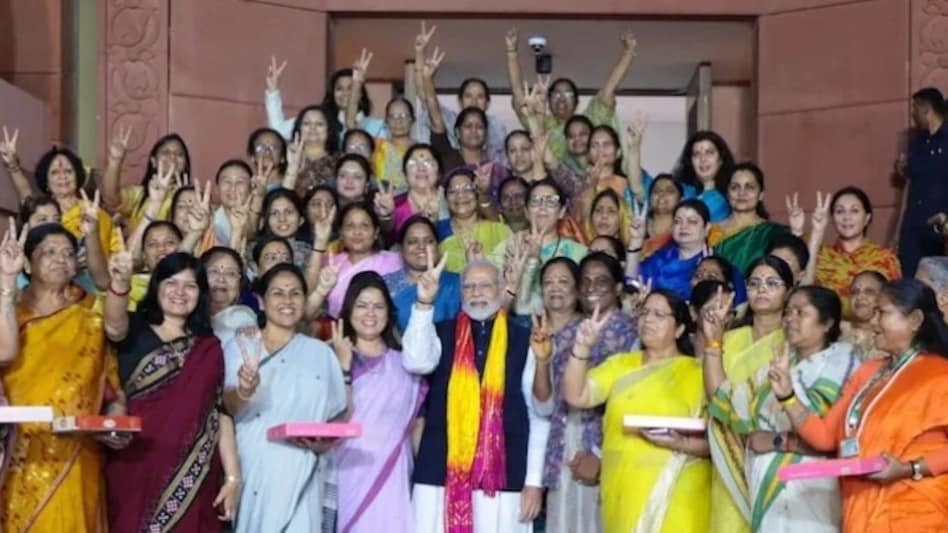
 Prime Minister Narendra Modi with woman Lok Sabha MPs outside Parliament premises. (File photo)
The Centre is moving to accelerate the rollout of the Women’s Reservation Act, with plans to rely on the 2011 census to push through implementation, according to sources.
The proposed shift could allow the government to move ahead without waiting for a fresh census and delimitation exercise, conditions built into the law's original framework.
Seat expansion plan in focus
Under the proposal, the Lok Sabha's strength could increase from 543 to 816, with 273 seats reserved for women.
The move is aimed at expanding representation while operationalising the long-pending quota in Parliament.
Bill likely in Budget session
Sources said the government is keen to move quickly and may introduce a Bill in the ongoing Budget session to amend the existing law. This would enable implementation without waiting for updated population data.
What is the Women’s Reservation Act?
The Constitution (106th Amendment) Act, 2023, also known as the Nari Shakti Vandan Adhiniyam, provides for 33% reservation for women in the Lok Sabha, state legislative assemblies, and the Delhi Assembly.
The quota is designed to address India’s historically low female political representation, which currently stands at around 14.94% in the Lok Sabha.
The law was passed in September 2023, nearly unanimously in both Houses of Parliament, marking a major legislative milestone after decades of debate.
Key provisions
The reservation covers one-third of the total seats, including those reserved for the Scheduled Castes and the Scheduled Tribes.
It is set to remain in force for 15 years, though Parliament retains the power to extend it.
The Act also mandates rotation of reserved seats after each delimitation exercise.
Why hasn’t it been implemented yet
Despite being passed in 2023, the law is not yet in force. Its implementation is tied to two conditions: the next Census and a subsequent delimitation exercise to redraw constituency boundaries.
The current proposal to use 2011 census data signals a potential shift away from this requirement, allowing the government to operationalise the quota sooner.
A long-pending reform
The legislation comes nearly 27 years after the idea of reserving seats for women was first introduced in Parliament.
It also builds on earlier constitutional amendments that provided 33% reservation for women in local bodies, such as panchayats and municipalities.

 Who is Pralhad Joshi? Modi names veteran Karnataka BJP leader to lead Education Ministry after Pradhan's exit
 Third round of talks: CJP ends 49-day-long protest, says govt accepted 'key demands'
 Dharmendra Pradhan resigns, says decision taken to protect students' future amid NEET row
 All about Dharmendra Pradhan's educational qualification, wealth, assets and more
 India's first REIT mutual fund is here. Can it change how Indians invest in real estate?
  FDs vs Markets: Where Should You Keep Your Short-Term Money?
 Why Term Insurance Is Essential for Every Earning Member | Sum Assured & Coverage Explained
 Pakistan's Alleged Terror-Politics Nexus: Lashkar Links Spark Questions Over Fazlur Rehman
 Think Life Insurance Is Optional? Here's Why Every Indian Family Needs It Today
 FD Vs Arbitrage Fund: Which Is Better For High Taxpayers?
 Adani Power: 45 GW target, Rs 2 lakh crore capex plan among conference call highlights
  ITC Hotels, Chalet, Ventive, IHCL, SAMHI: Hotel stocks to buy despite travel disruptions
 ITC shares: Rs 307 a key short-term level to watch; here's target price
 Mphasis shares: FY27 guidance maintained; brokerages keep 'Buy' after Q1; check target price
 Should you buy every IPO? Research suggests patience may be the smarter strategy
 Corporate FDs offer up to 9.1% interest: Should you choose them over bank fixed deposits?
 The 'Two-Income Trap': Why higher salaries aren't translating into wealth -- expert explains
 India gives Gen Z the world's biggest tax-free head start. Here's why that's a big deal
  Gurugram getting too expensive? These Haryana cities are attracting builders—and could boost your returns
 Sergey Brin's Dragonfly: The 466-foot superyacht with a dedicated business deck









