


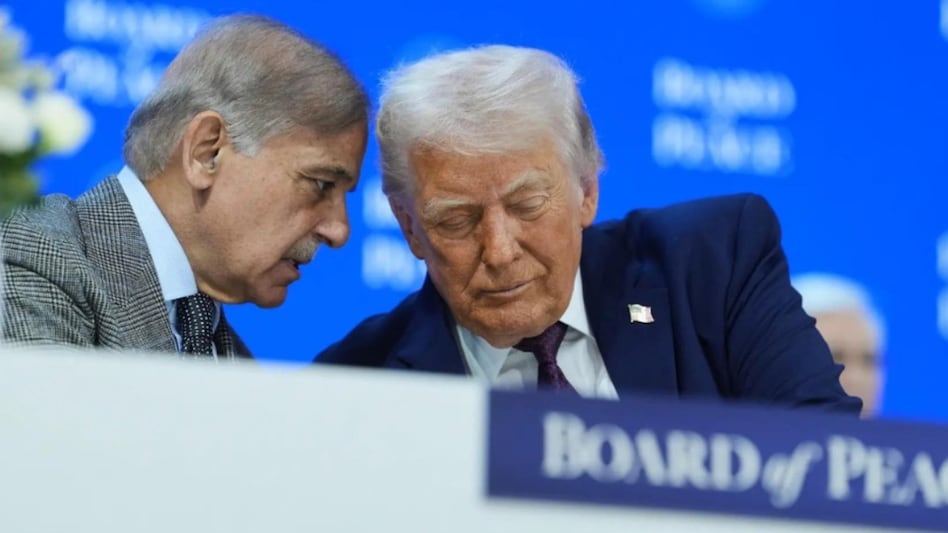
 India stayed away from the launch even as Pakistan Prime Minister Shehbaz Sharif appeared alongside Trump.
India stayed conspicuously absent as US President Donald Trump unveiled his proposed “Board of Peace” on the sidelines of the World Economic Forum in Davos on Thursday, even as Pakistan Prime Minister Shehbaz Sharif appeared alongside Trump at the launch, an optics-heavy moment that raised questions about the initiative’s intent, balance and global buy-in.
The ceremony in the Swiss mountain resort was carefully choreographed. Leaders walked up in pairs, took their seats beside Trump at a long table and signed the charter. Sharif was seated to Trump’s right, exchanged a handshake with the US President and spoke briefly with him before signing, an image that stood out amid scrutiny over participation and hierarchy within the grouping.
India was among several major countries missing from the launch, despite Prime Minister Narendra Modi having been invited. New Delhi neither accepted nor declined the offer, people familiar with the matter said.
Around 35 countries signed the charter following weeks of diplomatic outreach by Washington. France, the United Kingdom, China and Germany also stayed away from the event.
India weighs invite, Pakistan signs up
India’s absence drew sharper focus as Pakistan joined Trump and other leaders at the table. The optics are unlikely to have gone unnoticed in New Delhi, which has repeatedly flagged Pakistan’s role in cross-border terrorism, including the April 22 attack in Pahalgam in Jammu and Kashmir.
Officials said India was examining the proposal carefully, given the sensitive geopolitical and security issues involved. New Delhi has consistently backed a two-State solution to the Palestine question, supporting Israel and Palestine living side by side in peace and security within recognised borders.
Pakistan was confirmed as a member of the Board of Peace, alongside Argentina, Armenia, Azerbaijan, Bahrain, Belarus, Egypt, Hungary, Kazakhstan, Morocco, the United Arab Emirates, Saudi Arabia and Vietnam. Several others, including Germany, Italy, Paraguay, Russia, Slovenia, Turkiye and Ukraine, have so far remained non-committal.
‘India not bound to Trump’s Board of Peace’
Political risk expert Ian Bremmer said India was well placed to engage a second Donald Trump presidency from a position of strength, with more room to push back than many US allies.
Speaking at Davos, Bremmer described India as a “partner and friend” rather than an ally, giving New Delhi flexibility in dealing with Washington, including on Trump’s proposed Board of Peace.
He said India should prioritise trade talks, approach the board cautiously, and ensure that any participation does not weaken multilateral institutions such as the United Nations. Bremmer added that Modi’s political continuity puts him in a stronger position than many Western leaders to manage Trump, stressing that confident, coordinated engagement can yield results.
Trump repeats India–Pakistan claim
Addressing the gathering, Trump again claimed that his intervention had helped avert a military conflict between India and Pakistan, an assertion New Delhi has denied.
“We were very happy to stop the war that had started between India and Pakistan, two nuclear nations,” Trump said. “I was very honoured when the Prime Minister of Pakistan said President Trump saved 10 to 20 million lives by getting that stopped just before bad things were going to happen.”
Trump had made a similar claim a day earlier during a special address at the World Economic Forum, arguing that trade and tariff leverage helped Washington prevent conflicts.
The remarks referred to the May 2025 escalation following Operation Sindoor, a series of precision strikes carried out by India against terrorist infrastructure in Pakistan and Pakistan-occupied Jammu and Kashmir.

 Tata Consumer stock: Tata Group's FMCG arm reacts to Q1 earnings show
  Sterlite Technologies: What every investor should know about the stock post Q1 earnings
  NEET to be conducted through a computer-based model? Here’s what we know
 ‘Merely because there is agitation…’: Supreme Court says right to peaceful protest is guaranteed
 BT Explainer | PVR Inox shares: Analysts bet big on Odyssey, Ramayana, Avengers & others post solid Q1
 Nirmala Sitharaman Slams Govt Apathy After Tax Dept's 50-Year Land Struggle In Mumbai
 PM Modi’s Big Message To Youth: Border Villages Are India’s First Villages
 Pralhad Joshi At Davos 2026, Exclusive Conversation Resurrected With New Education Minister
 Should You Buy The Echo Dot Max? Full Review & Honest Verdict
 Smartphone Brain: How Excessive Screen Time May Harm Children's Health | Sneha Mordani Explains
 Infosys fined €175,000 by French authority over employee time tracking system; says no material business impactTata Consumer stock: Tata Group's FMCG arm reacts to Q1 earnings show
  Why KFin Technologies shares surged 9% today
 Sagility shares surge 8%; brokerages retain 'Buy' despite Q1 revenue dip QoQ; check target pricesSterlite Technologies: What every investor should know about the stock post Q1 earnings
  Where are the jobs: Youth unemployment remains high; fewer jobs for those with higher education in IndiaNirmala Sitharaman Slams Govt Apathy After Tax Dept's 50-Year Land Struggle In Mumbai
 Bihar cop who fired AK-47 at NEET protesters suspended; 15-year-old shot in neck, now stablePM Modi’s Big Message To Youth: Border Villages Are India’s First VillagesPralhad Joshi At Davos 2026, Exclusive Conversation Resurrected With New Education Minister









